Total Pageviews

Friday, August 30, 2013

"What If Our Dreams Come True!" - My forthcoming English Novel

                                                                   Preamble

80 year old Poornachandran - Poornam in short - was very sick, unable to speak and move freely due to a paralytic stroke he had a year ago. His daughter Chandrika, son-in-law Chandrasekar, and the only grand-daughter Uma Chandra, ten years old, all adored him so much and took care of him very well with all their love and affection. The only loss he could think of was his wife Ambika, who was a remarkable woman and a popular film playback singer. The sad part was, she died on the day Poornam had his stroke and she wasn’t there to serve him when he probably needed her most, for the first time in his life. Otherwise, he couldn’t complain of anything else in his life. His paralytic stroke and his immobility were, of course, an issue - but they too, stopped bothering him. Every now and then the thought that he shouldn’t burden Chandrika and her family surfaced. He wished to be sent away to Sharan, the old age home at Cheranmahadevi Poornam caused to establish, where any number of volunteers were ready to serve him. Chandrika and Chandrasekar vehemently turned down his request and accepted complete responsibility to take care of him. Strangely, Poornam was not responding to medicines and physiotherapy.

Everything was quiet until one day, an international television crew wanted to meet him for making a film on his life story. They had done some extensive research on his silent accomplishments and were proposing to name him the ‘Best Accomplisher of the Decade’, the conferment included a cash award of quarter million U.S dollars. They wanted to be the first to tell the rest of the world about his unique humanitarian social projects. They wanted him to be available for the ceremony that would be attended by the ‘Who is who!’ of the world’s dignitaries including the President of the United States of America.

Poornam shunned publicity, but this was one time when his non-verbal denial failed to impress Chandrika.

Appa, the world needs to know about you. Many more may feel motivated by your life. The Earth needs many more people like you.’

The television team landed at Chandrika’s small house at Cheranmahadevi. Poornam quietly acknowledged Welsch with whom he had worked earlier during his adventures at Brahmadesam. Poornam noticed tears in Welsch’s eyes as he was hugged. Though the TV team was sounded about his bad health, they didn’t expect it to be this bad.

“We need you and your active participation. Your health is very important to us. I can’t bear to see you lying immobilized.” Welsch chocked, as he said this. “I want you to agree to come with us for treatment in America. I want you back in action.”

The TV crew took about a week in travelling to places where Poornam had had his years spent and they were ready to pack off.

The very next week, the whole world knew about Poornachandran who made a silent appearance on the TV screen. Silence spoke more than words. His very appearance on the screen touched many hearts across the globe. His soul departed the very moment he, along with the rest of the world, saw himself on the television screen.

*****

I was seventeen or so when that happened in mid 1940s. I was single, parentless and lived in a small village, somewhere closer to Shencottai, a prominent town at the foot of Podhigai hills that formed part of Western Ghats in Tamil Nadu in Southern India and a gateway to the adjacent State of Kerala. Thanks to the financial support from a Christian institution and the kind priest at the local church, I had just completed my school final examinations.

One day, I had acute stomach pain and a few friendly neighbors admitted me to the local hospital run by a missionary. Doctors were unable to diagnose my condition, in the poorly equipped facility. I held my stomach between my both hands and squeezed it. A dilute carbonate mixture that they gave me provided no relief. Besides, I ate nothing for the whole day and I was vomiting constantly. It was midnight. With unbearable pain, I said all the prayers that came to my mind and prayed intensely. I didn’t know when I slept.

I was jolted in the middle of sleep. I perspired and trembled. Was it a nightmare? I just had a dream where Lord Siva appeared before me. He looked so real to me like the one I always saw in pictures. He was seated in a deep meditative posture and opened his eyes briefly to look at me. He saw me suffering with pain. I saw myself standing up in great devotion and prostrating before him.

“I know you are suffering from pain. You will be relieved of this pain now.”

With folded hands, I fell flat again and prostrated, tears rolling down my eyes.

“But on one condition!”Lord Siva said.

I just wanted relief from my stomach pain. I was willing to do anything. I just nodded my head in acknowledgement that I was listening.

“You would meet with me in seven places!”

‘Oh, that won’t be a great deal’ I thought. He seemed to be reading my mind.

“But, it is not going to be easy for you. Are you ready? Your pain will go away now.” said Lord Siva.

Again I nodded in silence. At that moment, the only thing I wanted was relief from my pain.

“Okay! You have my blessing. Remember to meet with me in seven places. Don’t take it lightly.” Saying this, he disappeared into a cloud of thick white smoke which suddenly appeared from nowhere and I was woken up.

Everything looked very hazy. I noticed that my stomach pain had disappeared. I slowly rose from my bed. I prayed intently, “Oh, Lord Siva! Give me the strength to come and meet with you in seven places as you ordained. Give me the strength to maintain my commitment”

I called the duty nurse, a Christian nun, a kind lady. I told her of my dream and the relief I had from my pain. She was puzzled and didn’t know how to respond. Closing her eyes, she just touched my head and prayed. She asked me to stay on for the rest of the night and leave early morning. She asked me whether I would be meeting with the Christian Father and I answered positively.

The next morning, I left the hospital and walked to the Father’s place. He must have been in his morning prayers. I waited to see him outside his hostel. When I told him about the relief I had after I had my dream, he looked at me pensively for a moment and smiled. “May Jesus Bless You!” was all that he said to me. I took leave from him when it seemed he just remembered something and he asked me to wait for a moment. He went inside and brought a talisman. He tied it to me on my upper arm and said, “Remember to keep this safely with you all the time.”

I spent the next several weeks without a clue, but the thoughts kept returning back. “I must meet with Lord Siva in seven places.”

“What did he mean by that?’

I went to Thangasami, our village ‘karnam’ (the village chief) who was my well-wisher. I told him about my dream and sought his opinion. Thangasami was a very pious and god-fearing man. He took me to a local astrologer Muneeswaran. The astrologer drew some squares on the floor with a piece of chalk and threw a few small conches. He closed his eyes for several minutes and finally told me:

“Lord Siva wants you to visit him at seven places that are known for his temples. Courtallam, Tenkasi, Sivashailam, Ambasamudram, Papanasam, Brahmadesam, Thiruppudaimaruthoor and many more places in our Tirunelveli region are great ‘Sivasthals’ – abodes of Lord Siva. Many of these temples are very old, may be thousands of years and are very sacred places. You must visit seven Siva temples and have HIS ’darshan’. You shouldn’t be inviting the wrath of Lord Siva, lest he could become furious. But he is also a very kind god and a great benefactor. You know, you were relieved of your stomach pain instantly the moment He appeared before you…………………

It also appears to me that you are going to have great hardship going through these places. But, you seem to be destined for something very significant about which I am unable to speak or tell you right now. But you will have Lord Siva’s blessings all along. So, go!”

That was the beginning of my long story. I had no one at home to worry about me. My mother left for heaven when I was just born and my father too joined her a year ago, mourning over the death of his dear wife, all those years. Even when he was alive, it was a moot question whether he supported me or I supported him.

I left home on foot, realizing very little what life experiences were waiting for me. I never knew that my meetings with Lord Siva were going to be so long and arduous. Where did I find my energy during all those years – during those years of encounter with Lord Siva? Only HE knows!
.................
I welcome comments on the Preamble to my new novel: "What If Our Dream Come True!"
T.N.Neelakantan
Author: Short Stories for Young Readers - Book 1
               Short Stories for Success for Young Readers: A New Lexicon Unfolded

Wednesday, August 28, 2013

‘Sun Singer’ program of Tamil SUN TV – A review

I have stopped watching television on a regular basis for quite many years now. During the last seven years, whenever I had absolutely nothing else to do, I had tried to fiddle with my TV remote, only to switch the TV off soon getting frustrated at not able to watch a decent, interesting program except on a few rare occasions. My brother complains that I have now become aged and that my tastes have changed. In every TV channel, I see only stereotyped programs, heavily loaded with endless advertisements that pop up almost every five to ten minutes. I still wonder how these poorly conceived programs still continue to attract people and stay popular with viewers.

If there was one program that fixed me to the TV screen, it was the ‘AIREL Super Singer’ program – in Malayalam through Asianet TV a couple of years ago and subsequently over Vijay TV in Tamil. Though I didn’t understand Malayalam well, I always relished watching the Super Singer Malayalam program. The judges, Sharath and Sreekumar, particularly, were superb with their humorous and critical commentary over the singer’s performance and were nonchalant. Sharath was especially a tough judge, coming from Dr.Balamurali Krishna’s school of singing. The anchor, Ranjani, (if I am right with her name) with her giggles and mesmerizing voice did a fabulous job. The singers were of fairly very good standard. I always wondered, how the contestants could sing even a few sophisticated songs fairly well; but then, I read an article in The Hindu that there was a ‘Fast Food’ type of factory functioning in places like Cochin, where a few music professionals train people to sing select few songs – thoroughly and professionally for Super Singer competition - for fabulous fees. We need to keep in mind that the prize money for the winner was invariably a posh flat in Cochin/Ernakulam. I particularly liked the cine-classical rounds much more than others in these competitions and participants, regardless of their religion, sang traditional carnatic music based songs without any qualms about it. It was really amazing to know we have so much talent.
Then, I had watched the ‘Hariyudan Naan’ competition on Tamil Vijay TV. The legend Hariharan, the singer, was personally there during all the stages of the competition, as one of the judges. The young contestants performed superbly. The winners were to get an opportunity to sing along with Hariharan for a music album. The finals were held in Dubai. For all the tempos built up during the competition, the telecasting the finals was a damp squib, merely commercial, organizers dragging the telecasting over several weeks. The one solace was the ‘Bhavayami’ performance by Sharath. His rendering was a class of its own and only Sharath could do that. I lost interest in watching the finals that were mere pomp and show.

Then, I watched Airtel Super Singer in Tamil Vijay channel regularly during 2012. All the episodes were very captivating and the competition really, really tough. There was a young girl, Pragati, from U.S who had flown to India to participate in the program. She had a splendid voice and remarkable control over her breath and singing, songs flowing from her like cool, vibrant rivers. Sukhanya challenged her well, but still a notch below Pragathi. In the finals, during October, 2012 Aajeedh, a wild card, won the competition snatching away a Rs.60 lacs worth flat as prize money, given away by none other than A.R.Rahman. Like many viewers, I felt sorry for Pragathi.  Ananth Vaidyanathan, the musician, who had trained the contestants in voice modulation, song selection, and performance had now become the most sought after in music industry.
During February – July, 2013, I was in U.S and I came to know through my brother that a new singing competition program was going on in Sun TV. He talked about Sun Singer 1 and told me that the program was available in YouTube for viewing and that too without all the tiring advertisements. I immediately took interest and started watching the episodes. I think Sun Singer Format I is doubtlessly one of the most captivating programs among all those I watched. The participants were all quite young – in the age group of 7-12. I couldn’t believe we have so much talent among the young children. I could notice the refinement and progress among the contestants, episode after episode. The children were quite smart, thoroughly professional, serious and keenly contesting. Robin, one of the contestants, was my favorite all through. He was masterly with his singing. He used his original voice without probably trying to modulate it. But, I think he lacked training on ‘brigas’ and ‘kamakams’ while singing cine-classical songs where Janakan scored over him. Janakan too was brilliant and I am sure he is already a student of carnatic music. The third singer who appealed to me was Shivani, a cute little girl. She was a real angel and another P.Suseela in the making. Her singing was neat, flawless and her voice melodious. I surmised these three would be the top three in the competition. The others like Anushya, Aswathi Raj and Ritu gave real fight to the title, challenging everyone with more and more sophisticated and difficult songs. So, there was real tough competition to the top three positions and the program kept me on the edge of my seat.

When the final results were announced, my heart broke for Shivani as she lost out of the race. She sang, ‘Kelviyin nayagane’ from the movie ‘Apoorva Ragangal’. I believe her song selection was wrong. As expected, Janakan came first singing the famous ‘Madhavi Ponmayilal’ from ‘Iru Malargal’ followed by Aswathi Raj and then Robin.
Among all the songs sung by all the contestants throughout the entire program over the 28 episodes, Robin singing ‘Unnai Kaanathu naan ingu naan illaiye’ from the movie ‘Viswaroopam’ alone rings in my ears all the time. Probably, if he had chosen another sophisticated song than the ‘Isai kettal puvi asainthadum’ from the movie ‘Thavaputhalvan’ for the finals, he could have probably reached the second place. He is really capable of challenging himself more and more, but he settled for a much simpler song that cost him the title in the finals. Overall, I liked the entire contest. It is really amazing and heartening that small children could take the contest so seriously and sing so professionally. Gangai Amaran, as the master, has done an excellent job of preparing the children for each level.

Now, the Sun Singer II program has started a couple of weeks ago and the children are just into the introductory, familiarizing stages. It is once again very clear that our young children can take life’s challenges very seriously and meet them successfully, if given the right guidance and leadership. Even the first twenty or so contestants in Sun Singer II already look very serious and determined about the contests and they all sing very well. The judges, I am sure, are going to have a tough time in judging them. P.Suseela was there as a special invitee guest for one of these episodes and it was sad to see that her sweet melodious voice had disappeared, may be, due to her aging.
O dear singers and contestants, keep the spirit of contest high and sportive. It is not about winning alone, but the very process of participating is the real joy. Keep it up. Hats off to the parents! Keep encouraging your children. They have remarkable talents.

Watch for announcements regarding “Classic Singer Tenkasi” contest among school children at Tenkasi to be held in early Jan, 2014 under the auspices of our L.N.Charitable Trust.

Sunday, August 18, 2013

Alaska: Our trip during July, 2013 - Final Part V

Thursday, the 18th July:

Talkeetna is basically a mountaineering town and was built by miners, prospectors, adventurers, and the railroad. It is at the junction of three rivers, the Talkeetna, Susitna, and Chulitna. The word ‘Talkeetna’ means ‘where the rivers join,’ in the local Athabascan language. Talkeetna is also a great place for flight-seeing trip around Denali. One can find any number of water-planes parked in the waters of innumerable lakes around the place.

At Talkeetna, Viji had booked a cabin house very close to the river. It was quite late at night when we reached there. The cabin house was located quite interior, ten miles away from the main Anchorage-Denali highway. The road to the cabin house was deserted. Without our GPS, we couldn’t have located the cabin house. Cell phones went dead. The place, initially, looked haunted and scared all of us.
 
There was a small board “Welcome to Neelakantan family’ in front of the cabin house and that was the only pleasant surprise. Here too, mosquitoes flew around freely everywhere. We quickly rushed inside the house, not only to escape from the mosquitoes, but also for fear of any bear suddenly emerging from the nearby woods. ‘I will get out of this place, first thing in the morning,’ was the terse pronouncement from Viji. All her earlier enthusiasm to stay in a cabin house vanished quite dramatically. After making sure that the front door was securely locked, we all went to sleep immediately.
Honestly, to be fair, the cabin house was really a great accommodation, as we discovered the next morning. It was neat, fully furnished, well equipped with a fridge, micro-wave, kitchen-range, dish-washer, utensils for cooking and so on. It offered plenty of open space to play or party around and a quiet stay away from the din and noise of towns.  Knowing that we could be arriving with our children late at night, the caretaker lady had left some milk and other ingredients for making coffee or tea. But, we were all so tired the previous night after a long drive and scared about the deserted location of the cabin-house that we had no enthusiasm to notice the nicer things about this place.


In the early morning, there were a few more surprises, though not pleasant.  Electric power went off and so, there was no water in the taps in the bathroom. We quickly prepared to leave, but before leaving we went to the caretaker’s place. We found some wonderful breakfast – some special bread, coffee, cereals, and yoghurt. The caretaker was a pleasing woman. She explained away the sudden power tripping as something totally unexpected and rare and the lack of water supply from one of their overhead water tanks resulting from some inmates inadvertently leaving the water tap open during the night. A few other guests sitting in the dining room too spoke highly about the place.  Though we weren’t fully satisfied with the explanations, we had sumptuous breakfast and left the cabin house around 11.30 AM towards Denali.

The drive to Denali took nearly 3 hours and we reached our hotel at around 4.00 PM. The front desk at the hotel was very elegant and impressive. A coffee shop functioned in one corner and a gift shop in another corner. However, the rooms were located in a number of smaller condo units spread out in a sprawling campus. No parking was there in front of our condo unit and we had a cumbersome walk over quite a distance carrying our heavy luggage to access our room. It was drizzling too at that time.
Once we lodged our luggage in our room, the first thing we wanted to do was to buy our tickets for the Denali National Park Shuttle Tour for the next day. So, we went to the Wilderness Access Center and bought our tickets for the 66 miles, 8 hours long, Eilson Visitor Center Tour scheduled for 9.00 AM on Friday. We had also planned to return to Anchorage Friday night and so, we decided to get off the shuttle at Toklat River Point to shorten the tour to six hours.

After buying our tickets, we went for some shopping. We couldn’t do any other activity for the rest of the evening since it rained intermittently. We went back to the hotel, prepared our dinner for the night and lunch for the next day, and went to sleep after finishing our dinner.

Friday, the 19th July:

The Athabascan, the indigenous people of North America, called the high mountain, ‘Denali’ to mean ‘the high one.’ The place is habitat for wild animals like grizzlies, caribou, wolves, moose, dall sheep and others. It is also a place for gold mining. The development of a National Park in Denali owes to a great extent to the dream of one Charles Sheldon, an early conservationist and gentleman hunter from Vermont along with Harry Karstens, a legendary outdoorsman and dog musher. By 1917, after almost a decade of hard work, Sheldon and others persuaded American Congress to create Mount McKinley National Park. Four years later, in 1921, Karstens was hired as its first superintendent. President Jimmy Carter, in December 1980, with only weeks left in his presidency, signed into law a legislation that established over 100 million acres of new national parks, preserves, and wildlife refuges in Alaska that included enlargement of Mount Mckinley National Park from two million acres to six million acres into the present Denali National Park and Preserve. Mount Mckinley or Denali is visible from both Anchorage and Fairbanks and lies between the two cities. The park is a six million acres of wild land bifurcated by a ribbon road. Visitors’ vehicles are not allowed beyond the first fifteen miles of this road up to the Savage River. Beyond this, one has to use only the shuttle bus service operated by the Wilderness Access Center.
Denali is a popular destination for hikers, mountaineers, campers and for those interested in winter sports. It also forms part of bear country and visitors are advised to avoid encountering with bears. Elaborate instructions are available on what is needed to be done when one sees a bear.


We reached the Wilderness Access Center well in time to catch our 9.00 AM shuttle for the Eilson Visitor Center tour. We had to carry the heavy baby-car-seats too, as this was mandatory for children to travel in a shuttle bus too. I think a lot of fuss is made in some places in America in the name of security and safety. It was very quite an onerous job carrying the heavy baby-car-seats everywhere you go. The tour operators could have as well provided a few baby seats in every shuttle bus. The baby seats can be easily fixed and removed. It was raining and drizzling intermittently. The driver was a lady and as she drove, she also functioned as the tour conductor describing the places, scenic spots, the mountains, the rivers, the history of the inhabitants of the terrain, and so on all the way. The shuttle passed through Savage River, Sanctuary River, Tehlenika River, Igloo Creek, Sable Park, and Polychrome Overlook before it reached Toklat River. One got fabulous views from Igloo Creek stopover.


The shuttle stopped once in every one-and-half hours for restroom facility. At other places, it just stopped for a few minutes for tourists to take pictures. Tourists were advised to bring their own lunch or snacks, as no facility was available on the way. Besides, we were not allowed to eat anything outside the shuttle bus to avoid attracting animals and birds. The rain was a real dampener and many of the scenic spots were covered by mists. Sun came out partially here and there, but mostly not seen.
We reached Toklak River at 1.00 PM. We got off from the shuttle to take another one for getting back to the Wilderness Access Centre. In Denali, there are tours go up to Kantishna after crossing Wonder Lake and Reflection Pond. We understand, on a clear day, one gets a view of 20320 feet high McKenly Mountain, the tallest in U.S.A, from many viewing points. In Wonder Lake and Reflection Pond, on a clear day, one can see a reflection of the McKenly Mountain in the waters of the lake. However, these trips could take anything about 11 hours. For a visitor to Denali, I think one would need at least three days to do full justice.
At Toklak River, there was a tented souvenir shop and a number of restrooms. Tourists were allowed to get down from and change into the shuttle bus anywhere, subject to availability of seats. We didn’t get proper seats in the 12.20 PM shuttle from Toklak River; I felt the driver could have been a little more accommodative to ask a few fellow tourists to move over to other seats to accommodate the small children with us, but he didn’t. So, we had to wait till 1.00 PM. In the meantime, as the rains stopped temporarily, we walked around a bit taking pictures.


We boarded the 1.00 PM shuttle. The driver was quite accommodative requesting a few other passengers to move to other seats to make room for us and for the kids, so the kids could sit by our side.
We returned back to Wilderness Access Center by around 3.00 PM. We went back to our hotel, did some shopping, packed our things, put them in our car and left Denali around 5.30 PM for Anchorage.
On the whole, I felt, if weather was better, we could have enjoyed the Denali tour much more.
We stopped over at Taco Bell at Wasila on the way, for dinner. We reached Embassy Suites Hotel in Anchorage by around 11.00 PM when it was still not dark. Viji and Sanjay went out to take pictures, after we checked into the hotel room.
Saturday, the 20th July:
We got up leisurely around 8.00 AM. The hotel offered cooked-to-order breakfast in addition to regular items. We had a rich breakfast. In the meantime, Viji and Balaji went to return the rented car. The hotel arranged an airport shuttle to take us to the airport. We were there at the airport around 12.45 PM. Viji and Balaji along with the children left by 3.00 PM flight to Phoenix via Seattle and we left by a 4.20 PM flight to Chicago via Seattle. We reached Chicago on 21st morning around 6.30 AM and our flight was delayed by an hour.
On the whole, our trip to Alaska was very satisfying. I am very happy that one of my long time passions was fulfilled during this year. I thank Viji and Balaji for that. I thank Sanjay and Sahana for their excellent cooperation for most part. They are small children and become restless when they are bound in a car seat for continuously long hours. That was understandable. They just want to be free. Only we lack the ability and innovation to keep them cheerful when they become restless.
A trip to Alaska is very costly too. The flight tickets, the hotels, the rented car, the groceries, the entrance tickets to various tours, facilities and shopping are all prohibitively costly. I thank Sri Amma Bhagawan for making this tour possible without any discomfort.
Now, Kailash and Manasarover in Himalayas seem to be my next target.
Summary:
Alaska is a must see place in one’s life, if one can afford. It is in places like Alaska where one finds Nature’s play in full. The scenery, the serene and clean atmosphere, the quiet ambience, the whispering cool winds, gurgling rivers and waters, expansive land and space, frightening mountain heights, tantalizing lakes and most importantly the clean and smooth road systems of Alaska are something to be remembered for lifetime.
 

Tuesday, July 30, 2013

Alaska - Our trip during July, 2013 - Part IV

Wednesday, the 17th July:

For this day, we had booked tickets for a cruise ride at Whittier, 88 miles away from Seward (and 60 miles South of Anchorage). Whittier sits at the head of the Passage Canal. We drove back on the Seward highway until we reached Turnagain Arm of Cook Inlet and then into Portage glacier road. There is a 2.5 miles long Anton Anderson Memorial railroad tunnel (locally known as the Whittier tunnel or Portage tunnel), through the Maynard Mountain hills, just before Whittier.

Whittier tunnel, along with the port at Whittier, was built as a military facility during the Second World War by the U.S. Army. It is the second longest highway tunnel, and longest combined rail and highway tunnel, in North America. It links the Seward highway south of Anchorage with Whittier and is the only land access to the town. The tunnel is named after the army engineer who supervised construction of the rail spur through Maynard Mountain. The tunnel is a critical bottleneck. It allows traffic to flow from one side to the other, allowing 15-minutes slot for the vehicles and another 15-minutes slot for the train. That meant, once in an hour, you got a 15 minute slot to cross through the tunnel. We couldn’t afford to be late, so we had started from our hotel at Seward quite early and we were there in front of the tunnel just five minutes before the suggested 10.30 AM slot for our crossing-over.

Whittier is just a small port town with a population of less than 300 most of who stay in one big building. The spur of the Alaska Railroad to Camp Sullivan, as the place was originally named by the army, was completed in 1943 and the port became the entrance for U.S. soldiers into Alaska. The port remained an active army facility until 1960. The two huge buildings that dominate Whittier were built after World War II. The 14-story Hodge building, now known as Begich Towers, was built for housing solders and the Bucker Building, completed in 1953, was called the ‘City under one roof.’ Both these buildings were at one time the largest buildings in Alaska. The Begich building is now a condominium housing nearly all the Whittier’s residents. Whittier was incorporated in 1969. Tsunamis triggered by the 1964-Good Friday Earthquake severely damaged the town, including the now abandoned Bucker Building. Whittier is a popular port of call for cruise ships. Whittier is also popular with tourists, sport fishermen and hunters. The Whittier Glacier near Whittier was named for the American poet John Greenleaf Whittier in 1915.

We boarded the 12.30 PM 26-Glacier Cruise. The cruise ship, we were told, would help us explore glacier carved Fjords, ancient ice and towering mountains of the Chugach National Forest. A quick reference to Google described a Fjord (pronounced as F’eord – the letter ’j’ being silent, also spelled as ‘fiord’) as: “a long, narrow inlet with steep sides or cliffs, created in a valley carved by glacial activity.” I learn that the coasts of Norway, Iceland and Greenland have many fjords.

Some more interesting information about Whittier: Long before Westerners arrived, Chugach Eskimos, now known as Alutiq, crossed the pass that separates Prince William Sound from the Cook Inlet’s Turnagain Arm in search of fish, almost 7000 years ago, as the glaciers began to retreat. Miners later took the route to reach the gold fields of Turnagain Arm. In Geography, a Sound or Seaway is “a long, relatively wide body of water, larger than a strait or channel, forming an inlet or connecting two large bodies of water, such as two seas, or a sea and a lake.” The Chugach Eskimos were water people whose lives centered on hunting and fishing. The Eyak, who shared the Sound, were people of the shore who came from Alaska’s Interior. These early people created small villages and lived in wooden houses. They made clothing from sea otter and seal, wove baskets from grass and spruce roots and used stones, bones, wood and shells to make tools. Today, about 1000 Alaska Natives live in the Sound where their lifestyles range from traditional subsistence to leading major Alaska Native-owned corporations.
Some of the greatest explorers who visited the Sound include:
·        Vitus Bering, a Danish navigator who served in the Russian Navy and who discovered Alaska in 1741,
·        George William Stellar, the famous German Naturalist, a member of the Bering Expedition, which made landfall at Kayak Island, approximately 100 miles southeast of Whittier. Many living species are named after Stellar: Stellar Sea Lion, Stellar Jay, Stellar Eider and Stellar Sea Eagle, and
·        Capt. James Cook who entered the Sound on May 12, 1778. While he traded with the area’s indigenous people, William Bligh – later of the Mutiny of the Bounty fame – took a small boat and paddled long enough to determine it was not the Northwest Passage. It was Bligh Reef that the Exxon Valdez struck in 1989.

That day’s 145-miles journey on the cruise aboard the largest, fastest catamaran in Alaska took us through rugged wilderness, towering glaciers and pristine waters.
Prince William Sound is 2100 square miles of islands and fjords, carved by 15 million years of glaciations and surrounded by the Chugach National Forest. It is America’s largest intact marine ecosystem and North America’s northern-most rain forest.  It is also one of the most active seismic regions in the world. The journey took us near the epicenter of the 1964 Good Friday earthquake that measured 9.2 on the Richter scale.

From Whittier, the cruise headed east through Passage Canal to the Egg Rock sea lion rookery in Port Wells. We continued to scenic Esther Passage where only small ships can navigate. High mountains protect this narrow channel from rough seas and winds. Many animals call this area home. Bald eagles are frequently seen fishing. Orcas are common and sea otters are almost always present. Beyond Esther Passage, the vessel headed north in College Fjord, a glacier-rich region whose namesake came from a science expedition led by American railroad financier Edward Harriman. The team named each glacier along the northwest side of the fjord after prominent women’s colleges, while those on the southwest side were named after men’s colleges. Next we cruised to Barry Arm and Surprise Glacier in Harriman Fjord. The cruise plotted a path through the ice-filled waters up to the front of the glacier so we could watch for ice calving into the sea. The ship made the last stop at the kittiwake bird rookery just across the bay from Whittier. It is reported that more than 10000 birds inhabit these rocky cliffs each summer laying eggs, fishing and teaching young hatchlings the survival tips they will need before they fly south for winter.
Our routes took us past three types of glaciers found in Alaska:
1) Tidewater Glaciers: Pressured by their own weight, active tidewater glaciers move toward the water, ending at the ocean’s edge where they frequently ‘calve,’ shedding slabs of ice that crash into the sea. These floating icebergs are so heavy that only the very tip is visible.
2) Piedmont Glaciers: These glaciers rest at the base of the mountain. They are formed when glacial ice forms a fan-shaped mass at the foot of the mountain range.
3) Alpine Glaciers: Also known as hanging glaciers, these ice masses start high on the slopes of mountains, and literally ran from the mountainsides.

We also learnt that the areas surrounding our journey are habitat for more than 1645 animal species, some of the important species being: Sea otter, Harbor seal, Ribbon seal, Stellar sea lion, Black-legged kittiwake, Eagle, Black bear, Mountain goat, Dall’s porpoise, Orca/Killer Whale, Humpback whale and Minke whale.


The journey on the cruise was exhilarating. It was a great experience standing on the deck outside the cruise ship, and facing the strong wind. We saw glacier after glacier, otters, eagles and many more. Lunch was provided in the cruise and it was just okay. When the journey was about to end, the Forest Ranger who was conducting the tour gathered all the small children, administered a pledge to all of them and presented a Junior Forest Ranger Badge to every one of them. Sanjay was once again very proud. We were back at the harbor at 05.30 PM. We, immediately, rushed to our vehicle to get back through the tunnel and drove all the way to Talkeetna, north of Anchorage, on our way to Denali National Park, our last destination in our Alaska tour.

………..to be concluded in Part V

Sunday, July 28, 2013

Alaska – Our Visit during July, 2013 - Part III

Tuesday, the 16th July:

Seward is situated at the head of Resurrection Bay on the Kenai Peninsula and is known as the ‘Gateway to Kenai Fjords National Park.” Seward is a picturesque town with a bustling harbor. The Seward highway connecting Anchorage with Seward has been named an All-American Road, which is the highest designation of a National Scenic Byway.

In the morning, Sanjay and I left for the riverside. It was just opposite to our hotel. Actually, we wanted to get into the river to play in water, but there was no secure arrangement and so Sanjay for disappointed.


We returned back after taking pictures and spending some time in the spectacular restaurant located near the front desk at the hotel.

Meanwhile, Viji had prepared some delicious ‘rajma’ and rice for our lunch. We had cereals for our breakfast. We left our hotel to reach the visitor centre for Exit glacier and after collecting necessary information brochure, we began our hike.
We managed Sahana in the stroller for some distance, but the smooth pavement ended soon and we had to hike carrying Sanjay, Sahana and the stroller, through rough uneven rocky route. We shed weight by discarding the stroller to one corner on the way. Viji carried Sahana on her back, and I carried Sanjay on my back. We quickly moved forward. We stopped near a small bridge on the way to take some rest before we hiked further. It became colder and colder as we went closer and closer to the glacier. There was strong, chilly wind blowing in our direction. We reached the penultimate view point before the glacier and from there we had wonderful view of the valley down and the glacier up the hill. Sanjay and I went further up to the final view point that was very close to the glacier. It was freezing cold there and worsened by cold winds. The glacier looked beautiful in semi-bluish in color and at the same time very scary too.


An information board kept there, revealed that the glacier had been receding or shortening in its length over years, probably indicating global warming.


While returning back to the visitor centre, some visitors whom we met on the way reported that they spotted a bear in the woods area and they cautioned us to go carefully. However, we saw no bear and we were back safely at the visitor center. While we were looking at a few souvenirs displayed for sale, Sanjay attempted some puzzle in a book gifted to him by the Ranger staff in the visitor center. For successfully completing the puzzle, Sanjay was presented with a Forest Junior Ranger Badge and was administered the Junior Forest Ranger’s pledge. It was funny watching Sanjay taking the pledge without opening his mouth. But he was visibly proud that he had received the Badge. We went back to the hotel for our lunch.

In the evening, we left for the bay area. Sanjay and Sahana played for sometime in a park and we didn’t have much activity to do except watching the bay and the moving, small ships and speed-boats.
Suddenly, Viji had an idea. She suggested that we could drive up to Cooper Landing on the Seward highway to see Kenai River and Kenai Lake. It was a 47 miles drive on the way to Anchorage.

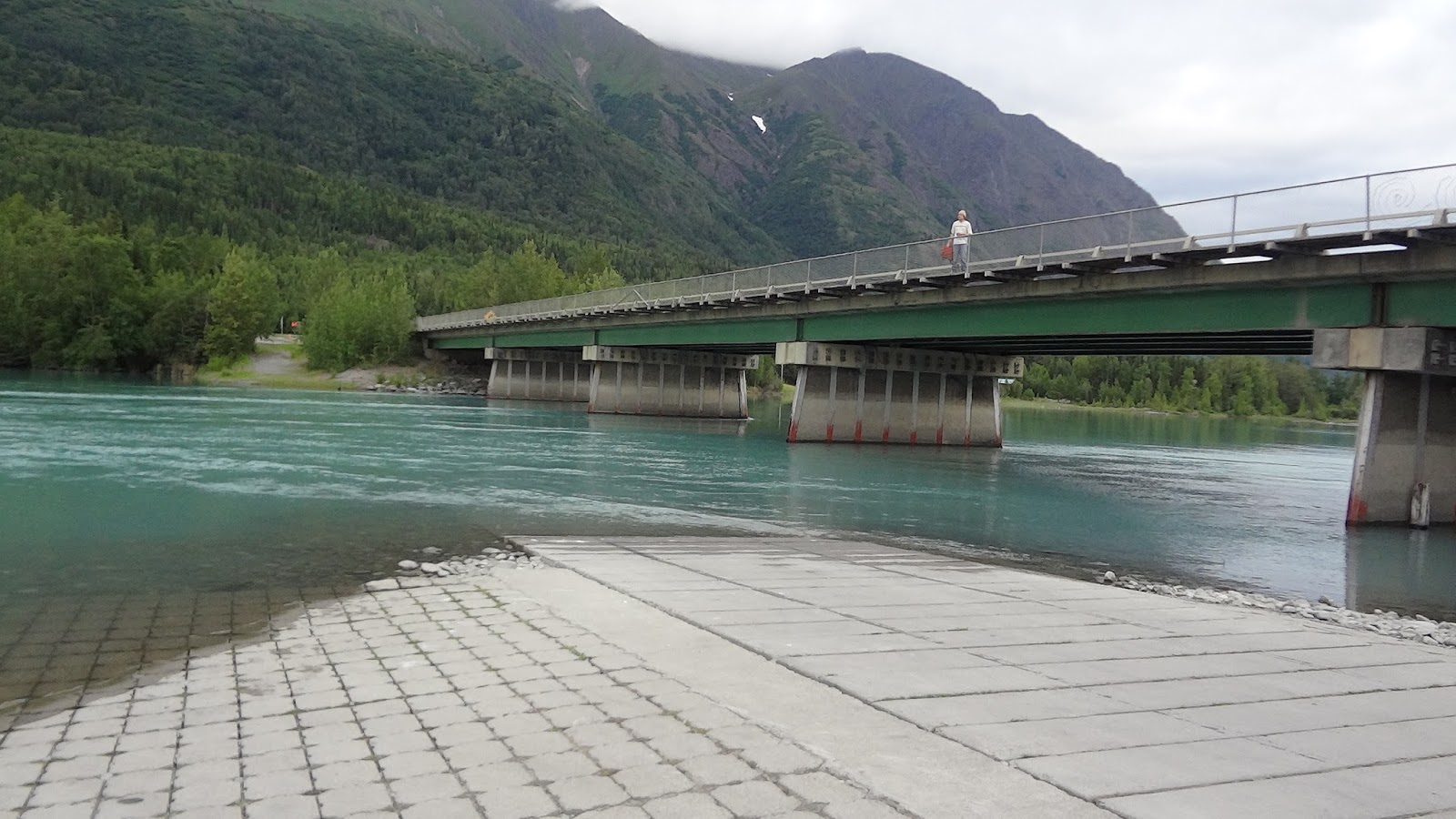
It was late in the evening when we reached the quiet Kenai Lake. The lake was desolated, but for a lady and her small child. The lady patiently watched her two-year-old son playing with pebbles near the water. She carried a gun on her belt and that scared us. But she was nice, she lived there and she gave us very useful information about the place. On her suggestion we drove a little up on the main road to reach a bridge across the Kenai River from where we could get excellent view. The river and its blue water with the backdrop of the hill offered scintillating view. It was past 8.00 PM and someone was just beginning his lonely river-rafting. He must be a daredevil, we thought.


After taking several pictures, we returned back to our hotel, had our dinner and went to sleep.

The hotel we stayed was located in a beautiful, spacious campus with plenty of trees, flowers and plants.


..................... continued in Part IV
   

Thursday, July 25, 2013

Alaska - Our visit during July, 2013 - Part II

Part II
Sunday, the 14th July:
We spent our forenoon at the Science Centre at Anchorage. The children enjoyed the several scientific exhibits playfully. Sanjay and Balaji went for a ‘dinosaur show’ while we went for ‘Northern lights’ show in the planetarium theatre.
Alaska is known for the Northern Lights – Aurora, a strange phenomenon of a natural display in the sky particularly in the high latitude (Arctic and Antarctic) regions, caused by the collisions of energized charged particles with atoms in the high altitude atmosphere (thermosphere).


We also went around the Science Centre looking at various exhibits about life in Alaska, its history and heritage and later developments.


In the evening we went for buying souvenirs from a gift-store. Later, we walked along the Downtown hoping to catch the entry to the walking/biking/hiking trail along the bay, but we couldn’t locate it. And so, we spent our time in a few parks, the children enjoying their park time more than our planned hike.
Monday, the 15th July:
We vacated from our hotel after our breakfast and headed towards Seward. We took the same scenic Seward highway along the Turnagain Arm.

On the way, we stopped for hiking to Flattop Mountain. This is a 3510 feet high mountain forming part of Chugach State Park, with an elevation of 1280 feet from the parking lot. It was generally cloudy and misty around the mountains. There are several levels to climb on this mountain. One could walk or bike.


We could view Anchorage from the first level. We went up to the second level too. Lakshmi and Sahana stayed back. We couldn’t try to hike to third and further levels for want of time. Besides, Sanjay started complaining about his hurting legs. After all, he was just four years old.
From the Flattop Mountain, we drove further on the Seward highway and on the way we stopped to view a small waterfall. We drove all the way to the end of Turnagain Arm and then to the other side of the Arm and then towards South to reach Seward. The drive on the other side of Turnagain Arm was really very scenic with mountains, rivers, and lakes. Two of the important places we passed through were:

·        Moose Pass situated on the shores of Upper Trail Lake 30 miles outside of Seward. Iditarod trail begins here and was used to transport gold and supplies. There is abundance of moose in the area and prompted the name for the place.

·        Cooper Landing, considered as the ‘Gem of the Kenai Peninsula’, ‘a Emerald’ in summer and ‘a Diamond’ in the Winter, is one of the finest, most diverse outdoor recreation area Alaska has to offer. Conveniently located in the middle of the Kenai Peninsula, nestled in the majestic Kenai Mountains along the beautiful turquoise waters of Kenai Lake and the upper Kenai River. These waters are uniquely tinted blue-green by suspended ultra-fine glacial silt. Fishing, rafting, hiking, sightseeing, horseback riding, mountain biking, sea kayaking, and gold panning are popular activities of the place.


We reached Seward in the evening. Our stay was arranged at Windsong Hotel on the banks of the Resurrection River. The view of the distant mountains, some of them snow-capped, from the banks of the river was mesmerizing.

                                                                                                                          ………………..Continued in Part III