Thursday, the 18th July:
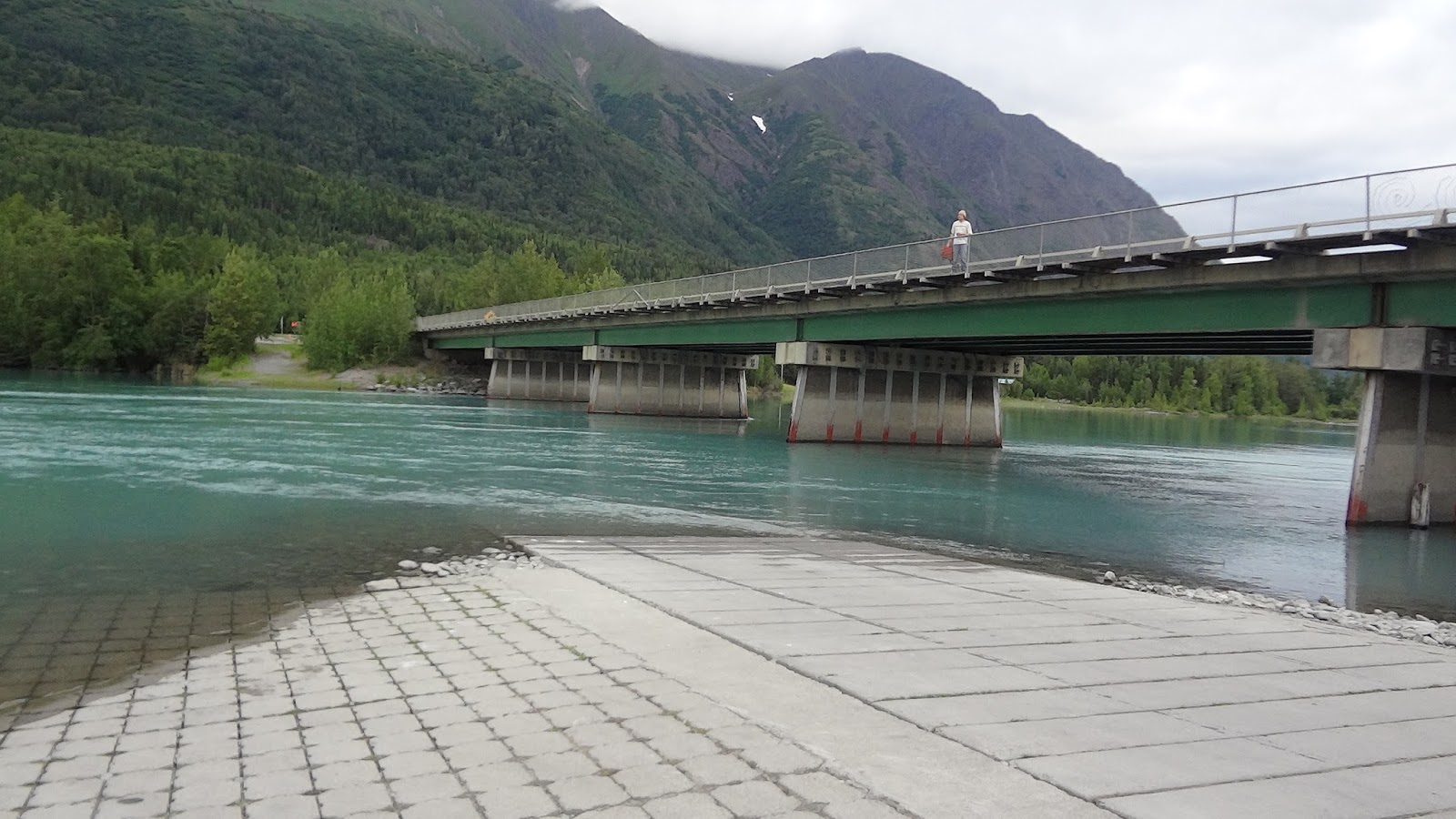
Talkeetna is basically a mountaineering town and was built by miners, prospectors, adventurers, and the railroad. It is at the junction of three rivers, the Talkeetna, Susitna, and Chulitna. The word ‘Talkeetna’ means ‘where the rivers join,’ in the local Athabascan language. Talkeetna is also a great place for flight-seeing trip around Denali. One can find any number of water-planes parked in the waters of innumerable lakes around the place.
Talkeetna is basically a mountaineering town and was built by miners, prospectors, adventurers, and the railroad. It is at the junction of three rivers, the Talkeetna, Susitna, and Chulitna. The word ‘Talkeetna’ means ‘where the rivers join,’ in the local Athabascan language. Talkeetna is also a great place for flight-seeing trip around Denali. One can find any number of water-planes parked in the waters of innumerable lakes around the place.
At Talkeetna, Viji had booked a
cabin house very close to the river. It was quite late at night when we reached
there. The cabin house was located quite interior, ten miles away from the main
Anchorage-Denali highway. The road to the cabin house was deserted. Without our
GPS, we couldn’t have located the cabin house. Cell phones went dead. The
place, initially, looked haunted and scared all of us.

 There was a small board
“Welcome to Neelakantan family’ in front of the cabin house and that was the
only pleasant surprise. Here too, mosquitoes flew around freely everywhere. We
quickly rushed inside the house, not only to escape from the mosquitoes, but
also for fear of any bear suddenly emerging from the nearby woods. ‘I will get
out of this place, first thing in the morning,’ was the terse pronouncement
from Viji. All her earlier enthusiasm to stay in a cabin house vanished quite
dramatically. After making sure that the front door was securely locked, we all
went to sleep immediately.
There was a small board
“Welcome to Neelakantan family’ in front of the cabin house and that was the
only pleasant surprise. Here too, mosquitoes flew around freely everywhere. We
quickly rushed inside the house, not only to escape from the mosquitoes, but
also for fear of any bear suddenly emerging from the nearby woods. ‘I will get
out of this place, first thing in the morning,’ was the terse pronouncement
from Viji. All her earlier enthusiasm to stay in a cabin house vanished quite
dramatically. After making sure that the front door was securely locked, we all
went to sleep immediately.
Honestly, to be fair, the cabin house was really a great accommodation, as we discovered the next morning. It was neat, fully furnished, well equipped with a fridge, micro-wave, kitchen-range, dish-washer, utensils for cooking and so on. It offered plenty of open space to play or party around and a quiet stay away from the din and noise of towns. Knowing that we could be arriving with our children late at night, the caretaker lady had left some milk and other ingredients for making coffee or tea. But, we were all so tired the previous night after a long drive and scared about the deserted location of the cabin-house that we had no enthusiasm to notice the nicer things about this place.


After buying our tickets, we went for some shopping. We couldn’t do any other activity for the rest of the evening since it rained intermittently. We went back to the hotel, prepared our dinner for the night and lunch for the next day, and went to sleep after finishing our dinner.
Friday, the 19th July:
The Athabascan, the indigenous people of North America, called the high mountain, ‘Denali’ to mean ‘the high one.’ The place is habitat for wild animals like grizzlies, caribou, wolves, moose, dall sheep and others. It is also a place for gold mining. The development of a National Park in Denali owes to a great extent to the dream of one Charles Sheldon, an early conservationist and gentleman hunter from Vermont along with Harry Karstens, a legendary outdoorsman and dog musher. By 1917, after almost a decade of hard work, Sheldon and others persuaded American Congress to create Mount McKinley National Park. Four years later, in 1921, Karstens was hired as its first superintendent. President Jimmy Carter, in December 1980, with only weeks left in his presidency, signed into law a legislation that established over 100 million acres of new national parks, preserves, and wildlife refuges in Alaska that included enlargement of Mount Mckinley National Park from two million acres to six million acres into the present Denali National Park and Preserve. Mount Mckinley or Denali is visible from both Anchorage and Fairbanks and lies between the two cities. The park is a six million acres of wild land bifurcated by a ribbon road. Visitors’ vehicles are not allowed beyond the first fifteen miles of this road up to the Savage River. Beyond this, one has to use only the shuttle bus service operated by the Wilderness Access Center.
Denali is a popular destination for hikers, mountaineers, campers and for those interested in winter sports. It also forms part of bear country and visitors are advised to avoid encountering with bears. Elaborate instructions are available on what is needed to be done when one sees a bear.


 The shuttle stopped
once in every one-and-half hours for restroom facility. At other places, it
just stopped for a few minutes for tourists to take pictures. Tourists were
advised to bring their own lunch or snacks, as no facility was available on the
way. Besides, we were not allowed to eat anything outside the shuttle bus to
avoid attracting animals and birds. The rain was a real dampener and many of
the scenic spots were covered by mists. Sun came out partially here and there,
but mostly not seen.
The shuttle stopped
once in every one-and-half hours for restroom facility. At other places, it
just stopped for a few minutes for tourists to take pictures. Tourists were
advised to bring their own lunch or snacks, as no facility was available on the
way. Besides, we were not allowed to eat anything outside the shuttle bus to
avoid attracting animals and birds. The rain was a real dampener and many of
the scenic spots were covered by mists. Sun came out partially here and there,
but mostly not seen.


 We boarded the
1.00 PM shuttle. The driver was quite accommodative requesting a few other
passengers to move to other seats to make room for us and for the kids, so the
kids could sit by our side.
We boarded the
1.00 PM shuttle. The driver was quite accommodative requesting a few other
passengers to move to other seats to make room for us and for the kids, so the
kids could sit by our side.


Honestly, to be fair, the cabin house was really a great accommodation, as we discovered the next morning. It was neat, fully furnished, well equipped with a fridge, micro-wave, kitchen-range, dish-washer, utensils for cooking and so on. It offered plenty of open space to play or party around and a quiet stay away from the din and noise of towns. Knowing that we could be arriving with our children late at night, the caretaker lady had left some milk and other ingredients for making coffee or tea. But, we were all so tired the previous night after a long drive and scared about the deserted location of the cabin-house that we had no enthusiasm to notice the nicer things about this place.


In the early morning, there were
a few more surprises, though not pleasant. Electric power went off and so, there was no
water in the taps in the bathroom. We quickly prepared to leave, but before
leaving we went to the caretaker’s place. We found some wonderful breakfast –
some special bread, coffee, cereals, and yoghurt. The caretaker was a pleasing woman.
She explained away the sudden power tripping as something totally unexpected and
rare and the lack of water supply from one of their overhead water tanks resulting
from some inmates inadvertently leaving the water tap open during the night. A
few other guests sitting in the dining room too spoke highly about the place. Though we weren’t fully satisfied with the
explanations, we had sumptuous breakfast and left the cabin house around 11.30
AM towards Denali.
The drive to Denali took nearly 3
hours and we reached our hotel at around 4.00 PM. The front desk at the hotel
was very elegant and impressive. A coffee shop functioned in one corner and a
gift shop in another corner. However, the rooms were located in a number of smaller
condo units spread out in a sprawling campus. No parking was there in front of
our condo unit and we had a cumbersome walk over quite a distance carrying our
heavy luggage to access our room. It was drizzling too at that time.
Once we lodged our luggage in our
room, the first thing we wanted to do was to buy our tickets for the Denali
National Park Shuttle Tour for the next day. So, we went to the Wilderness
Access Center and bought our tickets for the 66 miles, 8 hours long, Eilson Visitor Center Tour scheduled
for 9.00 AM on Friday. We had also planned to return to Anchorage Friday night
and so, we decided to get off the shuttle at Toklat River Point to shorten the
tour to six hours.After buying our tickets, we went for some shopping. We couldn’t do any other activity for the rest of the evening since it rained intermittently. We went back to the hotel, prepared our dinner for the night and lunch for the next day, and went to sleep after finishing our dinner.
Friday, the 19th July:
The Athabascan, the indigenous people of North America, called the high mountain, ‘Denali’ to mean ‘the high one.’ The place is habitat for wild animals like grizzlies, caribou, wolves, moose, dall sheep and others. It is also a place for gold mining. The development of a National Park in Denali owes to a great extent to the dream of one Charles Sheldon, an early conservationist and gentleman hunter from Vermont along with Harry Karstens, a legendary outdoorsman and dog musher. By 1917, after almost a decade of hard work, Sheldon and others persuaded American Congress to create Mount McKinley National Park. Four years later, in 1921, Karstens was hired as its first superintendent. President Jimmy Carter, in December 1980, with only weeks left in his presidency, signed into law a legislation that established over 100 million acres of new national parks, preserves, and wildlife refuges in Alaska that included enlargement of Mount Mckinley National Park from two million acres to six million acres into the present Denali National Park and Preserve. Mount Mckinley or Denali is visible from both Anchorage and Fairbanks and lies between the two cities. The park is a six million acres of wild land bifurcated by a ribbon road. Visitors’ vehicles are not allowed beyond the first fifteen miles of this road up to the Savage River. Beyond this, one has to use only the shuttle bus service operated by the Wilderness Access Center.
Denali is a popular destination for hikers, mountaineers, campers and for those interested in winter sports. It also forms part of bear country and visitors are advised to avoid encountering with bears. Elaborate instructions are available on what is needed to be done when one sees a bear.

We reached the Wilderness Access
Center well in time to catch our 9.00 AM shuttle for the Eilson Visitor Center
tour. We had to carry the heavy baby-car-seats too, as this was mandatory for
children to travel in a shuttle bus too. I think a lot of fuss is made in some
places in America in the name of security and safety. It was very quite an
onerous job carrying the heavy baby-car-seats everywhere you go. The tour
operators could have as well provided a few baby seats in every shuttle bus. The
baby seats can be easily fixed and removed. It was raining and drizzling
intermittently. The driver was a lady and as she drove, she also functioned as
the tour conductor describing the places, scenic spots, the mountains, the
rivers, the history of the inhabitants of the terrain, and so on all the way.
The shuttle passed through Savage River, Sanctuary River, Tehlenika River,
Igloo Creek, Sable Park, and Polychrome Overlook before it reached Toklat
River. One got fabulous views from Igloo Creek stopover.


We reached Toklak River at 1.00
PM. We got off from the shuttle to take another one for getting back to the
Wilderness Access Centre. In Denali, there are tours go up to Kantishna after
crossing Wonder Lake and Reflection Pond. We understand, on a clear day, one
gets a view of 20320 feet high McKenly Mountain, the tallest in U.S.A, from
many viewing points. In Wonder Lake and Reflection Pond, on a clear day, one
can see a reflection of the McKenly Mountain in the waters of the lake.
However, these trips could take anything about 11 hours. For a visitor to
Denali, I think one would need at least three days to do full justice.
At Toklak River, there was a
tented souvenir shop and a number of restrooms. Tourists were allowed to get
down from and change into the shuttle bus anywhere, subject to availability of
seats. We didn’t get proper seats in the 12.20 PM shuttle from Toklak River; I
felt the driver could have been a little more accommodative to ask a few fellow
tourists to move over to other seats to accommodate the small children with us,
but he didn’t. So, we had to wait till 1.00 PM. In the meantime, as the rains
stopped temporarily, we walked around a bit taking pictures.


We returned back to Wilderness
Access Center by around 3.00 PM. We went back to our hotel, did some shopping,
packed our things, put them in our car and left Denali around 5.30 PM for
Anchorage.
On the whole, I felt, if weather
was better, we could have enjoyed the Denali tour much more.
We stopped over at Taco Bell at
Wasila on the way, for dinner. We reached Embassy Suites Hotel in Anchorage by
around 11.00 PM when it was still not dark. Viji and Sanjay went out to take
pictures, after we checked into the hotel room.
Saturday, the 20th July:
We got up leisurely around 8.00
AM. The hotel offered cooked-to-order breakfast in addition to regular items.
We had a rich breakfast. In the meantime, Viji and Balaji went to return the rented
car. The hotel arranged an airport shuttle to take us to the airport. We were
there at the airport around 12.45 PM. Viji and Balaji along with the children
left by 3.00 PM flight to Phoenix via Seattle and we left by a 4.20 PM flight
to Chicago via Seattle. We reached Chicago on 21st morning around
6.30 AM and our flight was delayed by an hour.
On the whole, our trip to Alaska was
very satisfying. I am very happy that one of my long time passions was
fulfilled during this year. I thank Viji and Balaji for that. I thank Sanjay
and Sahana for their excellent cooperation for most part. They are small
children and become restless when they are bound in a car seat for continuously
long hours. That was understandable. They just want to be free. Only we lack
the ability and innovation to keep them cheerful when they become restless.
A trip to Alaska is very costly
too. The flight tickets, the hotels, the rented car, the groceries, the
entrance tickets to various tours, facilities and shopping are all
prohibitively costly. I thank Sri Amma Bhagawan for making this tour possible without
any discomfort.
Now, Kailash and Manasarover in
Himalayas seem to be my next target.
Summary:
Alaska is a must see place in
one’s life, if one can afford. It is in places like Alaska where one finds
Nature’s play in full. The scenery, the serene and clean atmosphere, the quiet
ambience, the whispering cool winds, gurgling rivers and waters, expansive land
and space, frightening mountain heights, tantalizing lakes and most importantly
the clean and smooth road systems of Alaska are something to be remembered for
lifetime.