Total Pageviews

Saturday, November 22, 2008

About my interests- Part II - Reading


22nd November 2008

I seem to have developed my interests in reading almost from my 7th or 8th class. I was born in Tamilnadu and I studied in Tamil medium, and naturally my early readings were in Tamil only.

Probably, I initially started off with weekly Tamil magazines and Ananda Vikatan, a Tamil Weekly was my favorite. My paternal uncle and his wife were voracious readers. His wife became paralyzed almost immediately after marriage and she became invalid below her waist. She made her levitating movements from place to place within their house using her two hands. She was a very kind lady. To help her pass time, my uncle subscribed to almost every magazine. He spent a major portion of his meagre income on magazines. After they read them, they collected all serial stories by cutting them from the magazines and binding them neatly into books. They had great such collection of stories, novels, dramas and preserved them like a treasure. They stayed about a mile from our place. We used to visit their place quite often and borrowed some of these collections to read. They were a great couple.They had a special place in my life and I would like to write about them elaborately on another occasion.

I had particular interest in one detective serial called “ Thuppariyum Sambhu” (The Detective Shambu) by Devan. Mr.Shambu was a detective and went about investigating and unravelling many crimes and mysteries in the town. These stories were humorous, very simple and straight and used common sense approach to solve mysteries. The second serial that absorbed me was 'Veera Vijayan' (The Bold and Mighty Vijayan) – a serial about a personality who was extrordinarily tall and his adventures(and ironically, the inconveniences he had being very tall). The other serial that took Tamilnadu by storm and would dwarf today's 'Bold and Beautiful' serial in terms of length was 'Kanni Theevu' (An Island known as Kanni). This was getting published in the daily Tamil newspaper 'Dina Thanthi' (an equivalent of Daily Telegraph) and was a daily attraction in the paper. There was a large reader group for these comics serials those days.

In Southern Tamilnadu, Saiva Siddhaantha Kazhagam (an organization that promoted Shaiva philosophy) established libraries in several towns including ours. There was a municipal library in addition in our town. While the municipal library had collections of both English and Tamil books, Saiva Siddhanta Kazhagam library offered only Tamil books – both fiction and non-fiction. They also published several books on ancient Tamil literature, theology, spiritualism, and philosophy.

However, those days I had no interest in non-fiction and I focused on Tamil novels There were many popular writers. Historical novels were particularly popular. Family stories were popular especially among household women. Detective novels lured youngsters.

The detective novels written by the late Tamil Vaanan appealed to me a lot. The Detective Sankarlal was the hero in most of these novels. Saiva Siddhantha Kazhagam library did not allow readers to take books home and so, as soon as I returned from the school, I would rush to the library. Usually a novel would be finished within a week or so and many times, I went to the library only to be disappointed as my chosen book would be in the hands of someone else. I read almost all his novels. Besides writing novels, Tamilvanan also ran a weekly magazine called ' Kalkandu' (The Sweet Candy). It was a kind of tit-bits magazine. I wondered how he collected volumes of information on wide ranging topics for publishing in Kalkandu as tit bits. In addition, there was a question-answer section, where he answered a variety of questions from readers– from history to modern science, biology to psychiatry, current affairs to Neanderthal man. His style was simple and straight forward so that ordinary folks could easily understand them. The tit-bits were very informative, inspiring inquisitiveness and curiosity. They were a kind of ' Tell me Why?', ' What you want to know?', 'How they work?' collections. It baffles me even today that he could do this in 1950s. Compared to that, what do we find in most magazines today? Most pages in today's magazines in Tamilnadu are filled up with films and film related stories or news, the remaining part consumed by advertisements to create revenue.

Most of the very popular and versatile writers contributed their stories to weekly magazines – the most famous among them were Ananda Vikatan, Kalki and Kumudam. I enjoyed the writings of eternal names of those days in Ananda Vikatan: Jayakanthan, Seval Kodiyon, Saa Vi, Kothamangalm Subbu, Bilahari, Sivasankari, Indumathi just to name a few. Of particular interest were the serial novels like: Thillana Mohanambal (about the dancer Mohanambal), Un Kannil Neer Vazhinthal (a family drama), Washingtonil Thirumanm (a hilarious story about a South Indian Brahmin marriage at Washington D.C). S.S.Vasan, the Tamil film legend and the then owner of a large film studio 'Gemini' in the heart of Chennai city was also the publisher and owner of Anand Vikatan. He maintained very high standards about the contents of his magazine. Their cover page along with the satire joke captured many and was a Tamil parallel of acclaimed R.K.Laxman cartoons.

'Kalki' that comes out even today had somehow lost much of its earlier sheen. The then editor and owner Kalki wrote some of the most ever talked about tamil novels titled: Ponniyin Selvan, Parthiban Kanavu, Alai Osai to name only a few. Many of these serial novels were written with historical perspectives and had tremendous readership. The name Vandhiya Thevan, the hero of his most popular novel Ponniyin Selvan roars in my ears even today.

While Ananda Vikatan and Kalki appealed to the asthetic sense of intelligent and educated Tamilians, Kumudam appeared to be more commercial appealing to masses by focusing on current affairs, films, and juicy tit-bits and probably set a radically new trend in magazine media that rules the state even today. Unarguably, Kumudam continues to enjoy the maximum readership. The stories written by Jawar Seetharaman, Sandilyan, Raa Ki Rangarajan, S.A.P and the likes were very popular. Historical novels written by Sandilyan were great hits. These well-researched novels cleverly forged history and creativity ending in a suspense week after week; one couldn't wait till the next issue to know how the story progressed further. Jawar Seetharaman used to write on mystical topics and his 'Udal Porul Anandhi' was a spine chilling novel. Some of his novels used subjects like mesmerism, and meta-physical topics to induce reader anxiety.

There were other great authors too like Akilan, Naa Paarthasarathy, Ki Vaa Jagannathan, Manian, in whom I took particular interest.

In Tamil story writing, two people made significant impact and changed the way the magazines looked. One was none other than the author Sujatha and the other was the artist Jey (raj). Suffice is to say they are a class by themselves. Tamil media lost Sujatha recently in mid 2008 and he will be ever remembered for his variety and novelty in writings.

Somehow, I did not show much interest in other popular magazines lilke Kalaimagal. Mangayar Malar, another popular monthly magazine published even today, is popular especially among brahmin ladies.

Another aspect of these Tamil magazines was the pictorial depiction of characters or incidents in a novel or story, by artists. Those days Gopulu was a notable cartoonist and also a painter. Though one should not draw comparison, he was a tamil parallel for R.K.Laxman. Every artist was unique in some way or other. Besides the vivid and stunning images of Vandhiya Thevan (of Ponniyin Selvan) drawn by Sinha in Kalki are still lingering in my mind. Maya was another paint artist who deftly drew ordinary people like you and me and he drew pictures for many family stories.

The coming of Jey (Jeyaraj) as a paint artist changed the face of many Tamil magazines. He was an expert in human anatomy and he drew captivating pictures of the characters particularly the women characters who adorned the modern looks.

I must mention about another magazine 'Thuglak', that is popular with its political satire. The Editor Cho Ramaswamy is a political commentator, a former comedian in Tamil films and dramatist. His plays on stage were great hits those days during a time when there was so much anti-establishment feelings among people. He echoes people's concerns, worries, criticisms in his usual inimitable humorous and satirical manner. Though very controversial, I enjoy Thuglak today also.

As I entered High School, my interests slowly got shifted to English books. Strangely, I was one who took to learning English seriously. I always adopted my free-style answering in English language tests and exams and chose not to use the ones usually dictated by the teacher. I made lot of mistakes and scored only average marks in English language, but the teachers always appreciated and lauded my independent style of writing and encouraged me to continue the way I used to write regardless of the not-so-good performances in class tests. Remember, I studied in Tamil medium school.

My initial reading interests went towards Perry Mason detective novels written by Earl Stanley Gardener. I visited the local municipal library and read every Perry Mason novel. I relished the court scene arguments, Perry Mason's summary on how he solved the mystery from bits of information and the final twist in every novel. Somehow, my comfort levels with the writings of Agatha Christie and later on James Hadley Chase who were near contemporaries, was quite low and I did not read many much.

During my high school day, I particularly liked the non-detailed text books for their story values. Many stories written by famous authors like Charles Dickens, Alexander Dumas and the likes were prescribed for study and they were mostly in an abridged form.

As I progressed, I started taking interest in the novels of Arthur Conon Doyle – his novel ' Hound of the Baskervilles' and a few others where Sherlock Homes detective was the chief character used to be my favorite.

During the time I was in in my high school, they used to show films in the school auditorium. I specifically remember enjoying movies like 'Twenty thousand leagues under the sea' and 'Around the world in 80 days' (besides a few Charlie Chaplin movies). These films motivated me to search for the story books from the library.

As I was just completing my tenth standard, one of my seniors, whom we usually called RV – he later joined IPS and became a successful police officer – encouraged me to learn better and better English and suggested that I must buy a book '30 days for a more powerful vocabulary' written by Wilfred Funk. I couldn't afford to buy that book then, though eventually I bought it much later. Though I lost of the copy of this book in course of time, I bought it – the original publication- once again recently at Bangalore.

Entering college, I continued to take profound interest in English language studies, especially, the classics. The college I studied had a big library and they had good collection of books. I borrowed books from library from time to time and read some of the great authors like Winston Churchill on World War, Aldous Huxley, H.G.Wells, J.B.Priestly, Victor Hugo, Somerset Maugham and the likes. I used to enjoy Milton's ' Paradise Lost', John Ruskin's 'Sesame and Lilies', Jane Austin's 'Pride and Prejudice' to name only a few.

Though I was majoring in Chemistry during my graduation, we had one paper in English language and we had one Shakesperean drama as part of the English language paper. As part of my studies, I read 'Hamlet', 'As you like it', ' Twelfth Night', 'Mid Summer Night's Dream' – the ones that I remember now. I was greatly drawn by Shakesperean English and became obsessed with his writing that I read on my own the original plays: Othello, Merchant of Venice, King Lear, Julius Caesar, Macbeth, Much Ado About Nothing and so on. At that time, I could not understand the texts fully without a help from an English Professor, but still I read them with great enthusiasm. The soliloquy from Hamlet ' To die or not to die' , the speech ' Romans and country men' in Julius Caesar, ' You too Brutus' were all my favorites.

I used to like John Ruskin's style. Many of his sentences used to be very long, sometimes running for pages before they got completed. At times, I tried to imitate him in my English language paper and that did not go well with my professors.

Then,we had the drama 'Pygmalion' from George Bernard Shah and I enjoyed every page of it. Later on, when the movie 'My Fair Lady' was released in our town, though I saw the movie, I could not follow the accent -this difficulty of following western accent continues even today, much to my discomfort. Some serious psychology seem to be at work with me about accents.

I never knew how and why I took so much interest in reading English Classics during those days. Many said I would end up as an English Professor who was least sought after those days. However, destiny had made other decisions for me.

When I was doing my Post Graduation and also during the initial years of my employment during late 1960s and early 1970s, the reading habit came to a virtual stand still. Notwithstanding that, on my first ever employment in May 1970, I bought an Oxford Dictionary for thirty rupees from my first salary and on the front page, I wrote that this was for improvement of my English. I used several meticulous methods to create and build up my own vocabulary that I preserved for almost three decades.

Things changed again when I was posted to Delhi in my early career path during 1972. I stayed in Karol Bagh a popular residential area and asylum for migrating South Indians. Famous for its South Indian Restaurants and their idli-sambar, it also attracted people from other parts of Delhi regularly for its road-side Monday markets, textiles shops at Ajmal Khan Road and pavement book shops. On the pavements of Arya Samaj Road near the Ajmal Khan Road junction there used to be few old- books sellers and you could buy many books for throw away prices – mostly five rupees. My reading interest got kindled again and this time it was novels of later authors.

I feasted myself with books of Arthur Hailey and Irving Wallace my two favorite authors those days. I had read almost all the novels written by them. Particularly I liked 'The Hotel', 'Airport', 'In High Places' by Arthur Hailey from the old sections and 'The Prize', 'The Man' by Irving Wallace. The novel 'The Man' was a kind of clairvoyance and it took nearly forty years to become a reality – an African American has just been elected the President of United States of America in late 2008. The writings of Leon Uris, Nevil Shute, Alistair MacLean, Frederick Forsyth too were enjoyable. I would like to make a special mention about 'The Exodus,' 'Armageddon,' 'QB VII' by Leon Uris; “Ice Station Zebra,' 'Where Eagles Dare,' 'Guns of Navron' by Alistair MacLean are also worth mentioning here. Among the books of Frederick Forsyth, 'The Day of the Jackal' was a master piece.

During my stay in Northern India, I collected a number of English novels that I painstakingly brought to Madras when I was transferred. However, much to my compunction, I had to carry them in gunny bags and dispose them off for a paltry sum to old-book sellers at Moore Market as I realized that I had no serious arrangement with me to preserve those books. The humid weather at Madras spoiled books and they were exposed to the risk of being eaten away by white-ants. I had some of my saddest moments of life when I disposed them off. Besides, I was also concerned about the huge cost of carrying the books along with me whenever and wherever I was transferred to.

During 1980s and till middle of 1990s, I continued reading novels by Arthur Hailey, Irwing Wallace, Frederick Forsyth, Leon Uris. The only other addition that I made was Jeffrey Archer. Probably, I can claim that almost every novel written by these authors have been read by me, unless I had missed some. During this period, reading time got greatly compressed due to official pressure of work. I continued buying books from time to time though I never kept track of what I bought. Many friends and relatives used to borrow books from me; some of them never got returned and I too never bothered to follow them up.

Somewhere in the middle of 1990s, I turned my interest to books on finance, stock market, investments and I stayed with them for quite long.

After I took up a job in the Middle East during later part of 1990s, my reading interest once again got revived, but with a difference. This was when I took serious interest in spiritualism after I came into contact with Sri Amma Bhagawan. One of my clients once mentioned about an author Neale Donald Walsch and about his book ' Conversation with God' and knowing my interest in spiritualism, he recommended my reading that book. However, the opportunity to read that book came much later after an year or so. And when I read the first volume of “Conversation with God” I felt blown apart to pieces. That book really shook me. When I compared notes with teachings of my Bhagavan, I found extraordinary similarity in the messages I had. I read all the three volumes of ' Conversation with God' and that gave me an entirely new perspective to life. I became an ardent fan of Neale Donald Walsch.

During 2002, when I visited USA for the second time, I came to know about the writings of Dr.Deepak Chopra, an Indian Born doctor settled in America. He is a disciple of Maharishi Mahesh Yogi. I happened to read initially three books during that visit: 'Quantum Healing', 'Creating Affluence,' and 'Ageless Body and Timeless Mind.' His books gave me further insight into spiritual aspects of good health, healing, Mind-Body medicines, alternative healing systems, prosperity and affluence. My Bhagavan was already talking about healing and made many of us spiritual healers by his mere blessing. I adored Dr.Chopra and became an ardent fan for his writings too.

These two authors – Neale Donald Walsch and Dr.Deepak Chopra – coupled with the blessings and teachings of my Sri Amma Bhagavan changed my life completely. I know I am not perfect yet and so are many. I may still have my negativities stuck with me. But I know now that I am different now. Things look different to me though they are the same and I now know why have what I have. I continue to read their books even today. I subsequently read 'Communion with God,' ' Friendship with God,' ' Home with God,' by Neale and ' Seven Spiritual Laws for Success,' ' Life After Death,' 'Peace is the Way,' ' Return of the Rishi,' ' How to Know God' by Dr.Chopra. Every book by Walsch and Chopra is a master piece and I return to them from time to time by giving them a second or third reading.

During this time, another author who motivated me and inspired me heavily was Anthony Robbins and his books 'Unlimited Power' and ' Awaken the Giant Within' were extremely useful to me during times of difficulties and challenges. Again, like our Bhagavan, he talks about beliefs and how they control our lives.

During the last about 7 years, I had been reading more books that were spiritualistically oriented, though I had not quite given up novels. I continue to read novels just for time passing and the earlier charm in reading them was lost in me.

During my several visits to USA, one thing I enjoy most about my stay in USA are the libraries and the books. The subjects I read ranged over 'creation', 'big bang', 'evolution', 'science and religion', 'consciousness', 'healing', and so on. The chronicle of books read might look weird and I am not going into them now. Just for a small sample: 'Biography of Albert Einstein', 'Big Bang' (By Dr.Robin Singh), 'Instinctive Healing', 'The last hours of ancient sunlight' 'Train your Mind and change your brain', 'The Language of God', 'Conscious Living', 'J.Krishnamurthy' (By Propul Jaykar).... the list is long.

During the recent periods, I also read Dan Brown, John Grisham, David Baldacci, Clive Cussler, Sydney Sheldon and I must make a special mention about Da Vinci Code (Dan Brown), Camel Club (David Baldacci), Client (John Grisham) that I liked.

In between, I also rediscovered my old interest in reading Tamil books, though this time, my interests were different. I read on Ramakrishna Paramahamsar, Paramahamsa Yogananda, Ramana Maharishi, Alwars and Nayanmars of Tamilnadu, Hindu Relion (by Kannadasan) and so on.

My interest also went into learning Sanskrit slokas, various sukhtams, Rudram, Chamakam and I learnt them even while I tried to understand their meanings. Understanding and Faith both are essential while one uses these slokas for ultimate liberation. I just started reading Bhagavad Gita, the core slokas and their essential meanings.

If the chronicle on my reading interests appears too long, I only wonder how little I have read so far and how much more are there waiting to be read. I found books as great sources of understanding, knowledge and inspiration. They are just not for time-passing alone. They have helped me in my imagination and creativity. I am just 60 now and I split my daily time between my reading, writing, music, exercising and preaching spiritualism to people who look for it – and I have to snatch some time in between for my wife too, while my children don't bother me any more.


Tuesday, November 04, 2008

Fall Colors in USA - Nature Plays Host

We all like colors and we would like to be seen and talked about as colorful personalities. Colors attract many and when nature plays host feasting to our eyes, then there can be no limitations. Look at the sky everyday in the early morning and evening. See the colors at dawns and sunsets. No painter on earth had so far been really able to replicate the color effects produced on the sky everyday and everyday, you have a new color combination.

Season changes are quite distinctively noticed in USA unlike in India, especially Southern India where we generally have only three seasons - popularly joked as ' hot, hotter and hottest'. In northern areas of USA and Canada, when the season changes from Summer to Autumn to Winter and back to Spring and Summer, one must really see to believe nature splashing colors.

I would like to make a special mention of the Fall Colors. When Summer is over, before the onset of Winter the tree leaves turn from green to purple to red and fall from the trees until the tree is eventually barren. Nature works so beautifully and rhythmically. It is as though they become aware of the onset of winter when snow will fall, the trees prepare themselves by shedding all its leaves so that they can receive snowfall gracefully. It is nature's way of responding and communicating with other living organizms.

The Fall usually happens during September – October of each year when one sees beautiful fall colors. Besides Spring, this is a season everyone enjoys,. The summer warmth is gone, it is cool but not unbearably cold. It rains from time to time. The weather alternates between bright sun shine to moody and cloudy days. People can go out for pleasant walk and enjoy the cool breeze. People can spend more time on open green areas on fun and games activities.

Somehow by coincidence, in the last several years, I had been visiting USA during the Fall periods and I have been enjoying Fall colors. My camera is loaded with pictures of Fall Colors everytime I visit USA during the Fall. These colors instil in me energy, vigor and enthusiasm and I feel that I am renewing myself too like Nature.

The pictures you see are in Des Plaines City, Chicago, Illinois


Saturday, October 25, 2008

Visit Switzerland


Introduction
Traveling places is one of my interesting pastimes and I love places of scenic beauty. Almost every year we go to places. During 2007, we visited Badrinath, Kedarnath and Gangothri on Himalayas. Himalayas always thrilled me. We had been planning a Europe trip for quite some time. Any number of tourist packages were available, but we felt that they were so cramped not really affording extensive and exclusive visits to places. The tour packages did not offer leisurely visits to important places. So, we decided to make a trip to Switzerland only on our way to USA during this year to save on flight costs.
My 60th birthday provided the ideal opportunity for us to visit USA and be with our children. So, we started hunting around for tour packages. The brochure that I had received earlier from Exotica Vacations gave us a clear broad picture of the places of interest In Switzerland. We wanted to spend our days in Switzerland at leisure spending time as it pleased us. Eventually, we got in touch with Swiss Tours in Bombay who gave us a package that met our expectations. Having experienced ' tour on your own' to Scotland and London earlier, we preferred a tour, where we were at liberty to spend time as it pleased us rather than being put on a tight schedule moving from place to place. We settled for a 8 days and 7 nights tour package offered by Swiss Tours ( I understand that this is part of Government of Switzerland tourism). This package offered us hotel accommodation for 7 nights (with complimentary breakfast), a swiss (train travel) card that would enable us to make five transfers, three excursions (including the one to Mount Titlis that we asked for) and a complimentary excursions to a place known as Harder Kulm.
The five tranfers planned were:
Land at Zurich by air and take the train to Geneva (2 nights halt at Geneva)
Geneva to Zermatt (one night halt at Zermatt)
Zermaat to Interlaken (two nights halt at Interlaken)
Interlaken to Lucerne (two nights halt at Lucerne)
Lucerne to Zurich and board our flight to USA
We requested them to provide us accommodation as close as possible to the railway stations in respective places. We bought tickets to Zurich and USA on our own thorough our travel agent.
Preparations
I was assured that language won't be a problem in Switzerland. We made considerable research through websites on Geneva, Zermatt, Interlaken and Lucerne where we were supposed to be staying overnight, the directions from the railway station to the hotel, directions from hotel to all important places to visit, location of Indian restaurants and took print outs for all the information we had found on the net. This booklet of information we made was our main guide when we were actually on the tour. Google Maps that we took from the internet were great tools, though in some places, the directions given were slightly skewed; we discovered much shorter and direct access at some places when we were physically present. We realized that many of the places we were visiting were not very large cities and one could easily navigate by walk. Besides, we came to know that public transportation by bus, train, boats are extremely efficient and economical. Taxis are prohibitively costly.
The weather was supposed to be okay, but rains were a clear possibility during our trip and so we carried umbrellas. If it rained, especially on the days we were planning to visit peaks, it would play spoil sports and no view would be possible. During the first couple of days of our tour, it was predicted to be raining continuously and it rained as predicted. You would see our umbrellas in most photographs during our visit to Geneva. Moreover, we learned that the places like Geneva, Zermatt, Interlaken and Lucerne by themselves were not located at higher altitudes but surrounded by Alpine hills. So, in the plains, it was not supposed to be very cold and it was so.
There were enough Indian Restaurants in all the places we were visiting, but they were all very costly. A dish of cooked vegetables could cost about CHF25 (Swiss Francs) and so a lunch or dinner could cost two persons about CHF50, if you were seriously particular about Indian food. We decided that we might not really go in after only Indian food. We decided to carry with us, a few savories, chutneys, snacks that could be combined with bread or rice, curd etc if they were available.
We did not have much problem with winter dresses as we had sufficient store. But, as we would be passing through five different places and carrying all the baggages everywhere could be a big drag on our energies, we decided to pack our materials in such a way that we could leave some of them in the Zurich Airport with the ' left luggages' facility.
We were told that for getting visa for Switzerland, we might have to visit their consulate at Bombay for a personal interview. However this was not needed and we got the visa without any problem. We also collected sufficient Swiss Francs cash to meet our day to day expenses from the authorized currency dealers.
In order to save some cost we decided to reach Mumbai by train and then fly from there to Zurich.
Our Travel

Day 1: 12th September 2008: Geneva
We reached Mumbai on the early morning of 11th Sep and we flew by Swiss Air to Zurich the same mid night. The flight took nearly 9 and half hours and we landed at Zurich airport on 12th Sep at 6:30 in the morning hours. Immigration and custom procedures were quite simple and efficient. We lodged one of our bags at the airport ' left luggage' facility. They charged us for the first day CHF12 and for subsequent days CHF8 per luggage per day payable when we go back to them to collect our luggage.
We went to the SBB counters (Swiss Rail) at the airport and collected all vouchers for our hotel stay and excursions besides the Swiss Card. They were all kept ready for our arrival and after checking them that they were in order, we went two levels down to the train station within the airport and boarded the next available train to Geneva. Clear directions were marked everywhere at the Airport and we met no difficulties. Besides, the people at the information counters were all very helpful.
We had a direct train from Zurich to Geneva and it took nearly 3 and half hours and we reached Geneva around 12 noon. Hotel Strassbourg Universe that was booked for us for 12th and 13th was just five minutes walking distance from the the Geneva Main Station (Called Cornavin Station). On our arrival, we were also given Transport Card by the hotel and this card entitled free bus travel within the city of Geneva. We had a bath, changed ourselves and left out for oursight seeing

In Front of Palais Des Nations, Geneva
After a little struggle as to which bus will take us to the United Nations Office (this was one thing we could not research in advance as the web sites gave all information in Swiss language), we found the bus. We got down in front of Palais des Nations – the European Head Quarters of UN - and walked down about a mile to get to the visitor entrance that was located at the back. We came to know that Geneva is the headquarters of some 200 international organizations, most of which are located around the Place Des Nations. Built in 1930s, the Palais is situated in a park offering magnificent panoramic views of the city, the lake and the Alps. The guided tour was priced at CHF10 per person and the tour was conducted in different languages including English. We joined the English group that took us to the main 2000 seat Assembly Hall, The Council Chamber decorated with gold murals depicting the human struggle for peace and a host of other meeting halls. There are as many as about 23 halls, small and big inside the UN Building, we were told. The tour took about an hour. The buildings were very impressively constructed. They explained how the UN got to acquire these buildings, how and where many meetings are held, the names of important people concerned, the various artistic paintings gifted to UN office by several countries.
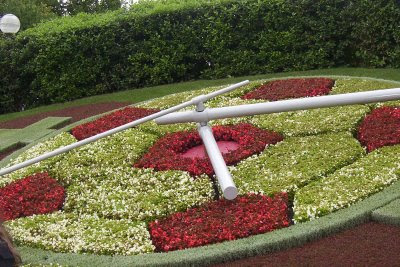
We were not particularly interested in visiting buildings and so we decided not to visit other museums and building where other organizations like International Red Cross were located. After finishing with UN building, we returned back to Cornavin Place, that seemed to be a major central district within Geneva for shopping, eating and whiling away one's time. The river Rhone flowed through the city. We then walked down to the lake side towards the English Garden, the Floral Clock and Jet d'eau, spouting a column of lake water jet as high as 450 feet.

Floral Clock, Geneva

view of Jet Deau, Geneva

The walk around the lake side reminded me of the walk we had earlier a few years back at Chicago with the fabulous sky rise building forming the skyline on one side and the lake and fading sunlight on the other side. The walk on the left side of the lake took about forty five minutes. We were delighted to see beautiful flowerbeds of roses and exotic flora and a wide variety of birds, such as swans, ducks and diving birds, in addition to multi colored sails. We went inside the English Garden and saw the world famous Floral Clock.
We walked back to the hotel and on the way back my wife spotted a small stores very close to our hotel where we bought some fruits, juice, snacks and believe me – samosa. (Even plain rice was available that we bought next day for our dinner)
The hotel room was quite small, but well done. There was a pay-phone and we could use that to call our children and narrate our first day experience.
Day 2: 13th September 2008: Geneva
Today, we were able to quickly find out the bus that will take us to the places we decided to visit. Our first destination was St.Pierre Cathedral (constructed between 1160 and 1232) where we climbed to the top of the tower through about 160 spiraling steps. One has to buy ticket to have a view from the tower. We were wondering how people who lived almost thousand years ago could build such difficult structures even without any of the modern engineering tools and lifts. We had a beautiful view of the entire Geneva from the top.
It was raining that day continuously. Disregarding the rain, we walked back from the cathedral to Place Bourg De Four, Hotel De Ville and to Place De Neuve. The names could sound odd, but bore strong resemblance to English names. Bour De Four was just a junction where four roads met and there was a market place that was called Place Bourg. ('De' means 'of' ) Hotel De Ville is the Mayor's office (Geneva's Parliament) and we climbed the cobbled square shaped ramp to the third floor. The ramp was said to have been used by the earlier rulers to travel up and down on horse-back. Place De Neuve was the artistic centre of Geneva and surrounded by a number of museums, music concert halls, parks.
As the bus ride was free, we returned to Cornavin Station, had lunch and went back to Place De Neuve and by then, the rain has stopped. We walked inside the Parc Des Bastions, a pleasant promenade embellished with monuments, fountains and statues along shady walkways. We walked along the Reformation Wall, erected in 1909, celebrating the great figures of Protestantism. We came out of the garden from the back side and walked around the University of Geneva campus, had coffee at Starbucks and returned back to Cornavin shopping area. We did some shopping. Watches, crystals, jewelery, army knife, cattle bell, and host of momento items were available.
Overall, Geneva, by any international standards was a small city, but beautiful. One can reach many places in Geneva by walk. It is a city of parks and museums and houses the offices of many international organizations. Though it was raining all through the days we stayed with intermittent breaks, was not cold. The city bus service was excellent and punctual. Plenty of eating places for those who like to wine and dine. People are very courteous. There was even a street market for vegetables that disappeared in the evening. We could hardly find any stores. We were wondering whether everyone eats out there and presumably, does no cooking at home. Everywhere, there were small and big eating places. The lake side and its boating facilities added to the attractions of Geneva. The breakfast at the hotel was sumptuous. Swiss chocolates are very famous and there were any number of shops selling chocolates.
We rested for the night to be prepared to vacate the hotel and leave for Zermatt the next day.
Day 3: 14th September 2008: Zermatt
This morning we left Geneva for Zermatt. We had some anxiety about this part of the journey as we had to change over at Visp that would mean getting down at one platform and carrying all our luggage to another. The changeover time was very short and the trains were punctual. However, we could do it sufficiently in time for the next train from Visp to Zermatt. Before leaving Geneva, we had gone to the Railway Tourism information counters and got the exact train timings for two successive trains so that if we missed one, we would know how long to wait for the next one. We noticed that everything in Switzerland – especially the trains, buses – are very punctual and you do not have to look at the clock at all. The journey from Geneva to Zermatt took about three and half hours.
When we arrived at Zermatt, it was raining and the Hotel Butterfly Best Western was located at a five minute walking distance. We took a taxi who charged CHF17 for this one minute drive. Taxis in Switzerland are very expensive and one really needs to be an amir to use a taxi for commuting. After we had checked into our room, we left for the local sight seeing.
There are two important peaks – Gornergrat (3089 meters) and Matterhorn (3883 meters)– that can be visited from Zermatt. However, the day was cloudy, though by afternoon, the rain stopped. We were told by the officials at the information center that it was very unlikely that we would be able to view anything at all after reaching those peaks. Besides, the last leg of the journey to Matterhorn peak – at a height of 3883 meters - was temporarily closed due to fog and weather conditions. Moreover the trips to these peaks were costly and were not included in our tour package. We calculated that anyhow we were going to visit similar places in our remaining part of the tour and so we decided to opt out of Gornergrat and Matterhorn. Matter horn was popular for its glaciers, glacier caves and for its highest sightseeing platform in Europe.We roamed around the small market street, the narrow beautiful roads, shops. There was only one main road Bahnofstrasse (that means, Railway station road – you will find this name in all the towns we visited) where most of the shops were located. We could not locate even a single departmental store as that happened to be a Sunday. We had a good long trek along the market street up to the cable car station where one can get into cable cars to reach Matterhorn. Though the cable cars were running, it was four in the evening and they had closed the counters when we arrived there.
At Zermatt
Zermatt is a beautiful small town with plenty of tourists who were walking up and down for whatever purpose. There was nothing much within the town for one to see. However, being a small attractive town, we felt quiet and serene and did not get bored.
We relied on our bread supply for lunch as well as dinner for the day.
Day 4: 15th September 2008 : Interlaken and Zungfrau
Today, we left Zermatt for Interlaken. On all the days, we got up at around 5 in the morning, had our bath and breakfast (that was generally ready by 6.30) and vacated our hotels around 7.30 and this was our schedule that helped us have sumptuous breakfast and reach our destination before noon so that we will have plenty of time at the destination for the day.
The train journey from Zermatt to Interlaken took about two hours and fifteen minutes including two change overs at Visp and Spiez. At each of these places, we rushed from one platform to another just to be sure that we don't miss the connecting trains. The train journeys were very comfortable and we had to show the Swiss Card to the Ticket Examiner in the train. One another thing - we were told to validate these Swiss Cards by punching them in a small yellow machine located on the platform. We had difficulties in locating these small machines – though I was still not sure whether this validating was really required; one could write out the date by hand on the Swiss Card as we were told when we collected the Card.
All the railway stations were neat and clean; hardly any crowd was there. We felt like privileged people, trains running for just a few of us. We noticed a number of commuters getting in and getting out at several stations in between during our train journey.
At Interlaken, Hotel Citi Oberland that was booked for us was little further away from the Interlaken West station. However, we could make it by walk even with our baggages. Here, as we arrived, we were told that the check-in time was 2.00 in the afternoon and that we would have to wait. Alternatively, we could leave the luggage in the office and go around the city until the room is ready. We checked about the weather at Zungfrau(joch), the 4158 meters high peak, we planned to visit only the next day and we came to know that the weather was extremely good over there. So, we took a quick decision to change our plan and complete our Zungfrau trip on that day itself rather than waiting for the next day Who knew, weather could play spoil sport for Zungfrau trip next day. Jungfrau is Switzerland's most popular and expensive mountain railway excursion and is unmissable.
So, we left our baggages in the hotel reception and started walking towards the Interlaken OST(East) station that was about 15 minutes away by walk. The journey involved our traveling from Interlaken to Lauterbrunnen by train and changeover to mountain train that took us to Klein. As we reached Klein, we could feel the cold and we saw snow having fallen here and there. The Klein station was remarkably small and beautiful and it was a scene to watch, from there, the red colored mountain train moving among white snow and ice. The mountain train that takes you from Klein to Zungfrau had just two coaches – small and cute. It also stops at two stations for five minutes for people to get down and enjoy the breath-taking view of Alpine hills and villages. The last pull of our journey from Klein to Zungfrau included a near ten minutes ride completely under tunnel dug between hills only to reach the Top of Europe – the highest at 3454 meters above sea level– railway station that was also built under rocks, just beneath the Jungfrau summit.

A view of the glacier river, Zungfrau

As we got down from the train, there was a visitor area with restaurants, souvenir shops and lift to take one to the Sphinx observation hall and terrace. From here we had the most fascinating and unforgettable view of the round-the-year glacier and the snow clad mountain peaks. Ice here never melts. The Great Aletsch Glacier, a 22 km long – rather the longest – ice-stream in Alps begins on the Jungfrau. The other attractions within Zungfrau included the Ice Palace, Glacier Caves and Top of Europe Glacier Restaurant. The day was extremely bright and I remembered to carry my sun glasses – a very essential matter one should remember to avoid the sun light glare (due to light reflections on the ice). It was extremely cold. One could walk over the glaciers to reach ice play grounds. As we were not very confident that we could bear the cold for long time, we did not venture much into the glacier ice. We made small walks into the glacier for taking photographs.


Overall, Zungfrau afforded one a view and the feel of the “heavens” - to describe my feelings. We returned back to our hotel in the evening after having Chapathi and Dhall in an Indian Restaurant on the way back from Interlaken OST station. The return train took us through Klein and Grindwald to have a round trip view of Alps. One way journey from Interlaken to Zungfrau took a little more than 2 hours.
Day 5: 16th September 2008: Interlaken and Harder Kulm
Interlaken city, by the very name implies that the city is located between lakes. It lies between Lake Breinz on the east and Lake Thun on the west. River Aare flows through the town. The city is small -with a meagre population of about 5000 – and is beautiful though very much bigger than Zermatt. Here too we were provided with the free transport card by the hotel. This day, we decided to explore the lake regions and they were located a bit far from the main city. We reached the bus station near the railway station and boarded a bus that took us to Lake Breinz. We went as far as the free trip allowed on the bus along the lake. The bus was actually traveling beyond into the villages. We got down and walked back noting that the bus will take thirty minutes to return to the same place. The locality surrounding the lake was quiet; we hardly found anyone on the road, though occasionally some vehicles were passing by and a couple of buildings were there overlooking the lake. The lake waters were cool with the mountain ranges on one side and was exquisite to look. We had a quiet walk for thirty minutes and found several overladen with fruits hanging down heavily from its branches. We boarded the bus again and returned back to Interlaken OST station.

A view of the lake at Interlaken


A view of snow clad mountain from Interlaken

A view of a Junction at Interlaken

We then decided to visit Harder Kulm, another view point for which we had a free excursion voucher as part of the tourist package. The Valley station from where we had to take the cogwheel funicular train was nearby and we reached there by walk. The steep cogwheel train journey from Valley Station to Harder Kulm (1322 meters) took about ten minutes. As we were seated in the front seat for better view, we could notice that the gradient on the hill was very high – could be as high as 50 percent- however, we never felt any discomfort during the journey on a steep track. I believe it was due to the structure of the red funicular they used to transport people up the hills. At the peak, we had a magnificent view of Interlaken and adjoining areas from the spacious sun terraces. On top, we notived several walking trails including the one to the city. Eventually, we met a couple who have just trekked up from below and they told us that it took them three hours and that the trek was very very steep in several places. On our return back to the hotel, we bought some plain rice from an Indian restaurant (for just CHF6) that was located just opposite to our hotel. We had stock of curd and some chutney, chips and cut vegetables, and enjoyed a great Indian lunch.
After taking some rest, we again stepped out into the city and walked around the market area, a vast open green area where para gliders (from Alpine Center) were flying into, some casinos, the river side, and Metropole Hotel (one of the large multi storied buildings) till it became dark when we returned back to the Hotel for dinner with rice.
Interlaken is often visited by adventure seeking back-packers. We came to know of a couple of other peaks too for great view. Since our stay here in Interlaken was restricted to two days only, we satisfied ourselves with visit to the most important places around.
Bus services in the city was extremely good. We saw frequent buses plying between several locations, though there was hardly any crowd. Probably, we arrived in Switzerland after the season was over. Everything was lush green, neat and clean. Shopping could be very costly in Switzerland, especially for Indians who are used to buying cheap back in India. Watches are great momentos and we did plenty of window shopping. Watches whose prices went up to even CHF23000 were under display.
Day 6: 17th September, 2008: Lucerne and Mount Pilatus
In the early morning hours we left Interlaken and reached Lucerne by a direct train. To reach the Interlaken Ost station from our hotel, we decided to take a bus and the bus was not to be seen at the time mentioned in the schedule board kept at the bus stop. We were becoming nervous because if we missed the 8:04 AM train, the next train was only after an hour. This was one occasion, where for a change, we noticed that the bus did not maintain the schedule displayed at the bus stop. We never knew why. However, the bus came a little late and we reached the station with just enough time to catch the train.
After reaching Lucerne station, (after a 2 hours and fifteen minutes) we walked to our hotel – Hotel Waldstatterhof – that was located at just 5 minutes walking distance. As soon as we unloaded our baggages in our room, we stepped out for our journey to Mount Pilatus. We needed to catch a boat, the jetty was adjacent to the railway station. We boarded the large steam boat that accommodated more than hundred people and the boat journey took 90 minutes to reach the base station at Alpnachstad for Mount Pilatus(elevation 7000 ft). The day was a bit cloudy and we were praying that we should be able to get good view at Mount Pilatus.
The cog-wheeled train that took us to Mount Pilatus went through another steep track, with gradient exceeding 40 or 50. I understand that this was the world's steepest cogwheel railway. This part of the journey took thirty minutes.

We were over the clouds, Mount Pilatus
A view of terrace and the hills at the back, Mount Pilatus

At the top, the mountain terrace afforded beautiful view of the entire snow clad mountain ranges and we were actually standing on top of clouds feeling terrific. We climbed some of the view points through narrow steps. Fortunately for us, it was bright and sunny at the peak though at Lucerne it was cloudy.
We were having a Golden Round Trip ticket to Mount Pilatus. So on our way back we returned to Kriens by aerial cable-ways and took a bus to Lucerne taking only about half an hour from Kriens.
Day 7: 18th September, 2008: Lucerne and Mount Titlis
Today happened to be the day of our great expectations. We had a Golden Round Trip ticket to Mount Titlis that entitled us to ride on the Ice Flyer Chair Lift. Initially we had no idea what a Ice Flyer Chair Lift would look like and how would be the experience. The very idea of traveling in a open car at higher altitudes was churning my stomach. We read that an Ice Flyer Chair Lift is an open-to-the-sky cable chair taking one over the snow clad hills and the glacier valleys and that information scared us. We were not very sure whether to take that trip or not. We set aside our thoughts for sometime and decided to enjoy whatever the trip could provide us and see later when we were actually there about the ice flyer chair lift.
First, we had to travel by train from Lucerne to Engleberg that took about an hour. There was an hourly train from Lucerne station. As we got down at Engelberg, there was a bus waiting just outside the train station to take us to the Cable car station about a kilometer away. During this journey, we met a young Indian couple from Pune and we had good company during our Titlis trip. The cable car initially took us to another station, where we had to change over to another cable car that took us to the second station. From there, we traveled by Rotair, a rotating cable cabin car, that rotates around its own axis. One needed to be standing inside the cabin. We had fabulous view of the mountains and snow as we went higher and higher on the hills.
When we reached Mount Titlis (10000 feet elevation), we had our first ever experience of glacier. Earlier, we had visited Zungfrau where there was glacier, but we did not step into the glacier. The weather at Mount Titlis was extremely good, bright, sunny and extremely cold. The temperature was negative zones as it was in Zungfrau too. However, we decided to walk down on the glacier to reach the Ice Flyer Chair Lift station and my spirits started going up as we were walking on the ice. As I was enjoying the walk on the ice and glacier, I decided to get into this Chair Lift and experience it for myself. On my motivation and assurance, my wife too agreed with me. We got into the Chair lift that went above the sloping hills and glacier. The glacier park at the other end was not open yet for at least another hour or so and we just came back on the same chair lift. The Ice Flyer Chair Lift journey was comfortable and very exhilarating. The view was breathtaking with snow all around.

A view from Ice Flyer Chair Lift, Mount Titlis

Inside the Glacier Cave, Mount Titlis


A number of fun activities were supposed to be there at the glacier park, provided we were willing to be playing in the glacier. We decided not to spend much time on ice for fear of falling sick and we came back to the terrace view station. We went to Glacier Grotto – a glacier cave – a 150 meter tunnel down to 20-meter under the glacier's surface. We were also pleasantly surprised at the number of Indians visiting this place and also by the presence of Indian restaurant at the Glacier station. We spent nearly two hours at Mount Titlis and enjoyed the place thoroughly. We carried some small snacks that we ate and returned back to Engelberg.
At Engelberg, a second surprise awaited us. We saw a Rajasthani restaurant just as we stepped out of the cable car base station, selling idli sambar, bada pav, pav bhaaji, and masala chai. We had some authentic pav bhaaji and masala chai as our lunch. They told us that they worked for six months and went back to India. We waited for the bus to take us to the train station. However, we did not know that it was lunch break for the driver and so the bus did not arrive. As our next train was just a couple of minutes away we decided to walk to the station To our disappointment, we saw the train leaving even as we just entered the station. Our waving hands to the driver was of no avail. We waited for another one hour at the station and reached Lucerne by around 4 in the evening.
Then for about an hour we were roaming around the Lucerne city criss crossing the river and reached back our hotel. We did not notice anything spectacular about the city. The city was quite big and crowded with lot of vehicular traffic, more active than the other cities we saw. Many of the old city buildings were presenting a picturesque skyline across the river.
After reaching the hotel, we started packing ourselves for our next day's return to Zurich to board our flight to Chicago.
Day 8: 19th September 2008
The train journey from Lucerne to Zurich took only one hour and we were there at the airport by around 8.15 AM. We collected our luggage from the left luggage counter and checked in for our flight and waited for boarding the flight. At 12.55 PM, our Swiss Air flight took the sky towards Chicago.
Summary
Our trip to Switzerland was enjoyable, comfortable and memorable. I was always attracted by hill stations as they offered beautiful view of greenery, trees, shade, flowers, birds, quietness, and fresh air my spirits go up. Each time I was in a hill station, I always felt my awareness shifts to higher planes with un-explicable feelings. Himalayas are great attraction to me and the scenery is different over there. I don't think anywhere in the world, one sees so much greenery as one finds in Switzerland and no wonder, it is looked upon as ' Heaven on Earth.' Time and finance permitting, I wouldn't mind another trip to Switzerland when I would spend my time exclusively on small villages and hill tops rather than in bigger cities.
My next ambition is to visit Kailash and Manasarover on Himalayas located on the Tibetan side. I am determined to work towards this trip and I trust it will happen in the near time.
I hope I presented a fair and exact picture of our trip to Switzerland and I hope you all enjoyed reading the report.

Tuesday, October 14, 2008

About my interests Part I - Music

Simply stated, I have interests in music, reading, writing and spiritual pursuits. They are not just interests, they are my fascinations too.

Let me speak to you about my interest in music first. I do not come from a family of musicians, but I know my mother was sensitive to music and she could sing very well too. My maternal uncle, at around 80 today, still continues to sing devotional songs with. My father, however, had a passive interest in music. When I was only in my early teens, when we were living in a small housing complex, we were the only household having radio and a fan at our place and my father liked to listen to Hindi songs more than others. Again, we were the only household where one could listen to Hindi songs in the complex, or may in the entire street. I had heard people making funny comments about our listening to Hindi songs and these sarcastic comments were promptly ignored by us. We regularly listened to the late night hindi programme , ' Jayamala' aired for the benefit of jawans (soldiers) by the then-government-owned Aakaash Vani (All India Radio). All India Radio usually aired old songs and the only second option we had was to listen to Radio Sri Lanka. One Mr.Mayilvahanan, anchor in Sri Lankan Radiol was particularly popular among listners.

I too developed a taste for songs and singing from my middle classes level. I was more into film songs and light music and I was never drawn to Carnatic music. I was a regular singer in all school competitions, in the daily prayer-song groups in the school. I also participated regularly in school dramas. I clearly remember to have participated in the annual school- day song sequence and drama playing the role of a Burmese when I was only studying seventh standard.

Around this time only the famous music duo Viswanathan and Ramamoorthy in Tamil films were becoming very popular in Madras State (as it was then called) and I was attracted by their music. I can even say that their music shaped my taste for music for my life. I used to go crazy about their music, all the time going after wherever their music was aired or played by local musicians, listening to the songs again and again and remembering every intricate details of the song and the music. There were any number of street side temples for Kali, the mother God, for whom there used to annual festivals - mainly during summer time -to appease the ferocious Kali and to bring rain . Invariably, during these festivals, strangely, a lot of film music was played over loud speakers. Local music troupes also held programs during these festivals. I used to be there standing out in some corner of the crowd listening to their music. I still remember the troupe headed by Shri Kannan (now a prominent politician in our place) hailing from our own street. I used to watch with great interest the way they play instruments like harmonium, tabla, bangose, and eventually, I developed a talent and taste for tapping with my hands and fingers on any surface. Rhythm and beats attracted me a lot. Rhythm and beats used to stir my nerves even those days, as it does today.

During the same time, my first younger brother too developed terrific taste in music and we two formed a formidable local duo. Whenever, we visited places, we used to fulfill demands from relatives and friends to sing. Our singing was always accompanied by tapping on table tops, chairs, newspapers or any surface.

Most of the times, our discussions with friends and people centred around film music - specially the ones tuned by Viswanathan and Ramamoorthy and we will discuss the minute finer aspects of their music and comment on various instruments used by them. In one song from a film called ' Pudhia Paravai', starred by the great Sivaji Ganesan, I knew they used more than hundred violin instruments creating history those days. Many tamil films became great hits , the music from this duo contributing considerably to their success. We had seen almost every movie in which this duo were the music directors. We were extremely pained - like many other ardent fans - when this Viswanathan and Ramamoorthy pair got separated somewhere in the middle 1960s. M.S.Viswanathan, usually called M.S.V continued to be very successful even after separation though T.K.Ramamoorthy failed miserably and eventually was forgotten and written off in the film world, though he happened to be one of the great violonists.

During the very early days of MSV and TKR pair - in the late 1950s and early 1960s - only gramaphones were used to play music. HMV was a leading manufacturer of Gramaphone instrument and records. There were no cassette tape recorders or players. We had one distant relative employed in the Electricity office and he bought a gramaphone once. He used to stay a little away from our place and yet, we used to visit his place often only to listen to music. They were ungrudgingly permitting us to listen to the music whenever we visited them, though we listened to the same songs again and again. There were only a couple of music records he bought - the records were very costly those days by any standards.

We had a childhood friend whom I will call SGS. He was a kind of 'shishya' (disciple) to me. Along with him, we improvised our own musical instruments for beats. We used things like fully shaven coconut shells, the ordinary school slate woods on to which we fixed flattened metal seals taken from softdrink bottle etc for our street music troupe. Owning musical instruments were only dreams due to affordability problems. At one time, I greatly aspired to become a film music director one day. They remained my aspirations only as I found practical realities driving me into other things in real life.

Around the time I was doing my school finals, the film ' Sangam' in Hindi was released in theatres in our place and it ran for nearly thirty days or so. On all the days, I used to go to the theatre, standing outside, to listen to the songs. The theatres kept their exit doors open, lowering only dark screens to prevent outside lights entering the theatre hall and so, one can listen to the film songs clearly even from outside. Noise pollution is never a problem even today in India. We greatly appreciated the music of Shankar Jaikishan, who were legends then. Almost the same time only, I also developed lot of interest in Hindi film music and we were regular listners of ' Binaca Geethmala' , a very popular weekly program. They will rank music according to the listner's choices and we used to hotly debate the rankings before and after these programs. There was another movie, ' Beegi Raat' which ran for only 6 days in our place. I saw this movie five times just for one song ' Dil jo na kaha sakha'.

While I was in the college I had a friend circle who met regularly in the evening near a petty shop adjacent to a theatre in our town. Our arguments many days over film music used to end in fist fights. K V Mahadevan, was another music director who was equally popular. Somehow, I never had a liking for his music, though I believed his tunes were very good, but very badly orchestrated by the background music. Sivaji Ganesan and M G Ramachandran (who eventually became the Chief Minister later) were the most popular heroes and general public got divided by their appreciation for the one or the other. M G Ramachandran had a special ear for music and in all his films, the songs were great hits regardless who was the music director - M S V or K V M. As for me, it mattered very little, as my judgment went merely on the basis of the musical results of the film rather than other aspects of the movie.

When I did my post graduation studies, I had a real chance to greatly improve my musical talents. I joined the hostel music group and could learn to play Banjo (Bul Bul Tarang), Tabla, bangoes and a little bit of drums. I started playing them well that during the second year of my PG studies, I became the hostel music troupe captain. With my meagre finances, I bought a Banjo of my own for thiry rupees - that was a big sum for me then - and in all my free time, I was on the banjo practising. Our performance during the annual college-day and hostel-day drew great applause and appreciation from one and all during the time when I was the music captain. I even tuned a new title song on my banjo to my immense satisfaction. As the captain of the team, I also had the responsibility and privilege of choosing music records to be played in our hostel recreation room. During that time, I bought a number of records of songs from films where M S V was the music director and it so happened that in most of these films, Sivaji Ganesan was the leading actor. I ran into lot of problem and quarrel with fellow students over my selection of Sivaji Ganesan film songs rather than M G R film songs. I had to make compromises from time to time and ended up buying many K V M song records also, much to my disgust.

After finishing my studies and joining a job, virtually my interest in music got limited to listening to songs from time to time over All India Radio. During the initial years of employment, exploiting my weakness for music, one of my colleagues dumped on me a useless tape recorder that hardly worked for a couple of months.

I could never continue my greater interests in music during all my working years, until I eventually came into contact with Sri Amma Bhagawan. During the days I was working abroad, I became a devotee of Sri Amma Bhagavan. They inspired me a lot and I started composing a number of devotional songs, tuning them and rendering them myself. Much to my own astonishment and as a pleasant surprise, I composed a number of songs in Hindi too, though I had only an ordinary fluency over Hindi language. I believe it is all due to His Divine Grace.

After taking my retirement, I had more time to listen to music and I have a great collection of film songs in Tamil and Hindi, devotional songs, carnatic music both vocal and instrumental, and other instrumental music. I continue to sing though I don't consider my voice anything great. In the place I decided to settle down, our house is one place where one can hear music all the time.

Currently, though I listen to music from the present day films - I have a special liking for A R Rahman - I believe that so far no one is yet to be born to challenge the stupendous performances of M S V and T K R in film music.

In the last little over a decade, I started appreciating Carnatic music as well and developed a small skill in identifying ragas - mostly by trying to recollect film songs tuned by M S V in earlier days using the same raga. I continue to enjoy my ability to discover new tunes that I believe are very melodious - but who cares. Today is the age of musical instruments and that too computer music devoid of any originality and creativity. I believe today's music is monotonous, jarring and completely lacking melody and synchronisation. A few musicians who still rely on good melodious tunes are still there -but there is considerable demand from producers and probably public on them to use coarse folk music, remix and plain copying from other country music.

I believe music greatly rouses our different emotions and I use a lot of instrumental music while doing ' Discover Yourself' programs for youth and others.

And I think, it is now time to go over to my other interests........................

Sunday, April 01, 2007


Part II
Day 4: i.e., June 5, 2004
Yellowstone National Park and Grand Titon National Park

On the fourth day morning, i.e., 5th June, 2004 we left Cody, again early in the morning, on our journey to Jackson Hole, where our stay for the night had been booked and on the way, we passed through a portion of our sight seeing tour to Yellowstone and Grand Teton National Parks. Cody was only about an hour’s drive from the East entrance of Yellowstone National Park.

Our first stop was at Buffalo Bill Dam built across Shoshone River. This Cody - Buffalo Bill Highway is a scenic beauty across 27.5 miles and follows the north fork of Shoshone River.

We took a few pictures here and then proceeded further to enter Yellow Stone National Forest through the eastern entrance. On the way we passed through the Yellow Stone Lake (7732 feet above sea level) and this is the second largest high altitude freshwater lake in the world. I understand that the maximum depth in this lake is 387 feet. In winter, ice nearly 3 feet thick covers much of the lake, except where shallow water covers hot springs. The lake freezes over by early December and can remain frozen until late May or early June. When we passed by this lake and took pictures, the water was fresh, blue in colour and ice had already melted. This is also a Grizzly territory and in a few places, we saw several tourists parking their vehicle on the road side, taking positions, standing, sitting, lying down and zooming their camera and looking at far off places to spot grizzly bear or other wild animals. Visibly, some movements and the silhoutte of an animal in the far off distances, gave us the impression that they were probably grizzly bears. We were not very sure, but plenty of tourists, have come only to watch these animals and were waiting hours together to spot these animals and photograph them.

As we passed through the Yellowstone Lake, our drive through the Yellow Stone National Park on that day and the next day took us through a loop that resembled the number eight and, took us through the geysers both passive and active, canyon, water falls, forests devastated by fire, waterfronts and all.

Yellowstone National Park is located in the western states of Wyoming, Montana and Idaho. Yellowstone is the first and oldest national park in the world and covers 3,468 square miles (8,983 km²), mostly in the northwest corner of Wyoming. The park is famous for its various geysers, hot springs, supervolcano and other geothermal features and is the home to grizzly bears, wolves, and free-ranging herds of bison and elk. It is the core of the Greater Yellostone Ecosystem, one of the largest intact temperate zone ecosystems remaining on the planet. The world’s most famous geyser, the Old Faithful Geyser is also located in Yellowstone National Park. A geyser is a type of hot spring that erupts periodically, ejecting a column of hot water and steam into the air.

However, after crossing over a portion of the Yellowstone Lake, we drove towards south towards Jackson Hole where we were to stay for the night. This is the southern entrance to Yellowstone National Park, which remains closed during winter. On this way, we first passed through Lewis Lake. The drive was narrow, very beautiful with water one side and mountains on the other side. The remains of some of the not-so-active geysers were there on the route and we stopped over at few places, to have a closer look. The small pits were fuming with clear water beneath and transparent to allow view of the lime deposits in rock-like-shapes below. There were water ponds nearby the geyser pits and the water was crystal blue as you can see in the pictures. The lake was just adjacent touching these geyser bases. We could even see huge – probably dead – geysers spots amidst water in the lake. They have built wooden fences surrounding these dead geysers; they are very dangerous to go nearby as they could violently erupt anytime. There was a small waterfall – Lewis Falls – running into a small stream. We stopped over and took pictures.

Then as we drove, we passed through Jackson Lake that had snow-peak mountains in the background. The view was breathtaking.

Jackson Lake is a lake located in north western Wyoming in Grand Teton National Park. The lake is natural, except for the top 33 feet (10 m), which is due to the construction of Jackson Lake Dam, built in 1911. This top level of the lake is utilized by farmers in Idaho for irrigation purposes. The lake is the remnant of large glacial gouging from the neighboring Teton Range, and is still fed by runoff from small glaciers in near the peaks of those mountains. The main source of water is the Snake River – where we went for a thrilling two-hours float ride the next day – and this river flows in from the North. Jackson Lake is one of the largest high altitude lakes in the U.S. at an elevation of 6,772 feet (2,064 m) above sea level. The lake is up to 15 miles (25 km) long, 7 miles (11.25 km) wide and 438 feet (134 m) deep. The water of the lake averages below 60 degrees even during the hottest summer months and can freeze to more than 6 feet (1.8 m) thick in the winter.

Grand Teton National Park.is at 13,770 feet (4197 m), is the tallest mountain in the Teton Range. I understand that there are trails for 200 miles on this park for adventurous hikers.

Part of the Rocky Mountains, the north-south-trending Teton Range rises from the floor of Jackson Hole without any foothills along a 40 mile (65 km) long by 7 to 9 miles (11 to 15 km) wide active fault-block mountain front system. In addition to 13,770 ft (4197 m) high Grand Teton, another twelve peaks are over 12,000 ft (3660 m) above sea-level. Seven of these peaks between Avalanche and Cascade canyons make up the often-photographed Cathedral Group.

We reached Jackson Hole sometime in the late evening. We had early dinner and slept off dreaming about our next day’s proposed float on Snake River. We were building up lot of expectations about this float trip and we were also quite apprehensive about what if the river turns wild, which it does without any notice.

Day 5 i.e., June 6, 2004
One thing we strictly followed during our entire trip is to go to bed early in the night and get up early in the morning. This gave us substantial daytime saving. Our trip was planned at the end of winter and beginning of summer. So, it was very bright sun and light in the early morning. We were able to wander around with only our T-shirts and we did not need heavy winter clothing, though we were traveling at higher elevations.

So, this day we started out early around 7.30 – 8.00 a.m. after our breakfast. The hotel provided, cereals, fruit juices, doughnuts, coffee or milk as breakfast. We first roamed about the small town of Jackson Hole. This is a valley. The valley is formed by the Teton Range on the western side and the Gros Ventre range on the eastern side. Grand Teton National occupies the north-western part of the valley encompassing the much of the Teton Range as well as as Jackson Lake. The town of Jackson, Wyoming, is at the southern end. The Snake River threads through the entire valley from its headwater in Yellowstone in the north to the mouth of the Snake River Canyon at the southern tip of the valley. The average altitude of the valley is over 6,500 feet. High altitude and steep mountain slopes on all sides of the valley often causes calm winter nights to be very cold.

We walked through the malls; restaurants were just getting opened for business in the early morning and the shops generally closed. There was a beautiful park with lots of green plants artistically cut into shapes. There was an ornamental arch inside the park. The mountain slope just began very close to the main road, fully green and resembled a sloppy meadow.

We, then, drove down several miles to reach the point from where we will be picked up for our Snake River float trip. We bought our tickets for the float trip in advance using AAA coupon as only limited tourists were taken through the float trip every day. We were driven in a van up the hills for about 10-12 miles and taken to a place very close the river. It was a small concrete bank built on the rushing river. The water flow in the river was very strong.


Snake River is a 1038 mile long river. The Snake originates near the Continental Divide in Yellowstone National Park in NW Wyoming and flows south to Jackson Lake in Grand Teton National Park and past the town of Jackson. The river flows down Wyoming's Snake River Canyon, then enters Idaho; it finally joins Columbia River in the State of Washington.

We were helped to get into a giant sized float (made of rubberized plastic or some synthetic material) which was dangerously wobbling in the water current even while anchored and tied to a pole on the banks. There was seating arrangements for about 10-12 people inside the float. We all wore life jacket before stepping into the float. Other than us, there was another family of 4-5 people in the float for the trip. There was a chief who took the rowing and another to assist him – both young guys. The person has to stand on a small platform inside the raft and he had a huge bamboo-like pole to row and direct the flow of the float. He has to, not only deftly manage the smooth ride of the float along the river, but also has to guard the float from getting stuck with sharp water-plants underneath the water, which could severely damage the float. In several places, the river was shallow, but with uncontrolled water current – should be due to small rocks and sharp rocks and trees below the water. On one side of the river were the magnificent mountainous ranges, many with their snow peaks and on the other side slush wild vegetation. The water flow was wild and the float rocked in several places, thrilling as well as scaring us from time to time. There was heavy breeze as the river flowed through the ridge. During the trip, the rower exchanged places. We understand that one of them is just a part-time and had been moving places in all kinds of odd jobs; he has eventually learnt rowing on a float. Both of them gave great explanations of the great peaks that rose from the riverbed. The float trip ended (at the point from where we were picked up) after a two hours river float along 11 miles river flow.

From there, we started driving towards north, where the Yellowstone National Park is located and inside, you have the world famous geysers. This was the same route by which we reached Jackson Hole. As we approached the south entrance to Yellowstone (this route generally remains closed during winter as I mentioned earlier), we saw in several places the remains of fallen snow accumulated on the sides of the road and in the small woods. As it was after several years, we were seeing snow once again, we stopped by the roadside and that is when we started our playing around ice. I started the play by picking up some loose snow and throwing at Bala and, he picked up the game with Viji who in turn retaliated back by throwing snow all around. We had some of the nicest action pictures on my video as well as on our still camera as we played on ice. Reluctantly, we stopped our play after some time realizing that we were already getting late towards our next tour spots. We also saw the devastating effect of forest fires as several charred trees having fallen aground. I understand that Yellowstone and surrounding areas are prone to forest fire the last most ravaging one took place in 1988 which destroyed almost 36% of the park. While the whole scenario in the valley and hills were eye catching, we could also see the rage of nature at several places.

We entered the loop (which resembles the number 8, that I mentioned earlier) and our first stop on this loop was the world’s most famous Old Faithful Geyser.

The Yellowstone park sits on a high plateau which is, on average, 8,000 feet (2,400 m) above sea level and is bounded on nearly all sides by mountain ranges of the Middle Rocky Mountains, which range from 10,000 to 14,000 feet (3,000 to 4,300 m) in elevation. These ranges are: the Gallatin Range (to the northwest), Beartooth Mountains (to the north), Absaroka Mountains (to the east), Wind River Range (southeast corner), Teton Mountains (to the south, see Grand Teton National Park) and the Madison Range (to the west). The most prominent summit in the plateau is Mount Washburn at 10,243 feet (3,122 m).

The Continental Divide of North America runs roughly diagonally through the southwestern part of the park. The divide is a topographic ridgeline that bisects the continent between Pacific Ocean and Atlantic Ocean water drainages (the drainage from one-third of the park is on the Pacific side of this divide). For example, the Yellowstone River and the Snake River both have their origin close to each other in the park. However, the headwaters of the Snake River are on the west side of the continental divide, and the headwaters of the Yellowstone River are on the east side of that divide. The result is that the waters of the Snake River head toward the Pacific Ocean, and the waters of the Yellowstone head for the Atlantic Ocean (via the Gulf of Mexico).

The major feature of the Yellowstone Plateau is the Yellowstone Caldera (A caldera is a volcani feature formed by the collapse of a volcano into itself, making it a small, special form of volcanic crater); a very large caldera which has been nearly filled-in with volcanic debris and measures 30 by 40 miles (50 by 60 km). Within this caldera lies most of Yellowstone Lake, which is the largest high-elevation lake in North America, and two resurgent domes which are areas that are uplifting at a slightly faster rate than the rest of the plateau. (In geology, a resurgent dome is a volcanic dome that is swelling or rising due to movement in the magma chamber. In the monitoring of volcanic hazards, resurgent domes are often observed the most intensively. A magma chamber is a large underground pool of molten rock lying under the surface of the earth)

Yellowstone Caldera is the largest volcanic system in North America. It has been termed a "supervolcano" because the caldera was formed by exceptionally large explosive eruptions. It was created by a cataclysmic eruption that occurred 640,000 years ago that released 1,000 cubic kilometers of ash, rock and pyroclastic materials forming a crater nearly a kilometre deep and 30 by 70 kilometres in area (18 by 43 mi) (the size of the caldera has been modified a bit since this time and has mostly been filled in, however).

Each eruption is in fact a part of an eruptive cycle that climaxes with the collapse of the roof of a partially emptied magma chamber. This creates a crater, called a caldera, and releases vast amounts of volcanic material (usually through fissures that ring the caldera). The time between the last three cataclysmic eruptions in the Yellowstone area has ranged from 600,000 to 900,000 years, but the small number of such climax eruptions can not be used to make a prediction for the time range for the next climax eruption.


Preserved within Yellowstone are many geothermal features and some 10,000 hot springs and geysers, 62% of the planet's known total. The superheated water that sustains these features comes from the same hot spot described above.
The most famous geyser in the park, and perhaps the world, is Old Faithful Geyser (located in Upper Geyser Basin), but the park also contains the largest active geyser in the world, Steamboat Geyser in the Norris Geyser Basin

Old Faithful Geyser: An eruption can shoot 3,700–8,400 gallons (14,000–32,000 l) of boiling water to a height of 106–184 feet (30–55 m) lasting from 1.5–5 minutes. The intervals range from 65–92 minutes with 91 minutes being the average.

An eruption can shoot 3,700–8,400 gallons (14,000–32,000 l) of boiling water to a height of 106–184 feet (30–55 m) lasting from 1.5–5 minutes. The intervals range from 65–92 minutes with 91 minutes being the average. An eruption can shoot 3,700–8,400 gallons (14,000–32,000 l) of boiling water to a height of 106–184 feet (30–55 m) lasting from 1.5–5 minutes. The intervals range from 65–92 minutes with 91 minutes being the average.


Steamboat Geyser is the world's tallest and currently active geyser. During major eruptions, water may be thrown more than 300 feet (90 m) into the air. Steamboat's major eruptions last from 3 to 40 minutes in length, and are followed by powerful jets of steam. Steamboat does not erupt on a predictable schedule with recorded intervals between major eruptions ranging from four days to fifty years. The geyser was dormant from 1911 to 1961. Minor eruptions of 10 to 15 feet (3-5 m) are much more frequent. After an eruption the geyser often vents large amounts of steam for up to 48 hours. Cistern spring, located nearby, will drain completely during a major eruption of the geyser and the spring refills within a few days.


The reason, I ventured into writing the geological details about Yellowstone and its attractions, is: we have seen with our eyes, the glory and ferocity of nature; we have experienced our hair rising on our spine when we were there watching the spring go up high into the air; we have experienced the fear in our mind what if we fall under the ground in these places or the ground erupts below our feet; many have not had these experiences. As I read my own writing and muse over our visit and the feelings we had, I feel so grateful to God, that he gave us a chance to experience a part of his grand dance. I have tried to narrate our trip and our feelings as accurately as possible without trying to embellish the story about our trip. We were in a great awe, admiration, astonishment, bewilderment, fear, appreciation and respect for mother nature as we were sitting, standing and running between different hot springs as they blew up from beneath the ground. The whole springs were cordoned off for a distance of almost 200 feet and we could only watch them from a distance.
When we arrived at the Old Faithful Hot Spring site, it was about 3.00 p.m. We learnt that the next eruption of spring might take place at 4.00 p.m. They have studied thpattern for long and have reasonably estimated the timing of the spring from time to time. So, we waited over there and also walked around the trail. The areas around the hot spring were cordoned and we saw a number of Bison gazing around these hot springs and also antelopes in the wood areas. Sharp at 4.00, we saw slow activity in the spring. There was a small fountain type from the geyser pot initially, which started growing higher and higher as time passed by and suddenly, it started shooting up vertically to almost more than hundred feet or so. The spring lasted for about five minutes or so and it subsided. We quickly moved to other geyser spots, especially the Steamboat geyser. We saw several people running towards that and we also ran and there we saw the geyser rising to heights. It was a magnificent view in both places. There were minor, smaller geysers too.

We stayed in the Old Faithful Geyser area for almost two hours and walked around the entire trail, where there were several alive and dead geyser pots. The authorities must have had tough time in erecting platforms all around the trail to ensure safety of the visitors.

Having thoroughly enjoyed our stay near the Old Faithful Hot Spring area, we decided it was time for us to reach our destination point for that day. We had booked our night’s stay at Best Western Hotel at Gardiner, which is the northern entrance for Yellowstone National Park. During winter, the southern and western entrances to the park are generally closed because of snow.


This was the first day, when Bala and Viji decided to eat out, though Lakshmi and me decided to manage with some bread and buttermilk, which we procured from the nearby store. The town of Gardiner was virtually deserted in the evening time excepting a few passing vehicles and people inside the restaurants. We took rest to be ready next day morning again for a long drive out going around the entire Yellowstone.

Day 6 : June 7th, 2004

Gardiner, the northern entrance to Yellowstone, lies in the State of Montana, just across the border. Yellowstone River passes through the town and our hotel was located just adjacent to the river on an elevation. After taking a couple of pictures near our hotel, we started out and our first stop was at Mammoth Hot Springs.

Mammoth is a large hill of travertine that has been created over thousands of years as hot water from the spring cooled and deposited calcium carbonate (over 2 tons of calcium carbonate flows into Mammoth each day in a solution). Although these springs lie outside the caldera boundary, their energy has been attributed to the same magmatic system that fuels other Yellowstone geothermal areas. A travertine is a mineral consisting of a massive usually layered calcium carbonate (as aragonite or calcite) formed by deposition from spring waters or especially from hot springs.


Thermal activity here is extensive both over time and distance. Terrace Mountain at Mammoth Hot Springs is the largest known carbonate-depositing spring in the world. The most famous feature at the springs is the Minerva Terrace, a series of travertine terraces. The terraces have been deposited by the spring over many years, but due to recent minor earthquake activity, the spring vent has shifted, rendering the terraces dry.

The hot water that feeds Mammoth comes from Norris Geyser Basin after traveling underground via a fault line that runs through limestone and roughly with the Norris to Mammoth road (the limestone is the source of the calcium carbonate). The Mammoth Terraces extend all the way from the hillside, across the Parade Ground, and down to Boiling River.

The entire walk around the Mammoth Hot Spring and the hills of calcium carbonate deposits took more than half an hour. It also presented a colourful picutre with panoramic view of the green hills, the town below steaming water from the springs when viewed from the top. We could also view from a closer angle the limestone deposits over the red and brown rocks and some of the deposits resembled the scenery one gets while travellng on hilly tracks, where you can see the step farming on the hills from a distance.

We then drove down south towards the Grand Canyon of Yellowstone. This canyon is 900 feet deep and half a mile wide. The specifics of the geology of the canyon are not well understood, except that it is an erosional feature rather than the result of glaciation.


(Yellow decayed rocks in the Grand Canyon of the Yellowstone)
One has to climb down to have a closer look at the waterfalls and so went down on a steep path and we reached the view point from where we can see the falls from a closer distance. Probably, this was the best ever spot, I have seen in our entire trip, I thought. With the sound of waterfalls roaring from the distance and the strong winds piercing one’s nerve, (my long hair going hay-ware in all possible directions clumsily), viewing the canyon on the sides, I felt so calm and peaceful inside. I wanted to meditate on the spot and so I sat on a small rock and meditated for a short time. I felt that this was one of my best meditating experiences in my lifetime.

After the meditation was over, I found a western couple, young in age, sitting over the wooden ridge, completely oblivious of the dangers, seemed to be in an entirely different world. The other side of the ridge, was just steep down three or four hundred feet – a sure way to hell(or may be heaven). I was panicky and I wanted to shout at them to get out of that place from that ridge. They were sitting there for some time. Though many tourists were moving around, no one felt like cautioning them. I was furious and feeling helpless. I just closed my eyes and prayed fervently, ‘Oh, Bhagawan, please go and tell them to get out.’ Just when I opened my eyes, I saw they got out of the ridge and walk away. I thanked Bhagawan that he responded to my prayer instantly.

I was not willing to move away from the spot for quite long. The view was so fascinating to me and the spot was compellingly mesmerizing me. Realization dawned on us that it could become dark soon. So, reluctantly we climbed back the steep passage back to the top and it took some considerable effort for Lakshmi and me.
We reached back to our hotel, took rest, had an early dinner in a restaurant opposite and went to bed. The next day is our return back to Billings city and back to Phoenix and that is when we passed through one the most splendid drive we ever had in our life.

Day 7: June 8, 2004

This the final day of our trip and we have to get back to Phoenix taking a flight from Billings. So, we departed from Gardiner reluctantly in the morning. Viji was insistent that there are some waterfalls on the way by taking a small detour. However, we probably lost our way and returned back, pushing aside any idea of taking further detours as this could delay our reaching Billings and we do not want to miss our flight to Phoenix. We began our journey along what initially looked like a valley on the hills until we started our climb on a winding route from Cooke city, which took us to an elevation of nearly 11000 feet above sea level. The entire travel was zigzag with several switchbacks (hairpin bends). This was the Bear Tooth Pass overlooking the glacier lakes. The approximate elevation rise is from 5,200 to 8,000 feet in 12 miles (1,600 to 2,400 m in 20 km) in the most daring landscapes - the highest parts of the Beartooth Highway level off into a wide plateau near the top of the pass, and then descend.

At one place in the valley, we were so excited about the scenic beauty and we stopped the car for a while. Viji wanted to feel the coolness of the waters of a small stream, running nearby. We took pictures at this place with the snow-spread mountains in the backdrop. As we climbed, we found that hardly anyone is on the road excepting us and that was scary too. It appears this road was cleared for traffic after the winter snowfall, just the previous week. As we climbed towards the peak, we could see at some points, people gathered for snow skying. Further up, at one place, we were so enthralled by the view of snow everywhere that we wanted to step into the snow. As we were trying to venture, we just noticed luckily for us that it is not just snow fallen on ground, but it is a frozen lake. We thanked God for not letting us into our misadventure into a frozen lake. Then we saw several such lakes frozen completely at the top; we did not know how deep they are. As we further climbed and reached the peak, the view was breathtaking with series of mountains scattered with snow. We climbed down from 11000 feet and reached Red Lodge. The travel from Cooke city to Red Lodge over a distance of about 69 miles on the hilly track took almost three hours for us and was one of the adrenalin shoot up experiences throughout. I came to know that due to the high altitutes, snowstorms can occur even in the middle of the summer and the pass is also known for strong winds and severe thunderstorms Our cell phones had gone dead during this entire mountainous drive and it was just Bhagawan’s grace that nothing untoward happened on the way. We also came to know that several mudslides and rockslides have taken place on this road severely damaging the road during 2005 and they took up extensive repairs on this section.

We stopped somewhere on the way to have our lunch, something we brought with us and finally reached Billings around 1.00 in the afternoon. We drove straight to the airport, deposited our car and awaited our departure for Phoenix. We reached back Phoenix sometime into the night.

Now, even after two years of this trip, I was vividly remembering the places we saw and the pleasant experiences we had. I would say that this was my most memorable sightseeing tour I ever undertook. The nearest I could think of is our trip and stay at Kedarnath and Badrinath in India during 2002 and I am ever determined to visit Kedar and Badri once again, before we loose our health, to stay and experience the Mother Nature in all her Purity and Sanctity.

Viji tells me that a place called Kalgiri in Canada is equally beautiful, fresh and engrossing. She has visited this place during 2005 and she must be a very fortunate person to see around places.

I owe my gratitude to 'wikipedia' for good deal of information about Yellowstone National Park and Grand Teton National Park and for some of the images I have produced here. I also thank Bhagawan to have given me an opportunity to visit these places and I pray to HIM that everyone who reads this travel report be able to vist these places so that they too enjoy what we did.