Total Pageviews

Friday, January 12, 2018

10.01.18 Our Tour to Madhya Pradesh – 3rd Part – Ujjain, Indore, Omkareshwar and Mandu


At Ujjain railway station we engaged an autorickshaw for visiting various temples. We agreed to pay him three hundred and fifty rupees. We rented a small room in a small hotel just for the purpose of taking bath. The autorickshaw took us to several temples, importantly:

Sandipani (Shandhipani) Ashram: This is where Lord Krishna, in the company of Balram, studied under the tutelage of Rishi Sandipani. The Ashram has since been converted into a temple. There is a stepped well inside the Ashram. The atmosphere inside the Ashram was quite calm and serene.


Shri Mangalnath Temple: Located on the banks of Shipra river, the temple is dedicated to Lord Shiva. The earliest Meridian (of earth) is claimed to have passed through this place, and hence the place is believed to be very significant for astrological studies.

Harsiddhi Temple, believed to have been built by King Vikramaditya. Legendary beliefs say that the elbow of Kali fell at the spot where the temple is built.

Shri Kalbhairav Temple, believed to have been built by the King Bhadrasen, several centuries ago. Here, the main offering to the Lord is brandy, besides the customary flowers. It was really funny to watch the Lord consuming litres and litres of brandy as the pundit pours down the mouth of the statue of the deity the brandy brought by devotees, and nobody knows where the brandy drains.


Bartrihari Caves: It is believed that King Vikramaditya’s step brother renounced his worldly life and chose to spend his remaining life in meditation in these caves. The caves were so narrow, deep, and small that it could hurt claustrophobic people.

Ghadhkali Temple: It is here Kalidas got his boon from Devi Maa. Some scholars believe that during 7th century this ancient temple was reconstructed by King Harshwardhan of Thaneshwar when he visited Ujjain. It is indeed the most ancient temple of Ujjain. The former Gwalior rulers rebuilt this holy shrine to its former glory.

On our way back to the main Mahakaleshwar Temple, we stopped briefly at Vikramaditya Temple and Bada Ganesh Temple – both on the roadsides and quite small. We also stopped over at Ram Ghat on the banks of Kshipra river, where the Kumbh Mela takes places once in 4 years.


There was a very long queue of devotees in front of Mahakaleshwar Temple, where one of the 12 Jyothirlingas is located. We learned that it could take several hours for free darshan. Fortunately, there was a special darshan, paying an entry ticket of Rs.250/- per head and we chose the short cut. We had very good darshan of Lord Mahakaleshwar. As they have built a kind of stepped platforms in front of the deity for managing the queue we could stand in front of the deity for longer time.

We took a Volvo AC bus and reached Indore by the evening. We checked into our hotel for the night’s stay.

The hotel was located in a busy area, surrounded by shops, restaurants, multiplex cinema theatre, etc., and we had a stroll to the nearby places in the evening.

Next morning, we decided to take a public bus to Omkareshwar, the other Jyothirlinga. It was a pity that there was no direct bus to Omkareshwar from Indore, despite the place being an important holy place. After nearly four hours, after changing a bus on the way, we were at Omkareshwar bus stand, which is another about a kilometer from the temple. An autorickshaw dropped us near the bridge to cross Narmada River to reach the temple.

Narmadha is an amazing river, the lifeline of Madhya Pradesh, 1312 kilometers long, originating in the Amarkantak plateau, and draining through the Gulf of Khambat into the Arabian Sea. It flows from East to West, rather the longest West flowing river. It also forms a kind of border between the northern and southern India.


At the Omkareshwar Temple, there was a chaotic crowd to have darshan of the Lord. Besides, the darshan was to have a break for an hour or so at 12.20 pm, and so, everyone pushed and crushed everyone else to enter the sanctum before the gates were closed. We were fortunate that we were also pushed inside the gate to have a very brief darshan of Omkareshwar. Virtually, everyone was pushed out from the sanctum.

We took a boat to cross the river to reach the Mamalleshwar, which taken together with Omkareshwar, his twin, is considered one of the 12 Jyothirlingas. Hardly, any crowd was here in this temple. We had good darshan, then finished our lunch, took a bus and returned back to Indore by the evening.

Next morning, we packed our things, left our luggage in the hotel itself, and departed for Mandu, an historical place. Again, we decided to use the public transport, and there was no direct bus. After changing over at Dhar, we reached Mandu after nearly three hours or so. Only taxis plied inside Mandu for sightseeing. We visited a number of historical mahals, masjids, and temples. Overall, I wasn’t so much impressed about the place, having seen several Islamic structures at various places in India. However, they all look beautiful in pictures.


The same evening, we took a late-evening bus and reached Bhopal by around 11 at night and checked into our hotel.


The next report will be our final on our Madhya Pradesh Tour.

Friday, January 05, 2018

06.01.18 Our Madhya Pradesh Tour – Part II


Our train from Satna – an express train from Varanasi to LTT terminal, Mumbai - reached Jabalpur quite late - nearly 2 hours – at 08.30 in the night. The hotel had offered a free pick up from the station. But the taxi wasn’t in sight, despite a personal conversation with the travel manager of the hotel. Probably there was a goof up. We were, in fact, frustrated, waiting outside the chilly railway station and that too, after a boring rail travel. I had to give the hotel reception staff a bit of my mind in the strongest terms. To appease us, the manager offered a free breakfast to us for the next morning. Other than this goof up, the hotel, the stay there, and the food were excellent.

Next morning, we had arranged a taxi to take us to Bheda Ghat Marble rocks – some 25 kilometers away from Jabalpur town - and other sightseeing places around Jabalpur. 

Balancing rock

Balancing rock


Rani Durgawati Fort

Rani Durgawati Fort

Rani Durgawati Fort
On our way, we stopped over at the ‘Balancing Rock’ and Rani Durgawati Fort. From the picture of the balancing rock you might wonder how these rocks had been balancing themselves delicately over thousands of years, as I had wondered too. Rani Durgawati Fort is situated on a small hill, and one can view this dilapidated fort, climbing some 200 steps. In northern India, this is possibly the story in many places; several kings and queens building small forts in places not easily accessible to enemies, to protect or hide themselves from (mostly) the barbaric Islamic invaders. Or, some of them hideouts built by Islamic chieftains to protect their Hindu concubine queens from the view of others.

We also went to a famous 1000-year-old Tiruparasundari temple. 


Bheda Ghat offers a fabulous view of Narmada River flowing between tall marble rocks, just similar to a canyon.

After loitering around the viewpoints and after doing window shopping at several makeshift shops selling exquisitely carved marble statues and articles of varied sizes along the way we went for the boat ride on the river. Another remarkable experience. A small boat which can accommodate about 15 persons. 

The boat rower told a number of stories about the river, the rocks, the film shootings, the film stars, and what not as he rowed the boat. Some funny, some hilarious, and some not-so-serious stories. At many places, the river was quite narrow between tall rocks and was a bit scary too. The pictures on the sides will tell the beauty of the river and the marble rocks. No need to explain in word. 


At one place, three young lads, not even 10-12 aged, jumped from sharp rocks, some 100 meters tall, into the river to entertain the boat riders and collect money. Dare devils! The river was very deep in many places – some 80 to 100 feet deep.

After visiting Bheda Ghat, we went to Bargi dam – another 40 kilometers drive. I have read about Bargi dam that it was one of the first of the chain of 38 dams built across Narmada River for irrigation and power generation. However, it turned out that other than a cruise on the waters there was nothing else to see there. When we went, only a motorized speed boat was run, and we had a 5 minutes ride in a speed boat for the first time in our life. Visitors, better avoid Bargi dam, if you want to save time.

We returned back quite disappointed from Bargi dam, went straight to the 76 feet tall Lord Shiva Statue temple in Kachnar, on the outskirts of Jabalpur.

A mammoth statue, indeed. We could see a lot of people visiting the temple – some devotees and many tourists. From there, we rushed to Gwarighat to watch the holy Aarti to Narmada River, which takes place at 7 at night every day. In the chilly darkness of the night, with the silhouette of the river in the background, five pundits performed the Pooja and Aarti to Narmada Devi to the meticulous chanting of Vedic mantras. Yes, in India, all rivers are considered very holy and as a form of female gods, reverently called Devis. The Aarti song always lifts up my mood, anywhere, everywhere, and anytime. So, for about thirty minutes I spent my time in some different world, forgetting all my worldly connections.  Really, a fantastic spiritual experience. A must see when one visits Jabalpur. There was quite a good crowd to watch the Aarti. In fact, they allowed a number of visitors too to perform the Aarti, holding the huge Aarti plates. We were one among the fortunate to perform  this Aarti. 


After the Aarti got over, we were dropped off at the Jabalpur railway station to catch our 21.30 train to Ujjain. We reached Ujjain the next morning at around 08.30 am.


Monday, January 01, 2018

01.01.2018 Our Madhya Pradesh Tour – Part I - Khajuraho


In this report, I will try to confine myself to our impressions on the places we visited rather than information about them. For those who are interested in detailed information, I had found very useful information about Khajuraho in the website: www.khajuraho-india.org

After our overnight stay in Bhopal we boarded an early morning train and reached Khajuraho, after a boring 7 hours journey. Without any breakfast, without any lunch. The train passed through some of the most barren terrains and villages. Outside the Khajuraho railway station, autorickshaw drivers swamped and surrounded the incoming passengers with offers for drop at hotels or sightseeing. It was difficult to separate the chaff from the wheat, among them. However, one driver who was persistent with us managed to get our agreement for a drop in the hotel and a trip around the Khajuraho temples – a 22 kilometer circular ride - for three hundred rupees. His name was Ramesh, and eventually, he turned out to be a good fellow. Our hotel was located just in front of the Western Group of Temples.

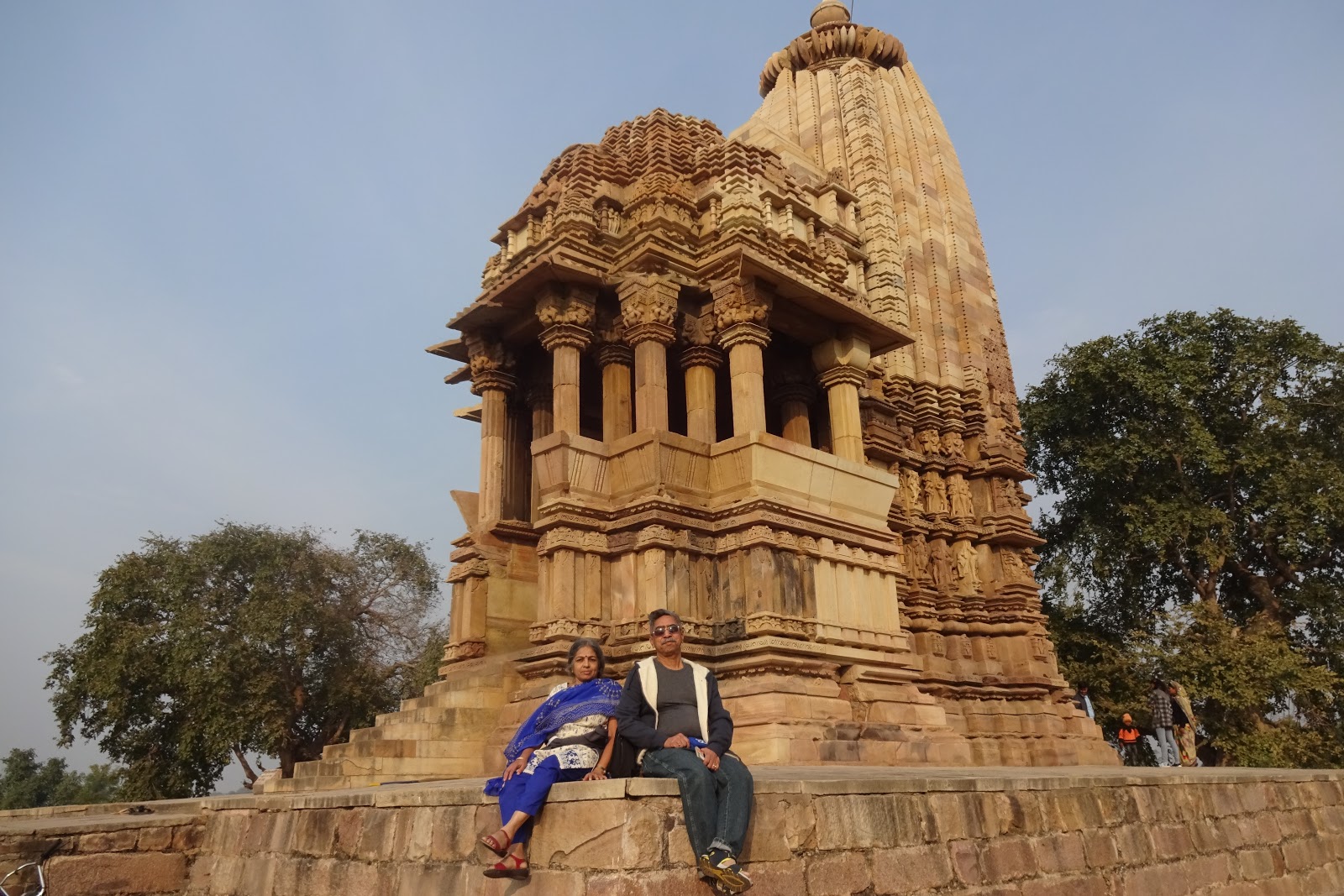
After we had dropped our baggage in the hotel and after we had a sumptuous north Indian Vaishnav lunch in a bhojanalay, Ramesh took us to a number of ancient temples – formally called the Eastern Group of temples and Southern Group of temples - like Chaturbhuja temple, Dulha Dev temple, a group of three Jain temples – Shantinath, Parshwanath, and Adinath – Javari temple, Ghantai temple, and Vamana temple. 
Chaturbhuja Temple
Chaturbhuja Temple

Delha Dev Temple

Shiv linga with thousand lingas on it
Jain Temples

Jain Temples
Vamana Temple

Jain Temples
Ghantai Temple
During the Light and Sound show

All these temples are located outside the little town, in remote locations. All these temples are protected and maintained as ancient World Heritage structures by the ASI. In almost all the temples, many of the sculptures had been disfigured during the military expeditions of Islamic invaders. All of them had exquisite carvings and magnificent temple towers, but all looked similar representing the architecture style of early 2nd millennium during the rule of Chandela kings. There was no worship or pooja in any of these temples.

There were very few visitors in all these temples. One could spend any amount of time in each of these temples according to one’s taste and availability of time. All these temples were maintained very neat and clean. During our visit, Ramesh also took us to one of the handloom showrooms who had displayed exquisitely colored sarees made of bamboo fibres, a popular favorite of many tourists to Khajuraho.

As it became dark at around 6 in the evening, we were dropped in the hotel for rest. There was a light and sound show (Sun-et-lumiere) in front of the Western Group of temples. The tickets were priced at Rs.250. We bought the tickets for the show. However, the whole show appeared a damp squib, at least to me.

In the early next morning, we started off by walk to the Western Group of temples, which was less than about 200 meters from our hotel. Mist and fog had covered the entire open space in front of these temples. Melodious ‘Rudram-Chamakam’ and other divine chanting went on over the loud speaker, and it reverberated in the whole little town and market place, creating a kind of electrifying and exalted feelings. We first had the darshan of Sri Shankar Bhagawan in the Mahadev Temple. Here, regular poojas go on to a massive Shiv Ling.

After that, we visited all the Western Group temples – Lakshmi temple, Varaha temple, Lakshmana temple, Parvati temple, Nandi temple, Viswanath temple, Kandaria Mahadev temple, Jagadambi temple, and Chitragupta temple. There are no worshipping in any of these temples. There was a moderate crowd of visitors in the early morning. This is where some of the world famous Kamasutra sculptures – tiny, small and big - can be found on the outer walls. I have no words to adequately describe the beauty of these temples for their architecture, very fine carvings, sculptures, the temple towers, their symmetry, and what not. You can look at some of the pictures I took and understand their beauty. These temples, I learn, were made of sand stones. Here too, a number of sculptures were disfigured, yet the overall structure has survived the Muslim invasion, and wear and tear and neglect over time.
Shankar Bhagawan

Western Temples

Western Temples

Varaha Temple

Minute carvings on the Varaha 

Sculptures on the wall

Sculptures on the walls

Sculptures on the wall

Sculptures on the walls

Erotica on the walls

Sculptures on the wall

Add caption

Add caption
There were folk dance shows and yoga-meditation classes that attracted a lot of foreign tourists.
Khajuraho is a ‘must-visit’ place for people who love to see ancient structures. I felt happy that a long time wish to visit this place got completed.

After our breakfast, Ramesh took us in his autorickshaw to Bhameeta, a place at around 12 kilometers distance from Khajuraho and put us in a bus that took us to Satna, for a paltry Rs.150. The bus looked a vintage model, yet ran very efficiently. The roads were superb, considering the difficult terrain. We passed through the famous Panna Tiger Sanctuary on our way. From Satna, we took the train to Jabalpur as we had reserved a ticket in the Varanasi – LTT Express.

For the popularity and fame of Khajuraho, the commuting to and from there could have been better; there is not much of a regular public transport to Khajuraho, excepting the trains reaching over there. For that matter, it appears that Madhya Pradesh government doesn’t seem to have a regular State Transport Corporation or Department to run public buses in most places in the State. After second thought, I felt that probably the government had been saving thousands of crores of rupees, year after year, by not running buses. However, no one seemed to complain about this.


My second report will be on Bheda Ghat Marble Rocks near Jabalpur and will appear in a day or so, after the New Year gaze and glaze had subsided. 

Please send your comments on Facebook or e-mail: neelkant16@yahoo.com

Saturday, December 30, 2017

30.12.2017 Introduction to my Madhya Pradesh Tour Report

A note of caution: Though I have written and published three books of short stories I am a novelist basically, and so, brevity is not known to me.


Probably, a tiny spark of desire to visit Madhya Pradesh got impregnated in my mind during 2015 while writing the 5th Volume of my book: I WANT TO KNOW ABOUT … INDIA, ITS STATES, AND IMPORTANT CITIES, which concerned about the Central India, including Madhya Pradesh. While collecting information on Madhya Pradesh for the purpose of the book I stumped upon some information about, among other places, Bhimbedka, in MP, where some 10000 years-old human paintings have still survived under the rock shelters. The desire must have been lying dormant for long until quite suddenly, during November, it grew into gigantic proportions. Fortunately, for me, whenever I am in India, the second half of December is always a dull period, with no activity, due to all round closure of schools and colleges.

In my house, I represent the kinetic energy, wanting action, movement, and commotion, and my wife stands for potential energy, wanting stability, balance, and peace. While I wanted to make the tour to Madhya Pradesh she wasn’t that keen. But, as it always happened, she gave in to my emotional blackmailing and agreed for the tour. Not that she doesn’t like sightseeing, but she has recently developed a habit of concerning more and more about health – present and presumed. So, my gratitude goes to her for agreeing to make the trip. God bless her.

Something similar had happened earlier too. Sometime in late 2013, I was reading Dan Brown’s INFERNO. As I read the extensive description about Florence and its various theocratic structures, suddenly I felt I must visit Italy, specifically, Florence. After some hard bargaining with my wife, we made a very happy trip to Italy during March 2014, and I felt fulfilled.

Coming back to our Madhya Pradesh tour, once we decided to make the tour, I started looking at places to visit. Madhya Pradesh is a very vast state, but thinly populated. I had visited several parts of the State during the early 1990s, as part of my official work, and I had noticed that several parts of the State were primitive in development and public conveniences. But I knew things have changed a lot over there since then.

We decided to limit ourselves to Khajuraho, Jabalpur, Ujjain, Indore, and Bhopal. Though it might look a bit convoluted, the crisscross journey across the State became inevitable as I insisted on visiting the Marble Rocks along the Narmadha River, near Jabalpur. And we were both happy that I insisted on passing through Jabalpur too. Our itinerary broadly fell like this:

Chennai to Bhopal (by train)
Bhopal to Khajuraho (by train)
Khajuraho to Satna (by local public transport) and from Satna to Jabalpur (by train)
Jabalpur to Ujjain (by train)
Ujjain to Indore (by public transport)
Indore to Mahabaleshwar and Mandu (by public transport)
Indore to Bhopal (by public transport)
Bhopal to Sanchi, Udaygiri, Bhojpur, and Bhimbedka by a hired taxi
Bhopal to Chennai (by train)

Taxi was a convenient option everywhere, but we decided to use public transport wherever possible. And it was not inconvenient.

We left from Tenkasi on 16th December evening and returned back on 29th morning. All hotels were booked through the internet through either MakeMyTrip.com or Bookings.com or Goibobo.com. The hotels we booked were decent, centrally located, easily accessible, comfortable, and quite economical. For me, the internet is almost a demi-God. Grants you anything you want!

The trip was quite hectic as we were constantly on the move. Yet, we enjoyed the whole trip. We enjoyed decent north Indian food everywhere. Adharak ka chai was uniformly great everywhere. Fortunately for us, there were no hiccups anywhere during our trip. All meticulously planned and realized.

My overall impressions about Madhya Pradesh can be summarized as follows:
     1.      Most places were very neat and clean. ‘Swachh Bharat’ advertisements were there on every wall at many places. We could see public toilets everywhere. Very commendable. Proper roads have been developed in all the places we visited. The people were very simple and helpful.
       2.      The people in the rural areas appeared genuinely poor. One could see large groups of people traveling with headloads of what, I don’t know, everywhere. Incidentally, Madhya Pradesh has the largest percentage of Adhivasis (Tribal people), who were illiterate or only semi-literate, and very innocent. We passed through several small villages during the trip.
       3.      On casual conversation with fellow travelers while traveling and a few public, we got the impression that the day to day State administration is as inefficient and corrupt as any other State.
       4.      The weather was cool during the night, but the days were quite warm or hot.


Await a couple of more reports on the details of the places we visited and our impressions about them.

Wednesday, December 13, 2017

14.12.17 - இன்றைய சிந்தனை - கஷ்டமும் நஷ்டமும்

14.12.17 இன்றய சிந்தனை

அவ்வப்பொழுது மகிழ்ச்சியான சம்பவங்கள் நடப்பதும் கஷ்ட நஷ்டங்கள் வருவதும் எல்லோருடைய வாழ்க்கையிலும் சகஜமாக நடப்பதுதான். 

ஒரு சில நல்ல காரியங்கள் நமக்கு நடக்கும் பொழுது நாம் யாரும் ‘இது ஏன் எனக்கு வந்து சேர்ந்தது?’ என்று பொதுவாகக் கேட்பதில்லை. எந்த விதத்தில் அதற்கு நாம் தகுதியானோம், அல்லது அதைப் பெற்று மகிழ்வதற்கு நாம் என்ன செய்தோம் என்று யோசிப்பதில்லை.

ஆனால், அதே சமயம் ஒரு பொருளை இழந்து விட்டாலோ – பல சமயம் அது ஒரு சிறிய அற்பப் பொருளாக இருந்தால் கூட – மிகவும் மனம் வருத்தப் படுகிறோம். சமயத்தில் ஒடிந்து போய் விடுகிறோம். பலரை குறை சொல்கிறோம். நம்மையே நொந்து கொள்கிறோம். ஏன், இறைவனிடத்தில் கூடக் குற்றம் காண்கிறோம்.

ஒரு பொருளை இழக்கும் பொழுது அது நம் கையை விட்டுப் போக வேண்டிய நேரம் வந்து விட்டது. அதனால், போய் விட்டது. விட்டுத் தொலைவோம் என்ற எண்ணம் பொதுவாக வருவதில்லை.

நான்கைந்து ஆண்டுகளுக்கு முன்பு பத்ரினாத் சென்றிருந்த சமயம் வரும் வழியில் ரிஷிகேசத்தில் ஒரு கடையில் விலை உயர்ந்த ஒருமுக ருத்ராட்சம் ஒன்று வாங்கினேன். அதை எப்பொழுதும் கழுத்தில் அணிந்திருந்தால் அதன் காந்த சக்தியால் பல நோய்கள் நம்மை அணுகாது என்ற நம்பிக்கை எனக்கு இருந்தது. அந்த ருத்ராட்சத்தின் தரத்துக்கு உத்திரவாதமும் அந்த கடைக்காரர் எழுத்து மூலம் கொடுத்திருந்தார்.

ஒரு சில நாட்களுக்கு முன்புதான் திடீரென்று நான் கவனித்தேன். என் கழுத்தில் தொங்கிக் கொண்டிருந்த கயிற்றில் கட்டிய வெள்ளிக் கம்பியிலிருந்து அந்த ருத்ராட்சம் எங்கோ விழுந்து விட்டிருக்கிறது. எப்பொழுது என்று தெரியவில்லை.  அதற்கு ஒன்றிரண்டு நாட்கள் முன்பு வரை அந்த ருத்ராட்சம் கழுத்தில் இருந்ததைப் பார்த்த ஞாபகம் இருந்தது. நான் வழக்கமாக கழட்டி வைக்கும் இடத்திலெல்லாம் தேடிப் பார்த்தேன். அந்த ஒன்றிரண்டு நாட்களுக்கு நான் சென்ற இடங்களிலெல்லாம் கேட்டுப் பார்த்தேன்.

எங்கும் கிடைக்கவில்லை.

திடீரென்று எனக்குத் தோன்றியது. பத்ரினாத்துக்குப் போகும் பொழுது ருத்ராட்சம் வாங்கி அணிய வேண்டும் என்று எந்த நினைப்பும் எனக்குத் தோன்றியதில்லை. எதேச்சையாக வாங்கியதுதான். நவரத்ன கற்கள் வாங்கலாம் என்ற எண்ணத்துடன் அந்தக் கடைக்குப் போன பொழுது சரியான நவரத்ன கல் எதுவும் எங்களுக்குக் கிடைக்காத பொழுது எதேச்சையாக ருத்ராட்சத்தை வாங்கினேன்.

அந்த ருத்ராட்சம் எனக்கு வர வேண்டிய வேளை… வந்தது.

இப்பொழுது என்னை விட்டுப் போக வேண்டிய வேளை. ..போய் விட்டது.
அது என் கழுத்தில் இருக்கும் வரை எனக்கு என்ன நன்மை செய்ய முடியுமோ அதைச் செய்தது. அதனுடன் நான் பிறக்கவில்லை. அதனுடன் நான் போகப் போவதுமில்லை.

இடையில் வந்தது. இடையில் போய் விட்டது. ஒரு ரயில் பயண நண்பர் போல.
‘விடு’ என்று விட்டு விட்டேன். இப்பொழுது மனதில் எந்த சலனமுமில்லை. எந்த சங்கடமுமில்லை.

கடந்த சில வருடங்களில் இது போல ஒரு சில நஷ்டங்களை – பெரியதும் சிறியதுமாக - நான் சந்தித்திருக்கிறேன். ஒவ்வொரு முறையும் ஏனோ எனக்கு இதே போல எண்ணங்கள்தான் வந்திருக்கின்றன. பெரிய மன வருத்தம் எதுவும் என்னிடம் தங்கவில்லை. இறைவனுக்கு நன்றி.


(காஞ்சிப் பெரியவருடன் ஒருவருக்கு நேர்ந்த அனுபவத்தைப் பற்றி இன்று முகநூலில் ஒருவர் எழுதியதைப் படித்ததன் தாக்கம் இந்தப் பதிவு.)