Total Pageviews

Sunday, July 28, 2013

Alaska – Our Visit during July, 2013 - Part III

Tuesday, the 16th July:

Seward is situated at the head of Resurrection Bay on the Kenai Peninsula and is known as the ‘Gateway to Kenai Fjords National Park.” Seward is a picturesque town with a bustling harbor. The Seward highway connecting Anchorage with Seward has been named an All-American Road, which is the highest designation of a National Scenic Byway.

In the morning, Sanjay and I left for the riverside. It was just opposite to our hotel. Actually, we wanted to get into the river to play in water, but there was no secure arrangement and so Sanjay for disappointed.


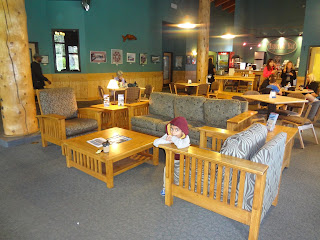
We returned back after taking pictures and spending some time in the spectacular restaurant located near the front desk at the hotel.

Meanwhile, Viji had prepared some delicious ‘rajma’ and rice for our lunch. We had cereals for our breakfast. We left our hotel to reach the visitor centre for Exit glacier and after collecting necessary information brochure, we began our hike.
We managed Sahana in the stroller for some distance, but the smooth pavement ended soon and we had to hike carrying Sanjay, Sahana and the stroller, through rough uneven rocky route. We shed weight by discarding the stroller to one corner on the way. Viji carried Sahana on her back, and I carried Sanjay on my back. We quickly moved forward. We stopped near a small bridge on the way to take some rest before we hiked further. It became colder and colder as we went closer and closer to the glacier. There was strong, chilly wind blowing in our direction. We reached the penultimate view point before the glacier and from there we had wonderful view of the valley down and the glacier up the hill. Sanjay and I went further up to the final view point that was very close to the glacier. It was freezing cold there and worsened by cold winds. The glacier looked beautiful in semi-bluish in color and at the same time very scary too.


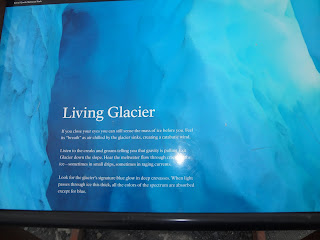
An information board kept there, revealed that the glacier had been receding or shortening in its length over years, probably indicating global warming.


While returning back to the visitor centre, some visitors whom we met on the way reported that they spotted a bear in the woods area and they cautioned us to go carefully. However, we saw no bear and we were back safely at the visitor center. While we were looking at a few souvenirs displayed for sale, Sanjay attempted some puzzle in a book gifted to him by the Ranger staff in the visitor center. For successfully completing the puzzle, Sanjay was presented with a Forest Junior Ranger Badge and was administered the Junior Forest Ranger’s pledge. It was funny watching Sanjay taking the pledge without opening his mouth. But he was visibly proud that he had received the Badge. We went back to the hotel for our lunch.

In the evening, we left for the bay area. Sanjay and Sahana played for sometime in a park and we didn’t have much activity to do except watching the bay and the moving, small ships and speed-boats.
Suddenly, Viji had an idea. She suggested that we could drive up to Cooper Landing on the Seward highway to see Kenai River and Kenai Lake. It was a 47 miles drive on the way to Anchorage.

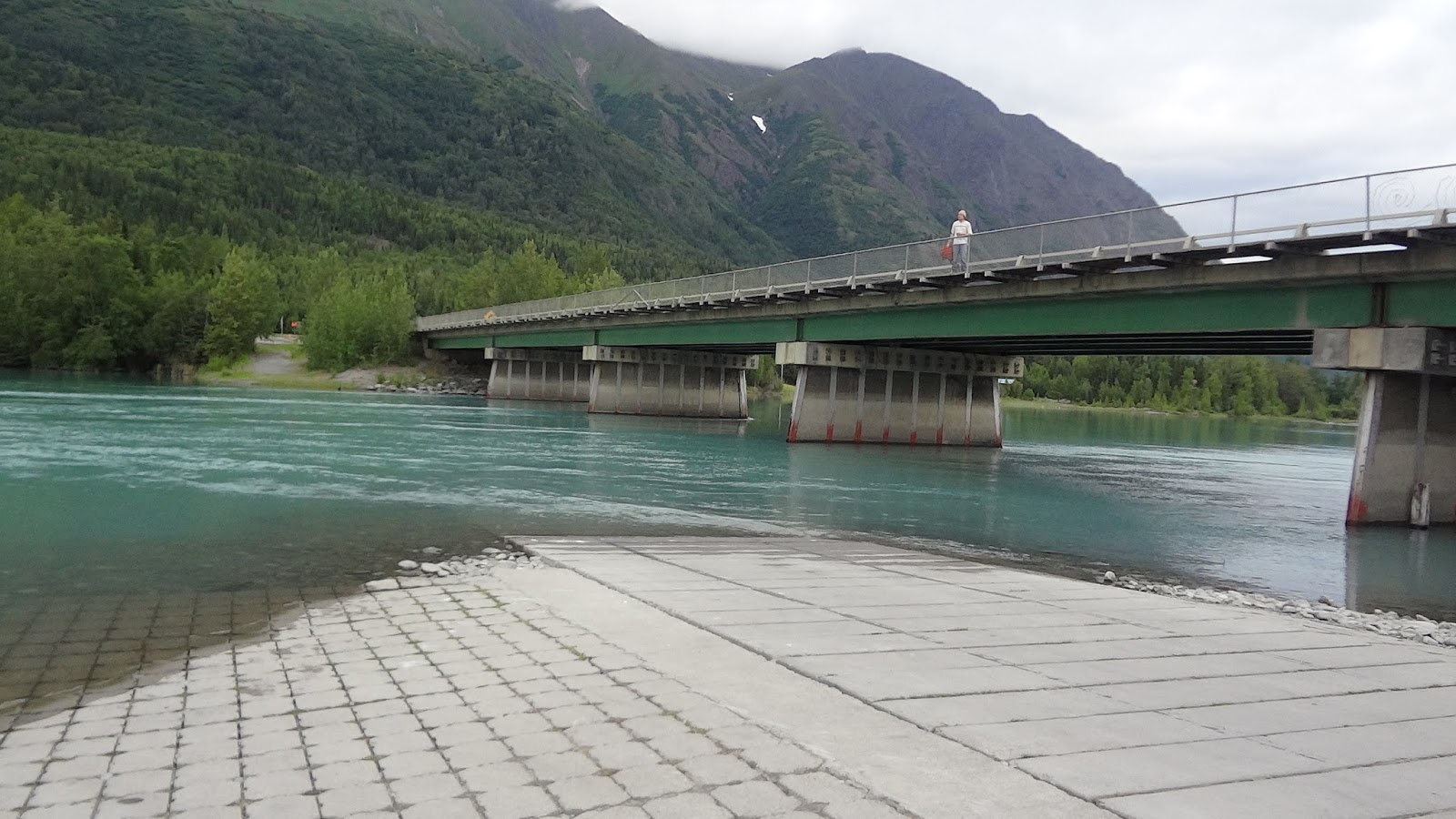
It was late in the evening when we reached the quiet Kenai Lake. The lake was desolated, but for a lady and her small child. The lady patiently watched her two-year-old son playing with pebbles near the water. She carried a gun on her belt and that scared us. But she was nice, she lived there and she gave us very useful information about the place. On her suggestion we drove a little up on the main road to reach a bridge across the Kenai River from where we could get excellent view. The river and its blue water with the backdrop of the hill offered scintillating view. It was past 8.00 PM and someone was just beginning his lonely river-rafting. He must be a daredevil, we thought.


After taking several pictures, we returned back to our hotel, had our dinner and went to sleep.

The hotel we stayed was located in a beautiful, spacious campus with plenty of trees, flowers and plants.


..................... continued in Part IV
   

Thursday, July 25, 2013

Alaska - Our visit during July, 2013 - Part II

Part II
Sunday, the 14th July:
We spent our forenoon at the Science Centre at Anchorage. The children enjoyed the several scientific exhibits playfully. Sanjay and Balaji went for a ‘dinosaur show’ while we went for ‘Northern lights’ show in the planetarium theatre.
Alaska is known for the Northern Lights – Aurora, a strange phenomenon of a natural display in the sky particularly in the high latitude (Arctic and Antarctic) regions, caused by the collisions of energized charged particles with atoms in the high altitude atmosphere (thermosphere).


We also went around the Science Centre looking at various exhibits about life in Alaska, its history and heritage and later developments.


In the evening we went for buying souvenirs from a gift-store. Later, we walked along the Downtown hoping to catch the entry to the walking/biking/hiking trail along the bay, but we couldn’t locate it. And so, we spent our time in a few parks, the children enjoying their park time more than our planned hike.
Monday, the 15th July:
We vacated from our hotel after our breakfast and headed towards Seward. We took the same scenic Seward highway along the Turnagain Arm.

On the way, we stopped for hiking to Flattop Mountain. This is a 3510 feet high mountain forming part of Chugach State Park, with an elevation of 1280 feet from the parking lot. It was generally cloudy and misty around the mountains. There are several levels to climb on this mountain. One could walk or bike.


We could view Anchorage from the first level. We went up to the second level too. Lakshmi and Sahana stayed back. We couldn’t try to hike to third and further levels for want of time. Besides, Sanjay started complaining about his hurting legs. After all, he was just four years old.
From the Flattop Mountain, we drove further on the Seward highway and on the way we stopped to view a small waterfall. We drove all the way to the end of Turnagain Arm and then to the other side of the Arm and then towards South to reach Seward. The drive on the other side of Turnagain Arm was really very scenic with mountains, rivers, and lakes. Two of the important places we passed through were:

·        Moose Pass situated on the shores of Upper Trail Lake 30 miles outside of Seward. Iditarod trail begins here and was used to transport gold and supplies. There is abundance of moose in the area and prompted the name for the place.

·        Cooper Landing, considered as the ‘Gem of the Kenai Peninsula’, ‘a Emerald’ in summer and ‘a Diamond’ in the Winter, is one of the finest, most diverse outdoor recreation area Alaska has to offer. Conveniently located in the middle of the Kenai Peninsula, nestled in the majestic Kenai Mountains along the beautiful turquoise waters of Kenai Lake and the upper Kenai River. These waters are uniquely tinted blue-green by suspended ultra-fine glacial silt. Fishing, rafting, hiking, sightseeing, horseback riding, mountain biking, sea kayaking, and gold panning are popular activities of the place.


We reached Seward in the evening. Our stay was arranged at Windsong Hotel on the banks of the Resurrection River. The view of the distant mountains, some of them snow-capped, from the banks of the river was mesmerizing.

                                                                                                                          ………………..Continued in Part III

Alaska: Our visit during July, 2013


Introduction
I love travelling and visiting places. To visit Alaska was one of my lifetime dreams. I dream a lot and aspire a lot. Obviously, I still have many more dreams to be realized. I am a regular visitor to U.S. during the last little more than a decade and for one reason or other, a trip to Alaska was eluding me every time. Finally, it materialized this year during July. We discussed a number of destinations in Alaska, debated between the sea route by a cruise from Seattle and the air route by a flight, the number of days required and the places to be visited etc. We decided upon Anchorage as our destination. We started planning for the trip since March/April. We had most of the arrangements done over the Internet before leaving for Alaska.   

On 12th July afternoon, while Lakshmi, my wife and I left from Chicago for Alska, Balaji, my son-in-law and Viji along with their children, Sanjay and Sahana, left from Phoenix around the same time the same day. We changed flight at Seattle, Washington after a four-hour wait while they changed flight at Portland, Oregon. We all reached Anchorage almost around the same time at 9.30 in the night. When we came out of the airport, we were pleasantly surprised that it was bright and sunny and looked like broad daylight. Sun doesn’t really seem to set during peak summer in Alaska. In Alaska, they usually have long days lasting almost 20 hours during summer and in winter, it is the reverse – just a couple of hours. It took long for me to understand that for earth, with its spheroid shape and axial tilt, its northern hemisphere is exposed to Sun for most part of the day and night and thus the days are very long during summer and the reverse during winter.

Alaska is situated in northwest extreme corner of North American continent sharing its international boundary with Russia to the West, only separated by the Arctic and Pacific Ocean, and Canada to the east. It is the largest state in United States by area, but the 4th least densely populated of all the States. I understand that nearly half of Alaska’s residents live around Anchorage region. Oil and Natural Gas exploration and Fishing are the major industries, supporting the economy of Alaska. Alaska originally belonged to Russia and was purchased over from them on March 30, 1867 for $7.2 M. It became the 49th state of the U.S. on January 3, 1959. In their native language, it is known as Alyeska, “the great land.”
 Saturday, the 13th July:

Marriot Residence Inn, where we stayed, was an excellent place and offered fabulous breakfast in the morning. We had hired a mini-van. Viji and Balaji had brought their two car seats from Phoenix for the children. Carrying the car seats everywhere, when one travels with the kids within U.S is one of the annoying factors, but something that one will have to live with. They also brought a frying pan and rice-cooker. We made some grocery purchases locally and cooked our own food in the hotel room. That was our routine on almost all days during our stay in Alaska. Getting decent vegetarian food could be very difficult in Alaska. So, cooking our own South Indian food, kept all of us free from any possible stomach trouble.
This day, we had planned to explore scenic places around Anchorage. Our first destination was to be Alyeska Mountain resort. Balaji took the steering with Viji sitting by his side in the front, for helping with directions. They had their GPS in place, but as we had seen in a few other places too, the printed maps provided by the local Tourist Information Centers were very much helpful in some interior places.

Cook Inlet stretches 180 miles from Gulf of Alaska up to Anchorage which looks surrounded by the two arms of Cook Inlet – Knik Arm on northern side and Turnagain Arm on the southern side. Just south of Anchorage, the Seward Highway hugs the dramatic shorelines of Turnagain Arm, arguably one of the most beautiful stretches of highway in America. Chugach State Park's 3000-feet mountains jut up on our left. Alyeska Mountain was 2500 feet high. We drove through this 41 miles long, scenic, four-lane Seward highway along the Turnagain Arm.
At night, I am told, the sprawling, sometimes four-mile-wide flats of Turnagain Arm seem to stretch like a plain to the opposite shores of Cook Inlet, where mammoth sloping mountains abruptly stop their flat expanse. Each turn during this drive revealed another scenic wonder.

Turnagain Arm is one of only about 60 bodies of water worldwide to exhibit a tidal bore, a tidal phenomenon in which the leading edge of the incoming tide forms a wave or waves of water that travels up a river or a narrow bay against the directions of the river or the bay’s current. Turnagain Arm sees the largest tidal range in U.S. with a mean of 30 feet, and the fourth highest in the world. The ocean’s natural 12-hour 25-minute tidal cycle is close to Turnagain Arm’s natural resonance frequency, which then reinforces the tide similar to water sloshing in a bathtub. That day, if we had waited till 10.30 PM in the night, we could have seen this very unique tidal bore phenomenon. Because of the children, we couldn’t afford to come back to Turnagain Arm to witness this.
We then reached the base station for going up the 2750 feet high Alyeska Mountain to reach the ski resort through a closed rope car. Mount Alyeska was part of the larger Chugach mountain range and the Alyeska resort is the largest ski area in the region. When we reached the base station, the first to welcome us was a swamp of mosquitoes. Yes, mosquitoes in America. Travel advisory strongly recommended carrying mosquito repellants while one travels to Alaska. We bought our tickets, got into the rope car and reached the ski station at the top, viewing on the way the scenic beauty around the hills and the valley down below. There we met a just-married couple – An African-American and a White lady at the Ski Station and took pictures with them.

The areas around the entrance to the ski resort were flat closer to the station, sloping up and down in different directions. They offered excellent opportunities to hike. Patches of snow were scattered here and there. The view was very good. We walked around, took lot of pictures, and played in the slippery snow.


We returned back to the base station and drove to Anchorage stopping over at several scenic places to take pictures of the Turnagain Arm Inlet.


We prepared dinner at the hotel room and went to sleep.

                                                                                                                        ……. To be continued in PART II

Wednesday, July 24, 2013

Free e-reading of my short story book


My first book: Short Stories for Young Readers – Book 1 is available for free e-reading on Amazon.com during the coming 27th to 29th July, 2013. I exhort you all to read, enjoy and comment on my book.

T N Neelakantan


Author: Short Stories for Young Readers – Book 1

               Short Stories for Success for Young Readers

Thursday, July 04, 2013

Short Stories for Success for Young Readers: A New Lexicon Unfolded


PROLOGUE

The school bell just rang and the children of class V enthusiastically awaited Kamala Teacher. She had joined this school only a couple of months ago, but became everyone’s favorite instantly. She was a master dramatist and a fabulous story teller. The students loved her for her stories. The children laughed, cried, shouted, booed, and mimicked along with her as she told stories. Her presence electrified her every class.

As Kamala teacher entered, the whole class rose in respect greeting her in chorus ‘Namaste Teacher!’

Kamala teacher was charming, immaculately dressed, quite tall and walked elegantly. Her voice was mesmerizing and looks penetrating. One could always notice the pleasing smile on her face. She measured her words when she spoke, but they flowed naturally and spontaneously. She loved and respected every student and the children reciprocated her bountifully.

“Good Morning Children! How do you all do today?”

“Excellent! Teacher!’ the reply came again in chorus.

“Do you all believe learning History is very important?”

The children nodded in agreement.

“Can you tell me why History is important?”

Many raised their hands ready to answer. Kamala Teacher pointed her fingers to Sharada who rose to answer. “History is full of stories of people and their experiences. We can learn a lot from their experiences.”

“Absolutely! Learning from the experience of our ancestors and elders is a smarter way to happiness and success than waiting to learn from our own experience.” Kamala teacher paused and then continued. “History is full of people who took great strides in life. It is also full of people who had failed miserably. Their life experiences are great lessons to all of us.”

“Now, I want every one of you to name one quality or a trait that you think can bring success and happiness to us. Then we will try to relate some stories from our history or mythology or from our folk tales for better understanding. What do you all think?”

Every student rose and contributed to a large pool of attributes that they thought important for success and happiness. Sometimes, Kamala Teacher had to prompt them and seek more clarifications. Finally she listed a number of attributes that they all agreed would bring success and happiness. A new lexicon was given birth to in the class.

A for Attitude                                             

B for Beliefs

C for Choice                                                                                    

D for Determination

E for Empathy                                                                                 

F for Faith

G for Gratitude                                                                              

H for Habit

I for Integrity                                                                                  

J for Judgment

K for Knowledge                                                                            

L for Leadership

M for Magnanimity                                                                      

N for Nobility

O for Optimism     

P for Perseverance

Q for Quest                                                                                     

R for Relationship

S for Sacrifice                                                                                 

T for Truthfulness

U for Unity  

V for Value and Victory

W for Wisdom                                                                                

X for eXtraordinary

Y for Young                                                                                     

Z for Zeal

“Excellent! This may not be an exhaustive list, but we have made a good beginning,” said Kamala teacher. And then she began her stories.

≡≡::≡≡


Monday, June 10, 2013

Short Story for Success for Young Readers: A New Lexicon Unfolded

Today is another eventful day for me.

My yet another book titled: Short Stories for Success for Young Readers: A New Lexicon Unfolded is digitally published through Amazon.com's Kindle Direct Publishing and is now available for buying under the following link. I thank everyone for their support for making this possible.
http://www.amazon.com/Stories-Success-Readers-Unfolded-ebook/dp/B00DB5LMLW/ref=sr_1_1?ie=UTF8&qid=1370908797&sr=8-1&keywords=short+stories+for+success+for+young+readers+t+n+neelakantan#_

Saturday, June 08, 2013

Short Stories for Success for Young Readers - A New Lexicon Unfolded by T N Neelakantan

What this book is about

Everyone deeply desires to succeed in their life. People succeed because of one or more of their unique character or trait or attribute. One’s personality makes a difference between success and failure. Character and personality form very early in one’s life. Most children pass into their adolescence and then into young adulthood carrying with them all those personality traits – good or bad, helpful or harmful – that they have formed very early in their life with very little awareness about them. They succeed or get stuck because of these personality traits.

We have a lot to learn from our elders and forefathers and thus from our history. Their life and what they did during their lifetime can be a good lesson to every one of us for our own future. Epics and folk tales were told by sages, seers and wise men to inculcate good character in people for them to be happy in their life.
This book contains 26 short stories - each representing one English alphabet and depicting a unique helpful character or a trait representing one alphabet. This book was inspired by the poem collections: “Aathichoodi” by the renowned Tamil female Poet of Southern India, Avvaiyar of Sangam period (3rd century B.C.E – 4th century C.E). In her great work Aathichoodi, Avvaiyar has coined one moralistic verse for each Tamil basic alphabet and most children of Tamil Nadu in India are familiar with Aathichoodi and the value of her teachings.

Thus 26 short stories from history, mythology and folk tales represent the following 26 character traits to help small children understand their value towards happiness, peace and success:
A for Attitude                                                                                             B for Beliefs

C for Choice                                                                                                 D for Determination
E for Empathy                                                                                             F for Faith

G for Gratitude                                                                                           H for Habit
I for Integrity                                                                                              J for Judgment

K for Knowledge                                                                                        L for Leadership

M for Magnanimity                                                                                   N for Nobility
O for Optimism                                                                                          P for Perseverance

Q for Quest                                                                                                 R for Relationship
S for Sacrifice                                                                                              T for Truthfulness

U for Unity                                                                                                  V for Value and Victory
W for Wisdom                                                                                             X for eXtraordinary

Y for Young                                                                                                  Z for Zeal

Friday, May 24, 2013

Remembering my initial bachelor days in New Delhi

23rd May 2013

After some good rains in the suburbs of Chicago, the weather was cool in the evening. I was on my usual walk under the shades of tall lined-up trees – maple, fur, pine, oak and many more - along many boulevards and avenues. My MP3 player, my usual walking companion was on. Today was R D Burman day for me. And then a popular song by Kishore and Lata from the old movie ‘Heera Panna’ – ‘Panna ki thamanna hai ki heera mujhe mil jaaye’ – came on. It used to be one of favorites. The song suddenly triggered lovely memories of my early bachelor days in New Delhi during 1972 and I was instantly transported to my past world.

*****

‘Hey, how are you here on this train?’ my friend Appu (all names in this article have been changed) jolted me from my slumber. We were together in the college for 6 years as students and lab assistants, albeit in different disciplines.  

It was early March 1972. We were on the legendary GT Express from Madras to New Delhi – the only express train those days to connect the two cities. I was on transfer from Madras to New Delhi on my job and was one of the countable few in our small circle to travel out of Madras those days.

My friend Moorthy was expected to receive me in the New Delhi railway station and my accommodation was to be arranged in Ramanuja Mess in Karol Bagh – a popular destination for most single Madrasis reaching New Delhi. Appu had no such arrangement and he was open to ideas. He was joining the Central Government as a Class I officer. Ramanuja mess was full, but the manager there was accommodative. I was only too happy to accommodate Appu, a known ready company in my room in the new place. The rent was just eighty rupees or so for a bed. No boarding, only lodging - three or four in a room, depending on the size of the room.

The same day evening, we took a walk to Connought Place from Karol Bagh. Both of us had very little knowledge of direction or Hindi. As we were half way through Panchkuin road, we were stunned by the spectacular view of the water fountain illuminated by multicolored focus lights in the centre of Connought Circle, even from a distance. What a great sight! We were very impressed with Delhi. After roaming around the fountain for some time, we returned via Gole Market where for the first time in our life we had sweet ‘lassi’ sprinkled with rose water served in a tall glass.

We were to attend office the next day. On my friend’s advice, we finished our bath very early in the morning to avoid crowding from other office-going inmates. Bathrooms and toilets were common and it was still chill in the morning. When we were ready, Moorthi dropped in and took us to Vaidyanatha Iyer Mess – another popular destination for vegetarian Madrasis. Fifty five rupees or so for two meals a day for a month – lunch in the morning and dinner at night. New Delhi was very cheap those days. This was raised to about eighty rupees or so in the next few months; quite a steep unprecedented increase.

After we had our lunch cum breakfast, we reached the junction of Ajmal Khan Road and Arya Samaj Road. Appu was directed to a nearby bus stop, while Moorthi and I waited for the legendary ‘fat-fatti’ – the masterly improvised motorcycle with a carrier for four people at the back. They plied on fixed routes - Karol Bagh – Connought Circus sector was one such sector. Fare – if I remember right – just a rupee.

Thus began our life in New Delhi.

In the evening, Appu brought Gopi who was another bachelor engineer in the Central Government. Gopi stayed in one of the nearby annexes to Ramanuja Mess. Gopi instantly turned himself as our first ‘guru’ for ‘Life in Delhi’.

‘You need to learn a few essential words in Hindi, if you want to survive here,’ he told. And he started with his first lesson, ‘bha…….tt’ – a crude equivalent of the sacred four-letter English word ‘f…….’ ‘Be serious, learn this first… and there are many more you need to learn,’ he frightened us. I was rattled.

That night he took us to the Lovely Milk Shop in Ajmal Khan Road after we feasted our eyes around the roadside shops and the giggling young Punjabi girls. ‘Don’t ever go near them. You will become a villain. They all have their bodyguard boy friends who wouldn’t hesitate to show you their knives,’ Gopi cautioned us. Very sensible suggestion, I remembered that throughout my stay. Just look around and enjoy – that is all.

The next day, in the afternoon, Mani Iyer brought idli, dosai, oottappam with sambhar. He is ‘aasthaana’ supplier for lunch every afternoon and a kind of savior for many vegetarian Madrasis at office. (Anyone south of Vindhya hills was just a ‘Madrasi’.) The food was monotonous, but was a safe bet for sensitive stomachs. No harm done.

Almost around the same time, many more from South joined our office in New Delhi and a few more squeezed themselves in Ramanuja Mess. So now we were a bigger ‘Madrasis’ gang.

That weekend, we all went to ‘Malai Mandir’ in Ramakrishnapuram and that became our routine on almost all weekends. A ride by the red colored double-decker bus was fascinating. In the evening, it was beer party time – religious awakening to ‘spirit’ual awakening. Liquor was a restricted commodity. There was one shop close by in Arya Samaj Road and one of us would procure it in turn.

I was assigned to a desk which no one voluntarily sought – a tough stressful job requiring long hours of work. Most days, I and another colleague along with the branch second-in-charge used to be the last among fifty and odd people to leave the office after locking it away.

One afternoon during my first week in the office, our senior colleague – Mr.Raju, who eventually became my mentor at work – took us to a small eating place behind Regal Cinema, where for the first time I came to know about ‘Chole Bhatura’ that continues to be my favorite North Indian food even today. On our way back to office, I bought a glass of ‘machine-ka-tanda-paani’ to drink for just five paise. Delhi was popular for ‘machine-ka-tanda-paani’ those days. But the water was clean. For the first time, I came to know about ‘gole-gappa’, ‘faludha’, ‘kulfi’ ‘gajar halwa’ and many more.

Sunday morning, Unni, another colleague took me to the Panickar hotel nearby and for the first time I had mouth-watering ‘puttu and kadalai’ - a favorite Keralite food for me even today. Moorthi dashed in suddenly, ‘Hey! There is a Tamil movie in the morning show at Sheila theatre in Pahar Ganj. Would you like to go?’ I don’t remember the name of the movie now, but we went. As an ardent movie lover, I became a regular visitor to Naaz, Odeon, Plaza, Regal theatres to watch Hindi movies. We still relied on Radio Ceylon for Tamil songs.

Whenever I felt tired of Vaidyanatha Iyer mess, I frequented other places – Easwaran mess, Mysore café, Raasans, Madras Hotel in Connought Circle, Indian Coffee House at Maan Singh Palace and in the central Connought Circus.

Whenever I was mentally disturbed, Irwin Road Pillayar temple in Connought Place provided the much needed solace and comfort.

At Ramanuja mess, there was one inmate Mr.Bharathi who taught me the nitty-gritty of Chess game. The World Chess Championship Tournament was on when in the end Bobby Fisher snatched the championship from the Russian Boris Spassky. We had another elderly inmate. And he had the peculiar trait of picking up an argument with anyone at anytime and it eventually ended up in a near fist fight all the time; even I didn’t escape this from him during our very first introduction itself. For that matter, even Appu and I, though we were thick friends, picked up heated arguments quite easily almost every day for something or other challenging and swearing upon each other.

Towards the end of the third month after reaching New Delhi, I was transferred from the Connought Place office to another office at Pahar Ganj with additional responsibilities. The funny part was that I knew very little Hindi and my customers there spoke and wrote a lot of Urdu and Hindi making my job unenviable. I relied upon sign languages in dealing with them and they were quite friendly, understanding and appreciative of my services to them. But the greatest challenge was the lunch in the afternoon. Having been so much used to South Indian food all along, I needed to satisfy myself only with ‘tandoori roti’ and ‘subzi’. A sardarji colleague used to take me to a few small cramped restaurants inside some of the narrow ‘gali’s in Pahar Ganj. I struggled with ‘roti and subzi’ initially, but soon started loving them so much that today I am more comfortable with ‘roti and subzi’ than rice and ‘sambhar.’

I was so naïve that many things were first for me in Delhi. But life moved on throwing in more and more bizarre environments and challenges even as it provided a great amount of variety, entertainment, friendship, rich food, and new relationships.

One thing, of course, never changed: longing to be with parents, family and the loved ones back home.

Monday, May 13, 2013

O Spring!

Chicago is one place where one can distinctly notice all the four seasons. Come March/April/May there is Tulip flower everywhere. Trees that have shed all their leaves to preserve themselves during Winter once again start greening. You find different colors even. It was an exquisite sight to see different colors during early May 2013. I share some of the pictures I took.


http://facebook.com/NeelakantanTN

Monday, May 06, 2013

Height of Human Spirit: “127 Hours” Movie from British Director Danny Boyle

Summary:

I happened to watch an amazing movie “127 hours” inspired by the true life experience Aron Ralston, (born October 27, 1975) an American outdoorsman, engineer and motivational speaker.

Aron Ralston is very widely known for having survived a canyonneering accident in south-eastern Utah in 2003, during which he amputated his own right arm with a dull multi-tool in order to free himself from a dislodged boulder, which had trapped him there for five days and seven hours. After he freed himself, he had to rappel down a 65 foot (around 20m) sheer cliff face to reach safety. The incident is documented in Ralston's autobiography ‘Between a Rock and a Hard Place’ and is the subject of the film ‘127 Hours.’

My observation and comment:

Most of us have very limited idea about our own potential and strengths. History is full of incidents of people who had displayed extraordinary spirit to show what humans are capable of achieving raising themselves to ‘God-like’ stature in the process. It is we who limit ourselves and become contended with our limited achievements.

The attitude, “Yes, we can!” needs to be encouraged from childhood. We need to encourage our children to explore and test their own strength. In our own anxiety and love for the children, we tend to be highly protective and discourage them from stretching themselves beyond some comfort zone. A right balance in parents’ approach could probably help many children explore newer areas, discover, and make great strides in their lives.

I was fortunate to watch the movie on ‘blue-ray’. The amazing photography of the canyons in Utach is very thrilling, captivating, absorbing and scaring too. The scene relating to Ralston and the two girls wantonly sliding along the rock through the narrow canyon into a deep blue pool really churned my stomach. The scene relating to Ralston amputating his own right arm is something only mentally strong people can watch. The music score by A R Rahman towards the end of the movie is a class only class musicians like A R Rahman can produce.

The Accident:

On April 26, 2003, Aron Ralston was hiking through Blue John Canyon, in eastern Wayne County, Utah, just south of the Horseshoe Canyon unit of Canyonlands National Park. While he was descending a slot canyon, a suspended boulder he was climbing down became dislodged, crushing his right hand and pinning it against the canyon wall. Ralston had not informed anybody of his hiking plans, thus no one would be searching for him.

Assuming that he would die, he spent five days slowly sipping his small amount of remaining water, approximately 350 ml and slowly eating his small amount of food, two burritos, while trying to extricate his arm. His efforts were futile as he could not free his arm from the 800 lb (360 kg) chock-stone. After three days of trying to lift and break the boulder, the dehydrated and delirious Ralston prepared to amputate his trapped right arm at a point on the mid-forearm, in order to escape. He experimented with tourniquets and made some exploratory superficial cuts to his forearm in the first few days. On the fourth day he realized that in order to free his arm he would have to cut through the bones in it, but the tools he had available were insufficient to do so.

When he ran out of food and water on the fifth day, he was forced to drink his own urine. He carved his name, date of birth and presumed date of death into the sandstone canyon wall, and videotaped his last goodbyes to his family. He did not expect to survive the night.

After waking at dawn the following day (Thursday, May 1) he had an epiphany that he could break his radius and ulna bones using torque against his trapped arm. He did so and then performed the amputation, which took about one hour with his multi-tool, which included a dull two-inch knife. He never named the manufacturer of the tool he used, other than to say it was not a Leatherman but "what you'd get if you bought a $15 flashlight and got a free multi-use tool".

After freeing himself, Ralston still had to get back to his car. He climbed out of the slot canyon in which he had been trapped, rappelled down a 65-foot (20 m) sheer wall one-handed and then hiked out of the canyon in the hot midday sun. He was 8 miles from his vehicle, and had no phone. However, while hiking out, he encountered a family on vacation from the Netherlands, Eric and Monique Meijer and their son Andy, who gave him food and water and then hurried to alert the authorities. Ralston had feared he would bleed to death; he lost 40 pounds, including 25% of his blood volume. Fortunately, the rescuers searching for Ralston, alerted by his family that he was missing, had narrowed the search down to Canyonlands and flew by in their helicopter. He was rescued six hours after amputating his arm.

Ralston has said that if he had amputated his arm earlier, he would have bled to death before being found, while if he had not done it he would have been found dead in the slot canyon days later. He believed he was looking forward to the amputation and the freedom it would give.

Later, his severed hand and forearm was retrieved from under the boulder by park authorities. According to television presenter Tom Brokaw, it took 13 men, a winch and a hydraulic jack to move the boulder so that Ralston's arm could be removed. It was then cremated and the ashes given to Ralston. He returned to the accident scene with Brokaw and a camera crew six months later on his 28th birthday to film a Dateline NBC special about the accident and to scatter the ashes of his arm where he says they belong.

Post Accident Feat:

After the accident happened, Ralston continued to climb mountains frequently, including participating in a 2008 expedition to climb Ojos del Salado in Chile and Monte Pissis in Argentina. In 2005, Ralston became the first person to climb all 59 ranked and/or named Colarado’s fourteeners’ solo in winter, a project he started in 1997 and resumed after the amputation in Blue John Canyon.

While Ralston says he intends to climb Mount Everest, he did not go along with polar explorer Eric Larsen on his "Save the Poles" expedition in 2010, as was previously reported.

Ralston’s background

Ralston was born on October 27, 1975, in Marion, Ohio. He and his family moved to Denver when he was age 11. He received his college degree from Carnegie Mellon University in Pittsburg, finishing with degrees in mechanical engineering and French, with a minor in piano. At Carnegie Mellon, he served as a resident assistant, studied abroad, and was an active intramural sports participant. He left his job as a mechanical engineer with Intel in Phoenix, Arizona, in 2002 and moved to Aspen, Colarado in order to pursue a life of climbing mountains. He had the goal of climbing all of Colorado's "fourteeners" — peaks over 14,000 ft high, of which there are 59; solo and during winter (a feat that had never been recorded). He has subsequently achieved this goal in November, 2001. In 2003, Aron got caught in a Grade 5 avalanche on Resolution Peak, Colorado with his hiking partners Mark Beverly and Chadwick Spencer. Nobody was seriously injured. Back in Aspen, Aron had a part-time job at Ute Mountaineer.

In August 2009, Ralston married Jessica Trusty. His first child, Leo, was born in February 2010.

Conclusion:

“Do what you love” or “Love what you do” if you really want to be satisfied, successful and famed.
Source:
I thank Wikipedia for the detailed information on Aron Ralston
http://en.wikipedia.org/wiki/Aron_Ralston