Total Pageviews

Friday, April 04, 2014

A tribute to four ordinary men


Excerpts from my yet-to-be-completed book: The Witness – An autobiography of an ordinary man

..............I want to introduce four ordinary people known to me and tell you what their life was all about. I may go a little personal in these pages and this is meant only as a tribute to these four people, and in no way to be construed as a judgement of their life.

My paternal uncle

My paternal uncle died, just missing his 80th birthday by a few days, during April 1996. I have closely seen him from my high school days. He was married to a lady who became invalid right from the very first year of marriage. I understand that some close relatives had advised and cautioned my uncle about this lady that she could possibly be having some serious health problem.

Soon after their marriage, this lady’s health condition deteriorated; she started needing extra help to move around, to lie down, to get up, to toilet and soon, she became incapacitated below her waist. She was a very charming lady, very soft spoken and kind. My uncle managed his life with this lady for more than three decades. He gave her every help, whatever she needed - physically, morally, psychologically and financially. I had never seen him complaining about his life. There was total acceptance of his life condition. Despite advice to re-marry, he refused, countering that if this physical ailment had happened to him, would the people ever advice the lady to re-marry.

Obviously, my uncle did not have any child at home. So, every one of us became his child. On any day, one could always find a number of relative children spending their time in his house, mostly reading books, magazines, newspapers; my uncle had spent fortunes in buying books and periodicals for the sake of my aunt, even with his small income. We all enjoyed carte blanche in his place and the couple, both, had the unique quality of giving, giving away their valuable possessions.

After the death of my aunty, my uncle settled with one of his nephews and spent the rest of his lifetime with them, more or less. He devoted his last decade or so of his life, in the development and maintenance work of our family temple. He walked and travelled to people mobilizing small, small money, for renovating the temple and building a compound wall around it to protect it from the encroachers.

He involved with and dedicated himself to the preparation and conducting marriage functions in several families. He was always there as a friend, philosopher and guide; always went around places with a bundle of horoscopes; finding alliances for marriage for eligible boys and girls.

He was a staunch supporter of Indian National Congress party and happily discussed politics. He discussed many people’s family issues with them and offered them free counselling. He would offer compromises for difficult situations. Orthopraxy was more important to him than orthodoxy.

Eventually, he died in a hospital, after he accidentally fell inside a bathroom and a few complications in his health thereafter. To the best of my memory, he never had any health problem, though he took medicine for his blood pressure in his old days. He had no restrictions on his diet and he liked spicy food.

He always felt young, freely travelling, roaming around, walking, and talking. He was a good conversationalist too, at his own level. I used to address him “ULAGAM SUTRUM VAALIBHAN,” meaning globe-trotting-youngster.

Was this man’s life a fulfilling one? I used to wonder many times. It should be. He must have gone through his life experiencing everything completely. Was he an extra-ordinary man in today’s context?

My Father-in-law

The second person, who impacted me, was my father in law, Madurai Yegnam.

He worked as an ordinary clerk in the Southern Railway at Madurai. With his meagre income, he stayed along with his wife and three children, in a twelve by twelve portions inside a compound wall, in a cluster of tenements, for more than two decades. He was central and pivotal to a large circle of relations and friends. Everyone visited him whenever they passed by Southern Tamil Nadu, even taking a detour, at times, to meet him. Any time of the year, one always found some or other relative or friend spending a couple of days with his family, notwithstanding his pigeon- hole-like apartment. Not many would have ever given a real, serious thought how this man, with a small income, could manage his large family and still entertain so many guests at his home. Madurai Yegnam was important to them, that was all.

Other than his meagre salary from the Railways, he had no other income. Only when he retired from his work, he saw a four-digit income in his life, by way of pension. He enjoyed the privilege of a railway pass to travel with family all over India as a railway employee, but he hardly used it other than to travel to Ayikudi, near Tenkasi to worship his family deity, Lord Muruga.

He smiled all the time, his smile infectious and highly photogenic. He was friendly with one and all and everyone adored him. (Incidentally, my wife seemed to have inherited from him, most of his pleasant temperaments).  Even when he frowned on rare occasions, it will disappear in moments.

He was very helpful, pious, religiously oriented, accepted his hardships as routine, maintained an excellent relationship with everyone and no wonder, he was a person whom everybody in the society liked and wished to deal with.

Though he lived with his younger son, after retirement, he maintained his financial independence, for his wants were very limited. He was highly contended, never had any great expectations from life and obviously, no disappointments and when he died, he left his small savings to his children. He made no special demands from life and was always ready to accommodate. He specialized in giving – giving his warmth, love, affection, pleasant manners, and anything he had.

He took keen interest in Sanskrit and Hindi language. He had a profound knowledge of Carnatic music; though could sing well, he rarely exhibited his talents openly- but he always enjoyed the music.

His wife (my mother in law) is an embodiment of patience and acceptance. Quite uneducated in today’s context – can only read Malayalam and Tamil – had never complained about anything in her life and made no demand from life, like her husband. She has a total acceptance of her life and continues to work actively in the kitchen, even in her eighties. Excepting recently, she never complained of tiredness – she was physically and mentally quite strong, accepted many deaths of her loved younger ones as quite normal. She never argued on any point, respecting others’ point of view. She had her own world and all her relatives adored her, too. She was very simple minded in her approach, never got perturbed over things, and she continues to live – shall I say, successfully in this world.

The Elder Brother of my Father-in-law

Coming to the third person, the elder brother of my father in law, a retired post master, passed away a few years ago when he was ninety two or so. He had enjoyed the company of his next third generation children in his family. He had four sons and a daughter, yet he preferred to live along with his wife separately, away from his children, enjoying his independence. Everyone visited him regularly and occasionally, he too went to live with his children. Excepting his one son, all his other children married persons of their own choice, even trans-language and he blessed all of them wholeheartedly.

He loved his children, supported all their activities, believed in their capabilities and was always proud of them. He went about independently, taking care of his needs, financially with his small pension and physically, too. Money was never a consideration in his life and he always felt that his life was an example of how one could lead a happy and satisfied life uninfluenced by money.

He had extensive knowledge of the Vedas, agamas (the rules and regulations of rituals and worshipping God) and the Puranas (the ancient epics). His wife, though currently suffers from the usual old age effects, is a great conversationalist, literally a scholar on many subjects including nuclear science, an authority on epics and scriptures of ancient India,  and she maintains a high degree of mental alertness. She had brought up almost all the younger children and grandchildren from their extended family, during her younger days. Everyone adores her. Despite her bad eye condition, she virtually sees people, things, and situations through her alert other senses.

When you visit them in their small village, they treat you like elite, privileged visitors, with all their love and affection. Past their age seventies, they travelled all the way to Australia alone, via Singapore, to spend a couple of months with their youngest son.

Overall, they remained very supportive of their children and all that they did, regardless of their being consulted or not on what they do. The children too, reciprocate their love equally. Both of them, and their children and grandchildren understood the generation gap, accepted the reality of the situation and never allowed their different approaches to life to interfere with their relationship with each other. All they had for their children was pure unconditional love.

In essence, they were a great couple, truly made for each other. Are they extraordinary?  

SRS, the cousin of my father-in-law

It would be an injustice, if I don’t make a mention of SRS, as he is fondly addressed by everyone outside and as ‘Puliyoor Ambi’ by everyone inside the family circle, my father-in-law’s cousin. He worked for the Bombay Electricity Board, lived on a meagre income, in a 10x10 portion of a house in the busy Chembur area in the then Bombay. He had just one son, whom he loved most. He was a personification of someone for whom relationship is everything in life. So, even with his small income, he made it a point to attend every function in his extended family - travelling all the way to the South, mostly – many times, in a cramped, unreserved railway coach.

My first contact with him was more an encounter; I was angered and irritated by him, when he forced some dishes on me during lunch, during my marriage celebrations. But he never took it as an offense. He had travelled all the way to Chandigarh, unmindful of the severe cold, to attend my son’s first birthday – attending the function was very important to him. He adored my wife and her brothers. My father-in-law was addressed as ‘hey, Anna’ by him and the response was always, ‘hey, Ambi.’ Their love for each other was legendary, unspoken and knew no limits. Of course, he loved others too, the same way.

He gave full freedom to his son regarding his studies, supported him to the hilt. His son too, proved his mettle by coming out with shining colours from the Indian Institute of Science, Bangalore meritoriously and is now a top executive with one of the leading IT companies.

Money, was very rare in the hands of the poor ‘Ambi’ until his son got employed. Ambi loved Ayikudi, his native place in the Tirunelveli District, famous for Lord Muruga and His temple. Ambi jumped at every opportunity to visit Ayikudi, at times, he created the pretext to visit the place, as he loved the company of Lord Muruga.

During the earlier years, he was closely associated with Chembur Fine Arts Society, Mumbai and then Amar Seva Sangam, an international organization for the physically challenged people established and developed by Shri Ramakrishnan, a native of Ayidudi, who has been leading the major part of his life from a wheelchair.

SRS, the ‘Ambi’ breathed last in the soils of Ayikudi during March, 2014, soon after meeting all his relatives and well-wishers, numbering a few hundred, during his Sadabhishekam function, his eightieth year birthday celebrations. He was like a ‘Bhishma pithamaha’, with strong convictions, bonding with people, accommodating and loving everyone. If he had any complaints in his life, at least he never openly exhibited them. He was able to forgive people easily and move with them as though nothing had ever happened.

A couple of months before he died, he was diagnosed with a life threatening illness, necessitating blood transfusion, twice. But he was a completely transformed, rejuvenated man when he landed in Ayikudi for his eightieth year birthday celebrations, full of energy and enthusiasm, without any symptoms of his critical illness. He even travelled all the way to Tirunelveli, just a day before his death. Such was his love for the soil of his birth, Ayikudi. The heavy turnout of people at the eightieth birthday celebration, that included several septuagenarians and a few octogenarians walking with the support of a crutch – was a remarkable tribute to the ever-loving SRS, ‘Ambi’.

What do we call these people? Ordinary! Successful!

Does one need to be extraordinary to be successful? After all, what is success? Is it just material prosperity alone? I continue to wonder.

T N Neelakantan
www.tnneelakantan.com 


Do you like this blog post? If so, you might be interested in my following other, earlier blog post too.

http://neel48.blogspot.com/2008/12/about-people-who-greatly-inspired-me.html

Tuesday, March 25, 2014

"What If Our Dreams Come True!" - my new novel


I am happy that my novel: What If Our Dreams Come True! - An uncommon meeting with Lord Siva has just been self-published on www.amazon.com and is available for buying for online reading - special price for Indian readers. It took nearly two years for me to ready this book for publishing. This novel took me to a number of small villages, towns, pilgrim centers for gaining firsthand information about the places along the holy Tamirabarani river, and also to several books about Tirunelveli District of Tamil Nadu in India, and several write-ups on the internet and the blogs. I am especially thankful to Wikipedia for the exhaustive information on any subject, for your asking. I was also influenced by the strong convictions of great leaders like Mahatma Gandhi, who had the moral and spiritual power of mobilizing people towards Freedom for India. I was also influenced by reading books of Thomas Friedman, Shashi Tharoor, The Autobiography of Yogi Yogahamsa Paramanand, Neale Donald Walsch, Translated works of Ramakrishna Mutt, Chennai on Upanishads and the likes. More than anything else, I was tremendously influenced by the great teachings of Sri Amma Bhagawan in Southern India, who gave me an entirely different view of life and continue to guide me as my Antaryamins.

Now, the book is in the hands of the readers like you to pass their judgments on my work.

To tell briefly about the book.....

"Poorna Chandran, or Poornam in short, has a rare dream wherein Lord Siva appears before him and offers to cure his acute stomach pain on a condition that Poornam meets with HIM in seven of HIS places. His stomach pain disappears instantly. The local astrologer cautions Poornam not to take Lord Siva's conditions lightly and suggests seven of HIS abodes along the river Tamirabarani, in the Southern Tamil Nadu in India. Thus begins Poornam's journey into his life full of miracles, challenges, hurdles and achievements and most importantly, an uncommon meeting with LORD SIVA.

Poornam dies watching himself on the television, when an international news channel decides to tell his story to the world."

This book is a story of stories of people who came together for a shared destiny. "Did Lord Siva send HIS army of people in my life towards HIS purpose? wonders Poornam.

T.N.Neelakantan


Thursday, January 30, 2014

A story from my first book: SHORT STORIES FOR YOUNG READERS - BOOK 1

KPL20/20 - Killiyoor Premier League: A Cricket Match

It was beginning of summer. Our annual examinations just got over when the Third Version of IPL 20/20- Indian Premier League Cricket - matches had an exciting close. We missed watching most of the preliminary games. After cajoling our parents, we were permitted to watch the semifinals and finals matches. Finals were an exciting fight between two great titans – Tendulkar and Dhoni. When Chennai Super Kings led by Dhoni won the finals, we jumped to the roof. A lot of betting had gone on between our friends for the finalist slot. Sachin was in great form and in irresistible mood. I was so sure he would win, but he let me down least realizing the stakes involved in our town. I ended up losing twenty one rupees entertaining my comrades with masal vadas.

I stayed in Killiyoor and ours was a small rural town. Ours was a narrow street where old houses stood majestically in multi colors for centuries. Many of them hadn’t seen painting for at least a few decades. Though a small town, people had large hearts. We were all very friendly with each other, though occasionally we had punched each other’s nose when it came to burning real issues like ‘Who was a Superstar – Ajith or Vijay?’ Elders never interfered with youngsters. Our fights were usually settled with exchange of a few  ‘Cadbury’s kit-kats’.

My name is Venky alias Venkatakrishnan and I was twelve and Kicha alias Krishnaswamy who was younger by two years was my bosom friend.

“Why don’t we play a cricket match?” Kicha asked me one fine morning pulling me up from my bed. He ought to have lost his sleep over this, the previous night.

I couldn’t wait to brush and wash. We ran out. We had some fine players in our street team - our talents matching only with the likes of Raina and Shewak. I already started dreaming about the match.

“But we are only seven people – how can we form a team, yaar?” asked Kicha

********

We immediately called a general body meeting of all the little ones in our street in Kicha’s house as it was bigger than others. Our street-houses were narrow, but mile long. The houses were divided into several smaller rooms, named differently as nadai, rezhi, muttam, thaazhvaaram, kottil, patta salai and so on. Our meeting went on acrimoniously even while Kicha’s grandmother ‘Sundari Patti,’ a kind and affectionate lady, kept sending sundal to all. The only other interruption came from his grandfather when he was powdering betel nut in a hand-held stone-grinder with loud thuds and when he intervened to tell us why he considered the earlier days’ five day test matches as superior and how Chandu Borde those days used to stand at the crease rock solid not-out even three full days while his score would be inching towards a century.

“Hey, Vasudev and Harini are reaching here next week for the vacations. We can include them in our team.” This was Subbu. They were his cousins.

“You stupid! Harini is a girl yaar …… we can’t take girls in our team” said Sai.

Immediately a long list of all those who were expected to visit our village during summer vacation was drawn and probable team members were considered. We spent next several hours selecting team. Fighting erupted every now and then over ‘Who would be in whose team?’ even as we devoured tasty murukku, kadalai and other snacks sent by Sundari Patti! Some were willing to prolong the discussions in the hope of getting more items to eat.

We narrowed down on fourteen names to be included in the team. We were still falling short of people.

“I can bring Sailesh and Gopu,” I told, bringing some hope to our discussions. They were my seniors in the school. “But they will come on some conditions” I paused adding suspense.

“They will play only if we get them onion rava masala dosa from Murugan Idli shop.” I said. They were cricket giants in our school and also notorious gourmets.

Sundari patti shouted from the kitchen, “Oh Children! I would provide puliodarai for everyone that day………… your food problem is solved.”  

“I know Sailesh and Gopu stay far away. My father has a TVS 50. He will bring them to the play ground. Don’t worry!” assured Ramki.

With suggestions coming from different corners, we somehow cobbled up twenty members. The next battle began for the captainship of the teams.

Kicha wanted to be captain for one of the teams and insisted on his right to choose his team. Others did not agree and there was a fight. Situation got flared up and suddenly Kicha walked out of the meeting.

Gone! His participation was important. We weren’t ready to lose three of his stooges and patronage of Sundari patti. Some of us ran behind him and virtually prostrated. After much persuasion from me, he finally settled for vice-captainship on the condition that he would be given the opening for batting and allowed to choose at least four of his team players.

Many promises were given and many compromises were made. Vasudev was chosen as captain for one team and Subbu would be the rival captain. We heard that Vasudev was a big guy now and he had even started having his shave. Knowing Vasudev as a big-time batsman, Kicha jumped to be his vice-captain and we couldn’t refuse. Subbu was hardly ten, but was an able bowler with his slow ball that could deceive even Dhoni.

Somehow, the team composition was agreed upon, but there was one catch. We had only eleven members in each team, the twelfth man was missing. We hoped that they would somehow emerge wherever they were.

*******

Finances were a source of worry. We needed complete cricket kit, with new bats, stumps, and balls. We were ready for funds-drive and agreed to go for door to door collections. We set out in small teams on a Sunday morning. The highest donation – Rupees ten – came from Gopalasamy, the loyal and sincere vegetable vendor who supplied vegetables to most houses in our street every morning. Subbu’s team collected seven rupees, I collected five and Kicha fifteen, thanks to Sundari patti who was ever generous with her contribution of twelve rupees. His thatha had grumbled, but Sundari patti over-ruled him as usual. On day one our kitty swelled to thirty seven rupees – very meager, but promising.

“What can we buy with just thirty seven rupees, everyone is a kanjoos yaar.” Subbu retired dejectedly.

*******

“Hey, how can we play without any practice?” questioned Ramki. Our conditioning camp began the very next day. Ramki pulled everyone out at five in the morning. Not only that, he also spoke to his father who was a good friend of Ganapathi Sir, our school drill master who agreed to be our coach and umpire for the match. Though he was due to retire in the next couple of years, Ganapathi Sir, was enthusiastic and energetic even with his rounded little belly and grey overgrown moustache and side-burns. He promptly reached our place at five thirty every morning in his khaki shorts and blue cut banian. He made us run for twenty minutes all the way to the nearby water tank. This was followed by exercises and then the cricket coaching began. We had two used bats which bore multiple plasters and some old balls and Ganapathi Sir didn’t grudge about them.

*******

‘We need a name for our tournament?’ said Kicha another day. Everyone immediately assembled in the courtyard of Rangu Thatha. Discussions went on for a few hours.

“The name should be very captivating,” said Rangu thata. Many names were sponsored and finally Subbu’s team was christened Killiyoor Demons and Vasudev’s team Roaring Lions. Great! I came up with the title “KPL - Killiyoor Premier League 20/20” for the game and the name spontaneously captured the excitement of all.

The D day was nearing and some of us were getting nervous. One thing, money was short and collections did not improve. The team members expected from outside our town was getting more and more uncertain. In between, three of our players fell sick due to fatigue practicing in heat. Subbu cut his toes while trying a return-catch when he bowled to me during practice and took rest next few days.

Suspense and drama was heightening day by day.

On Ramki’s suggestion we all did hundred and eight pradakshinam at the street Ganapathi temple seeking His blessings for the success of our match. Lord Ganesha too answered our prayers soon.

*******

One evening Subha gave us the good news that her uncle was expected from America in a week’s time.

“Hey, Can Subha talk to her uncle about financing our cricket kit?” asked smart Subbu astutely.

“Oh, Subha is very haughty, yaar!” snubbed Sai.

The responsibility to talk to her was thrust on me. Subha was only six and could be very demanding. Somehow I persuaded her to talk to her uncle and she agreed on the condition that her two American cousins should be included in the team. Now, we were used to any compromise as long as it met our objective.

“Oh, that is not an issue at all!” I promised without knowing the consequences. It was only much later when her cousins arrived we came to know that one was five and the other three and half years old. We were shell-shocked. Subha, however, maintained her side of deal and got us the entire cricket kit – two new bats, six stumps and a dozen balls and a few hand gloves through her American uncle. Her cousins were graciously included as twelfth men in the team. We got a bonus too. Her American uncle volunteered to capture the entire match on his Digital video camera.

So, it looked everything was set for the great KPL 20/20 match.

*******

There was a lake nearby our place and it usually got dried up during summer. It was agreed to be our stadium. Three days before the match, our drill master also cleared and approved the pitch. On the day prior to the match, it rained unexpectedly. It not only dampened our playground, but our spirits too. We cursed weather god. We all marched once again to Ganapathi temple to make 108 pradakshinam.

Clear messages were sent that all players must be present in our village at least one day before the match. Yet, on the previous day when head count was made we were only 20 including those American toddlers. We required two more players. Seshu mama and Ranghu thatha filled in the place on the condition that they would take care of our evening snacks – couple of pooris and aloo masalas – after the match.

On the day of the match, our whole street bore festive look. People assembled at the play ground very early. Sun God was kind and shone brightly. The pitch was somewhat wet delaying our starting the match. Some old people were seen discussing each team’s prospects. Many compared notes about their good old days when they had played cricket. Even mamis were ready finishing their daily chores early.

Latchumi akka painstakingly brought several pots of water from a nearby well for our use.

Revathi (6), Visalakshi (5) and Aswini (7) provided the much needed entertainment by way of their belly dance. They were present with the most colorful and enticing minis. (Who would watch KPL – Killiyoor Premier League 20/20 if entertainment was not part of it?) Sankaran Anna and the visiting Thiagaraja mama provided music with their harmonium and dolak that they used to play during Bhajan sessions in Margazhi month. All the non-players sang in chorus some popular numbers and cheered the dancers.

Sundari patti sent a large basin filled with puliodarai. A few other houses sent roasted peanuts, candies, kadalai sundal for refreshment.

Subbu won the toss and decided to field looking at the wet pitch.

The two American little ones were allowed to open the batting – we made history by asking the twelfth men to open the innings - and were cheered by all. They never touched the ball and it took fifteen balls to get them out. My senior Sailesh scored just one run. Most catches were dropped. Finally, Roaring Lions of Vasudev managed to score twenty eight runs in twenty overs including a brilliant twenty runs from Vasudev before he was declared run out during their first match. Kicha scored just one run. We had agreed to play three matches to decide the winner.

Ramki opened the batting for Killiyoor Demons. He played a great innings with twenty runs and at the end of the first innings they scored twenty nine runs – one run ahead of RL. I got out scoring a humiliating duck.

During the second match, both the teams got out for sixteen runs each and so there was a tie. But we were all too tired as sun started rising above our head. Most of the elders who initially cheered the players all left the ground and the spectator gallery was looking deserted. Drinks interval was liberally taken by everyone, but no one could complain. During the third match, everyone got so tired. Kicha and Subbu had serious private discussions about continuing the match. It was left to our umpire to decide. After almost two and half hours of play, it was decided to halt the match citing the scorching sun.

Finally, based on some complicated rules, Ganapthi Sir declared Subbu team as the winner. Kicha was unhappy and picked up a quarrel with me and Subbu. He threatened us with dire consequences and loss of patronage by his Sundari patti.

Somehow, when everyone was hungry, issues were forgotten and we all sat down to take a dig at awesome puliodarai.

………………………………………………………………………………………………………………………………………………………………….

‘yaar’ means ‘friend’

‘kanjoos’ means ‘miser’

‘pradakshinam’ means ‘circumbulation’ (going around)

‘mama’ means ‘uncle’, ‘thatha’ means ‘grandfather’, ‘patti’ means ‘grandmother’, ‘mami’ means ‘aunti’,

‘akka’ means ‘elder sister’, and ‘anna’ means ‘elder brother’

‘bhajan’ means ‘devotional singing’

‘Margazhi’ is a Tamil Calendar month between mid December of a year and mid January of next year

‘masal vada’, ‘sundal’, ‘murukku’, ‘kadalai’, ‘dosa’, ‘idli’ and ‘puliyodarai’ are South Indian snacks and eatables.

Comments from a reader on my new book: SHORT STORIES FOR SUCCESS FOR YOUNG READERS: A NEW LEXICON UNFOLDED

I received a very encouraging book review from Shri Narayanan, Trustee, Sri Subramania Seva Trust, Ayikudi, Tirunelveli District. I reproduce the review below:

QUOTE:-
Short Stories for Success for Young Readers: A New
Lexicon Unfolded Authored by T.N. Neelakantan, M.Sc.

The author is eminently qualified to write the Title, for
he knows the pulse of the youth. He has had and
continues to have a number of occasions to interact with
the student community during the course of the Courses he
conducts for their benefit on Personality Development,
Know Your Country, Communication Skills, Spoken English,
General Knowledge, and Quiz Programmes.

The author has in his ‘Author’s Note’ acknowledges what
influenced him to come out with the present publication.
As he says his source of inspiration has been Avvayar
besides promptings from Ms. Geetha, a teacher in a Higher
Secondary School. The Lexicon that he has patterned
representing each English alphabet is unique. That he has
drawn copiously from our Epics, from the teachings of our
Great Saints and personalities who have made a mark in
their lives shows he knows what needs to be dished out to
the present-day youth to make them responsible citizens.
His work is unique because each letter with a
corresponding word is pregnant with meaning and moral
values, the values enunciated and followed by eminent
personalities. Again, the known sources make for easy
absorption and adoption. The language couched in simple
English makes for easy reading and comprehension. That
the Lessons revolve round Kamala Teacher and her band of
students vouch for the importance the author attaches to
the relation of teacher and the taught. The author has
indeed adopted an innovative way to carry the reader
along.

The Lexicon will prove an asset to the student community
and teachers alike. We recommend it to one and all for
it contains Gospel Truths, a true Guide to one and all in
the present-day world where materialism rules the roost.
Anyone who acquires and lives up to the 26 traits so well
brought out in the text will reap rich rewards in one’s
life and will make a mark in all their pursuits.

We congratulate the author on his excellent work. He has
divided it into 26 Lessons—we prefer to call them so for
they are indeed lessons to guide us to the path of glory-
- with Author’s Note, Prologue and Epilogue, all running
to 90 pages and priced at Rs.100/- The author can be
reached on his email: neelkant16@yahoo.com and web site:
www.tnneelakantan.com


A.S.Narayanan
Trustee
Sri Subramanya Charitable Trust
Ayikudy
28.01.2014
- UNQUOTE

THANK YOU SO MUCH SRI NARAYANAN.

Tuesday, January 21, 2014

Pictures of CLASSIC SINGER TENKASI 2014 contests


Pictures of Second Anniversary of SAKTHI MUSIC ACADEMY, a unit of L.N.CHARITBALE TRUST


Sincere Apologies

Ever since I returned back home during end of July, 2013 I was preoccupied with a host of activities that took most of my time and I couldn't devote my attention to my blog.

The activities included:

1. Organizing "ARCADIA" contests through our L.N.Charitable Trust, for children of Class 6 - 8 from government and government-aided schools of Tenkasi Education District. 10 different contests were held on 26th October, 2013 wherein 578 students from 22 different schools participated. Cash prizes worth nearly Rs.18000 was distributed besides presenting them medals, cups and certificates.

2. Organizing "CLASSIC SINGER TENKASI" a singing competition among all children of class 6 - 8 from Tenkasi Education District. 254 students came for the initial screening held on 29th and 30th November, 2013. After three more selection rounds, 24 students were selected for the Quarter Finals held on 30th Dec, 2013. 16 of them moved to Semi Finals held on 4th January. 8 from the 16 moved to the Finals held on 11th January. We awarded a first prize of Rs.10000, second prize of Rs.5000 and third prize of Rs.2000 besides five consolation prizes of Rs.500. The winner Balasubramanian from Bharath Montessori Matric Hr Sec. School also got the title: CLASSIC SINGER TENKASI 2014. Mayuri TV, a local television channel shot the entire contest from the screening stage till the finals and telecast in their channel.

3. The Second Anniversary of SAKTHIY MUSIC ACADEMY, a unit of our L.N.Charitable Trust was held on the same 11th January. Several of our Mridangam students played mridangam on stage and received appreciation from Dr.Mrs.Latha Varma, Principal, Sri Satguru Sangeetha Vidyalaya Music College, Madurai and Akkarai Sisters Selvi Subhalakshmi and Selvi Sornalatha who presided over the functions. We are very grateful to our mentor and patron Shri Madurai K Thiagarajan, Asst.Professor, Sri Satguru Sangeetha Vidyalaya for his support and help.

4. The print version of my second book of short stories titled: SHORT STORIES FOR SUCCESS FOR YOUNG READERS: A NEW LEXICON UNFOLDED was released on the same 11th January by Dr.Sooryanarayanan of Sri Paramakalyani College of Arts and Sciences, Alwarkurichi and the first copy was received by Mrs.M.Kanthimathi, Senior Principal Bharath Montessori Matric Higher Secondary School

5. Akkarai Sisters, Selvi Subhalakshmi and Selvi Sornalatha who took special interest in our Trust activities came down from Chennai specially for the above functions and also gave a Carnatic Music Vocal performance on Sunday, the 12th January. Selvi Ranjani from Carolina, USA accompanied them on violin and Sri Palladam Ravi on Mridangam. It was a great gesture from our old friends - Sri Akkarai Swaminathan and his family. Tenkasi Carnatic Music lovers had her concert as a special bonus to mark Pongal Festival which fell on 14th.

So, now that I am a little more free, I shall blog more often. Thanks to everyone.

Friday, October 18, 2013

Excerpts from my "Short Stories for Success for Young Readers: A New Lexicon Unfolded"


D for Determination

Kamala teacher was again pleasantly surprised when, along with Brinda, a few more children too had moved to the front bench.

“Yes teacher. We decided to move forward to the front row from today onwards.”
“It is really quite encouraging to note that you chose to move forward. But let me tell you something more. Just making a choice is not going to be enough. You need to be determined about moving forward all the time. You need to be devoted to what you deeply desire to have. Do you know what the great Emperor Narasimha Pallava did?”

“The dynasty of Pallava emperors ruled the Southern States of our country during the 2nd to 9th Centuries. Mahendravarma Pallava was one of the most renowned emperors of Pallava dynasty during the 7th Century. He was greatly into arts, especially rock-cut temple architecture. Mahendravarma Pallava’s rule was marked by peace and tranquility, with no aggression, ever since he became the emperor after defeating his other enemy Pallava kings and other kings from other dynasties. His son Narasimhavarma Pallava was a great wrestler and was popularly addressed as ‘Mamallan’. Narasimhavarma was very much devoted to his father Mahendravarma Pallava. They ruled high with Kancheepuram as their Capital.

Pulikesin II of Chalukya Dynasty was another powerful king from North and ruled from Vatapi (Badami now) as Capital. He invaded the kingdom of Pallavas with the intention of capturing Kancheepuram and expanding his kingdom. Though Mahdendravarma Pallava succeeded in defending Kancheepuram, he was defeated at several places by Pulikesin and he lost substantial territory in Northern areas of his kingdom. He also died as an aftermath of the war. This led to a long conflict between Chalukyas and Pallavas.

After several years Pulikesin II once again attempted to seize the Pallava Capital, having failed in his earlier attempt. This time Narasimha Pallava was at the reigns of the Pallava kingdom and he was waiting for an opportunity to avenge his father’s defeat. During all these long years, Narasimha Pallava was carefully strengthening his army and preparing for an eventual war with Pulikesin II. He defeated Pulikesin II in several battles including the one at Manimangalam, close to Kancheepuram. He was determined to restore his kingdom’s prestige. He went after Pulikesin, invaded Vatapi and successfully defeated the Chalukya king. On his successful return, he was given the Tamil title: ‘Vatapikondan’. He also completed several unfinished rock-cut temple projects launched by his father. Today, Mamallapuram or Mahabalipuram, with its rock temples, stands as one of the world heritage sites.”

≡≡::≡≡

Tuesday, October 15, 2013

"What If our Dreams Come True!" - My new forthcoming novel


Chapter 3
During the next several days, I felt as though that sadhu was trailing me everywhere. Every time he passed me at various places, he reminded me, with the same stern look, to meet him at Chithira Sabhai. ‘Why are you ignoring me?’ he seemed to be asking me.

Somehow, I was not sure whether I should go to Chithira Sabhai.
The sadhu had bulging eyes, bore a menacing look and appeared to be in trance all the time.  I was scared of him; but I was also apprehensive of leaving Courtallam. The voice in the temple had already stopped me from leaving Courtallam. For how long do I need to stay on here? I knew no one in the town and could consult none. The one rupee coin that I had when I reached this place was still there safely in my pocket. I idled my days and avoided going to Chithira Sabhai.

I learnt subsequently that Chithira Sabhai (Hall of Artistic Work and Painting) was one of the five important abodes of Lord Nataraja – The Lord of Dancing or the Cosmic Dancer, the dancing form of Lord Siva; the other abodes were Kanaga Sabhai (Hall of Gold) at Chidambaram, Rajatha Sabhai (Hall of Silver) at Madurai, Tamira Sabhai (Hall of Copper) at Tirunelveli and Rathna Sabhai (Hall of Ruby) at Tiruvalangadu.                                                           


I also learnt that the cosmic dance was known as Dance of Bliss – Anandha Thandavam. Lord Siva performs five most important functions – creation, protection, destruction, embodiment and saving with grace - to keep the world alive and Lord Nataraja’s cosmic dance pose represents all these functions.

The hourglass shaped drum held by the Lord in his upper right hand represents ‘creation’; the second right hand gesture symbolizes ‘protection’; the fire held in the upper left hand represents ‘destruction’; the second left hand points towards raised foot signifies liberation from successive birth; the foot planted on the earth represents Lord’s ‘embodiment’ function; and finally the foot held aloft also symbolizes the ‘grace’. The dwarf demon lies at the bottom of the planted foot signifies ignorance. The flames surrounding the lord represent the universe. The snake found around the Lord’s waist signifies yogic energy (kundalini or prana-sakthi). The cosmic dance form of Lord Nataraja represents the continuous cycle of creation, protection, destruction, embodiment and liberation of the soul from successive births. Lord Nataraja dances with his consort Devi Sivakami. The annual dance festival takes place in these five important places on the day marked for Aarudra Star during the Tamil Margazhi month.

People also told me that Chithira Sabhai is a beautiful small temple above a small hillock nearby Kutralanadar temple and one got a better view of the temple, the waterfalls and the surroundings from the higher elevation there.  Everyone I met, encouraged me to visit the place.
                                                                                *****

Monday, October 14, 2013

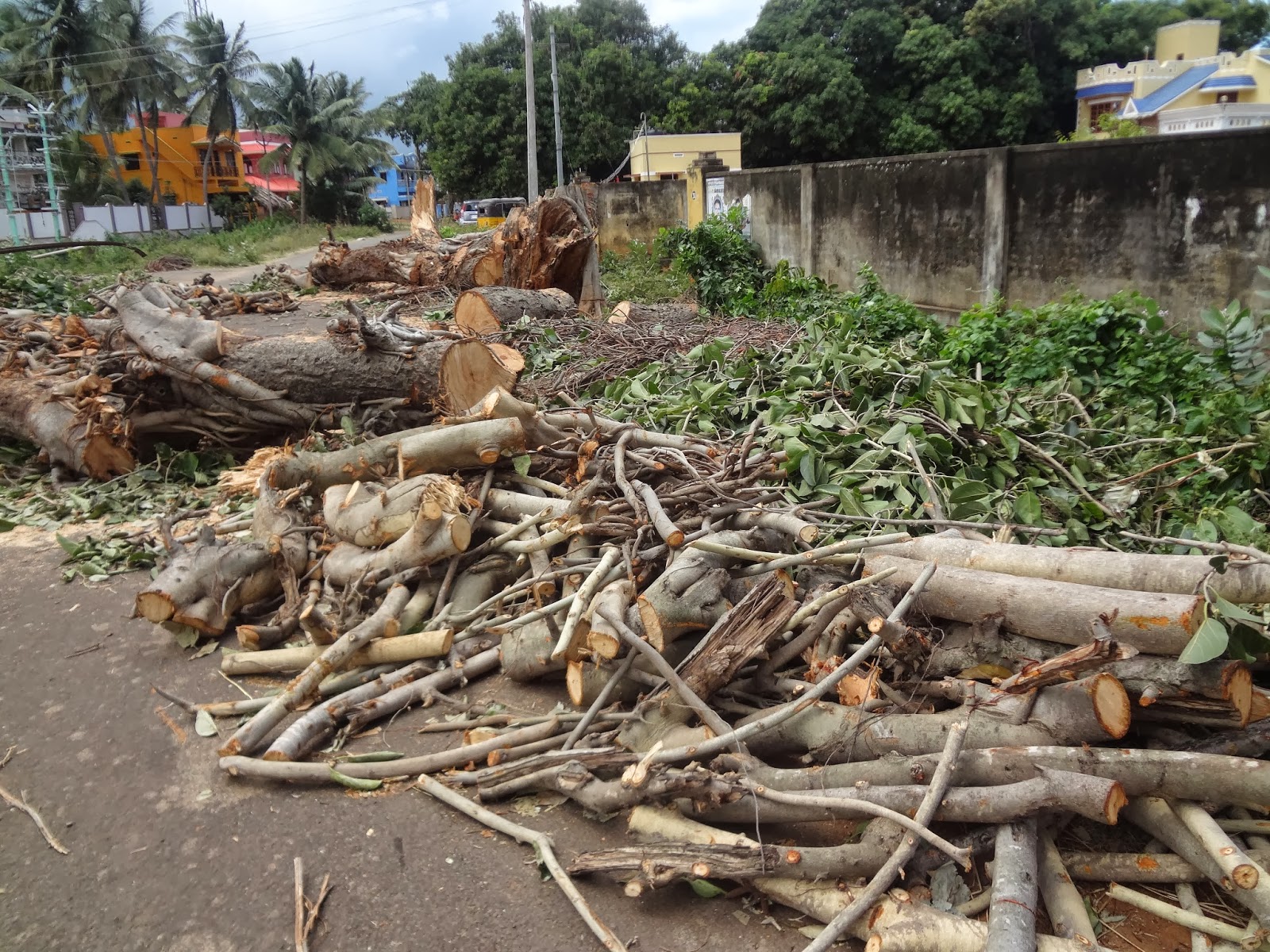
Remembering the fallen banyan tree at Courtallam - Tenkasi - Ilanji road

I love banyan trees. I believe they are symbols of strength and stability. They provide shelter. I read many historical figures of ancient India had slept under the banyan trees. One may find plenty of banyan trees in and around Courtallam, Shencottai and Tenkasi. A year back, while I was driving back home from Shencottai through Ilanji, I took pictures of a few banyan trees and wondered how long these trees would last and whether the greenery of Courtallam and Shencottai would ever be maintained in the years to come. I hear it might take many years before a banyan tree can grow into a full fledged tree.

Just a couple of days back, I was driving back through the same route and I was very sad to see one of the banyan trees felled as I heard that it became aged and broke off from its base. Will people ever plant a few more saplings to replace the aging banyan trees?

Urbanization is taking a heavy toll on the greeneries everywhere, notably Shencottai, Courtallam and Tenkasi. Many beautiful scenic spots are disappearing one after another.
                                                             
                                                                  The pictures then:


The picture now:


I invite people who are good at writing poetry to write a few lines on banyan trees. You may write in Tamil too.
 

Thursday, October 10, 2013

Short Stories for Success for Young Readers: A New Lexicon Unfolded - Excerpts from my book: "C" for "Choice"


C for Choice

“Every man builds his world in his own image. He has the power to choose, but no power to escape the necessity of choice.” – Ayn Rand, The English Author

That day Kamala teacher was pleasantly surprised to see Brinda in the front row in the class. “I am pleased to see you in the front,” she commented looking at Brinda.
“Yes teacher. After hearing the story of Rani of Jhansi, I decided to change myself.”

“I appreciate, Brinda. It is always a question of Choice before you: “To stay back and lag behind or go forward and make progress”. In every moment, everyone has a choice. The choice that you make now, decides your next moment. You are always left with the dilemma of having to choose between opposites. When you choose something that enriches you, empowers you, helps make progress - you will be happy. When you choose something that pulls you down, sucks your energy or brings obstacles to what you do - you are bound to be unhappy,” Kamala teacher lectured.
The children knew that Kamala teacher was ready to tell them a story and were all in great anticipation.

“Mahabharat is a great epic of India and we have several lessons to learn from it.
One such incident relates to Duryodhana inviting Yudhishtra for playing ‘chaturang.’  Chaturang was a game of gamble. The intention behind the invitation was wicked. Duryodhana suffered from jealousy and wanted to usurp Pandavas of their wealth and kingdom. He had Sakhuni, an expert player in chaturang, to play for him. Yudhistra knew that the invitation to play chaturang was with bad intention. Everyone around advised him to refuse the invitation. They all cautioned him that there was an evil intention behind the invitation to the game. Yudhishtra was in a dilemma. On one side, as a royal invitation, he couldn’t refuse it and on the other side, he knew that he would lose if he accepted it and played chaturang.

He chose to accept the invitation and play for the sake of ‘Dharma’ of a king. Again, while playing Chaturang in the Royal Court of Drudharashtra, he had several opportunities to halt the progress of the game. But he chose to continue to play pawning his small possessions first, then his wealth, his kingdom, his own brothers, himself and finally his wife. In every moment he had an opportunity to bring the game to a halt and redeem himself, but he didn’t.  The seeds of Kurukshetra war were first sown when Pandavas lost their chaturang game to  Duryodhana.

Another significant incident relates to the Kurukshetra war itself. The armies of both Kauravas and Pandavas had lined up for the war in the battle field. Arjuna was dismayed seeing the long lineup of his gurus, grandfathers, great grandfathers, besides all his kith and kin on the opposite side. He was shaken by the thought that all his kith and kin would be killed in the war on both sides. ‘What is the use of this war? How can I fight against my own kith and kin?’ were the questions uppermost in his mind. He asked Krishna for his advice and Lord Krishna delivered the most significant sermon in the form of ‘Bhagavad Gita’. Krishna reminded Arjuna about his duties and responsibilities and advised him against attachment to results of one’s actions. Finally, having given him the most remarkable advice ever in the history of mankind, Krishna told Arjuna, “Now you decide, what you should do.”
Even the Lord leaves it to man to make his choice. Arjuna decided to fight and uphold Dharma. The entire race of Kauravas was eliminated in the war. There were significant losses on Pandavas’ side too.”

Could Arjuna or Yudhistra or Lord Krishna have altered the course of the epic by making a different choice? Think of it.
So, your present moment and the choices you make now are the most important things in life. Remember that.”

≡≡::≡≡

Friday, October 04, 2013

What If Our Dreams Come True! My New Novel waiting to be published

                                                                   Episode 1

                                                                   Chapter 2
 
Next morning, I began my trek once again and reached Courtallam before midafternoon. God had blessed Courtallam with a number of waterfalls. The water from monsoon rains in Kerala on the other side of the Western Ghats provided a steady supply of water to the falls. Courtallam is one of the very few places in India where people can find waterfalls to take bath at ground levels. I went straight to the main waterfalls. I saw many people massaging their head and body liberally with ‘gingili’ oil, before they had their bath. The crowd was not much. I went straight and stood under the mighty waterfall for a long time. The water was quite cold and I shivered. I folded my hands in reverence in the cool waters and prayed. Suddenly I felt lost for some time. After the bath, I felt invigorated.

The Kutralanathar temple was just at the foot of the hills close to the waterfalls and was closed after the midmorning offerings to Lord Siva. I had to wait till four in the evening to have my first meeting with HIM.

Suddenly, I found a small crowd of people rushing somewhere and on enquiry, I learnt that annadhan was taking place in a nearby hall. Offering food to the poor (annadhan) was practiced by many, either as part of their way to salvation or as reparation for their sins. Feeling rather fortunate, I helped myself generously with the delicious meal.

After a small nap in the temple corridor, I was ready to meet the Lord when the main gates of the temple opened for the evening. I went straight to Siva. I was in no mood to look at or appreciate the temple architecture. There was hardly any soul inside the temple. The priest had not arrived yet. Everything was still and quiet. The air was thick, humid, and smelled pungent. Barring a few oil lamps shimmering in front of the idols, the temple was mostly dark.

I closed my eyes and stood silently before the Lord.

“I have never travelled outside my small village, but YOU have brought me here. I am now before you now, as you wanted. This is the first leg of my seven meetings with you, as you ordained. What next?”

It didn’t even occur to me that I should thank Lord Siva for what he did for me. He healed me miraculously from my pain. I was too immature to not realize the magnitude of my mystical experience. After all, I thought it was just a dream. But how was I healed instantly? It was a reality. I continued to ponder over the question without any answer. The astrologer had told me, “God has strange and miraculous ways of saving His devotees.” That must be true.  

‘Was I a devotee?’ I wasn’t sure. But, HE also left me as an orphan. Why did he do that? What was my mistake?

I stayed before HIM standing and closing my eyes for a long time. Thoughts were pouring out, waves after waves. Suddenly I opened my eyes and I saw hazily a sadhu entering the sanctum sanctorum. I continued to stand there for no reason. After some time passed, the sadhu turned around, came out of the sanctum sanctorum and seemed to be approaching me, his eyes fixed on me. I recollected immediately that he was the same sadhu whom I had seen the previous evening in the congregation under the banyan tree on my way to Shencottai. As he passed by my side, he looked straight into my eyes for a moment.  His look was penetrating and it blinded me for a moment. He didn’t stop by me, but I heard him telling, ‘Meet me at Chithra Sabhai’ as he passed by.

I was puzzled. ‘Did I hear him right?’ But he had gone and disappeared.

I continued to stand there as though my feet were clamped to the ground; I felt stuck. I had no inclination to move too.

When some more time passed, I was confused and I decided to get out.

When I took the first heavy step, I heard the sudden sound of a thunder inside the rock solid temple and along with the sound of the thunder, came the voice, ‘No, you can’t go!’

Where did the voice  come from? Was it my own imagination? Was I hallucinating?

Suddenly I felt very weak. My knees caved in. My whole body buckled and everything blacked out for me. I felt I was sinking and lost all consciousness even as I collapsed to the floor

I would never know how much time passed by and I opened my eyes when someone sprinkled water on my face. I saw a temple priest and he was trying to gently lift me up. He gave me some water to drink and some energy returned to me. When I felt better, I told the priest about the thunder and the celestial voice I heard.

The priest hesitated for a moment and then said, ‘Strange are HIS powers! Who knows, may be Lord Kutralanathar wants you to be here for some more time? Are you planning to go somewhere else, my dear son?”

I briefly told him my story - about the acute stomach pain I had, about my dream where Lord Siva appeared and offered to cure me on the condition that I met with him in seven of his places. I told him that Courtallam was my first destination and that I was planning to visit other places of Lord Siva. I also told him about the sadhu who ordered me to meet him in Chithra sabhai.

The priest looked bewildered, but soon recovered his composure. He then gently told me, “You seem to be an innocent village boy. What do I tell you about Lord Siva appearing in your dreams? Strange are the ways, things happen on earth. Hearing thunder inside the temple was bizarre and incredible. The sky is very clear outside. There is no possibility of a thunder or lightning. I suggest you don’t unnecessarily tell anyone outside, about your experiences. They will think you are out of your mind. But, if that was what happened to you really, ……. why don’t you stay here in Courtallam for some more time and see what happens? This is a lovely place. But be careful with sadhus. I am born and brought up here. I have also heard lot of stories about sadhus. There had been unique sadhus here in the past in this place and elsewhere. Courtallam is known for ‘Siddhars’ who had siddhic (mystical) powers. There is historical proof that many siddhas had mystical powers. Sage Agasthya was known to have lived in this place Courtallam and sanctified the whole hill. He had also written several books, and many of them were medical books. There are fakes too. One needs to be careful with the sadhus.”

With that, not wanting to have to do anything more with me, he abruptly turned back and went inside the temple to tend to his work.

I circumambulated along the inner and the outer walls of the sanctum sanctorum of the temple. I had a darshan of the kurumpala tree, the sacred jackfruit tree of the temple. On the back side, there was a corner and there, over the tall temple walls, I could see the waterfalls rolling down the rocks and hear its roaring sound.

I came out of the temple. ‘I need to know where Chithra Sabhai is’, I said to myself.

The sky was bright and clear outside, with no sight of any cloud. ‘Where did that thunder come from?’